Astronomers have spotted something rare. A pair of binary stars, both massive, both dead, both exploded. For the first time, we have evidence of a twin supernova system.
It sounds like fiction. Two suns dying together. Like Tatooine. But this is real data. The system sits about 6,000 lightyears from Earth. In Gemini.
More than half the stars in our galaxy have partners. Binary systems are common. Massive stars? Almost always binary. So why did no one notice this specific pair until now?
How the Jellyfish Nebula Revealed Its Secret
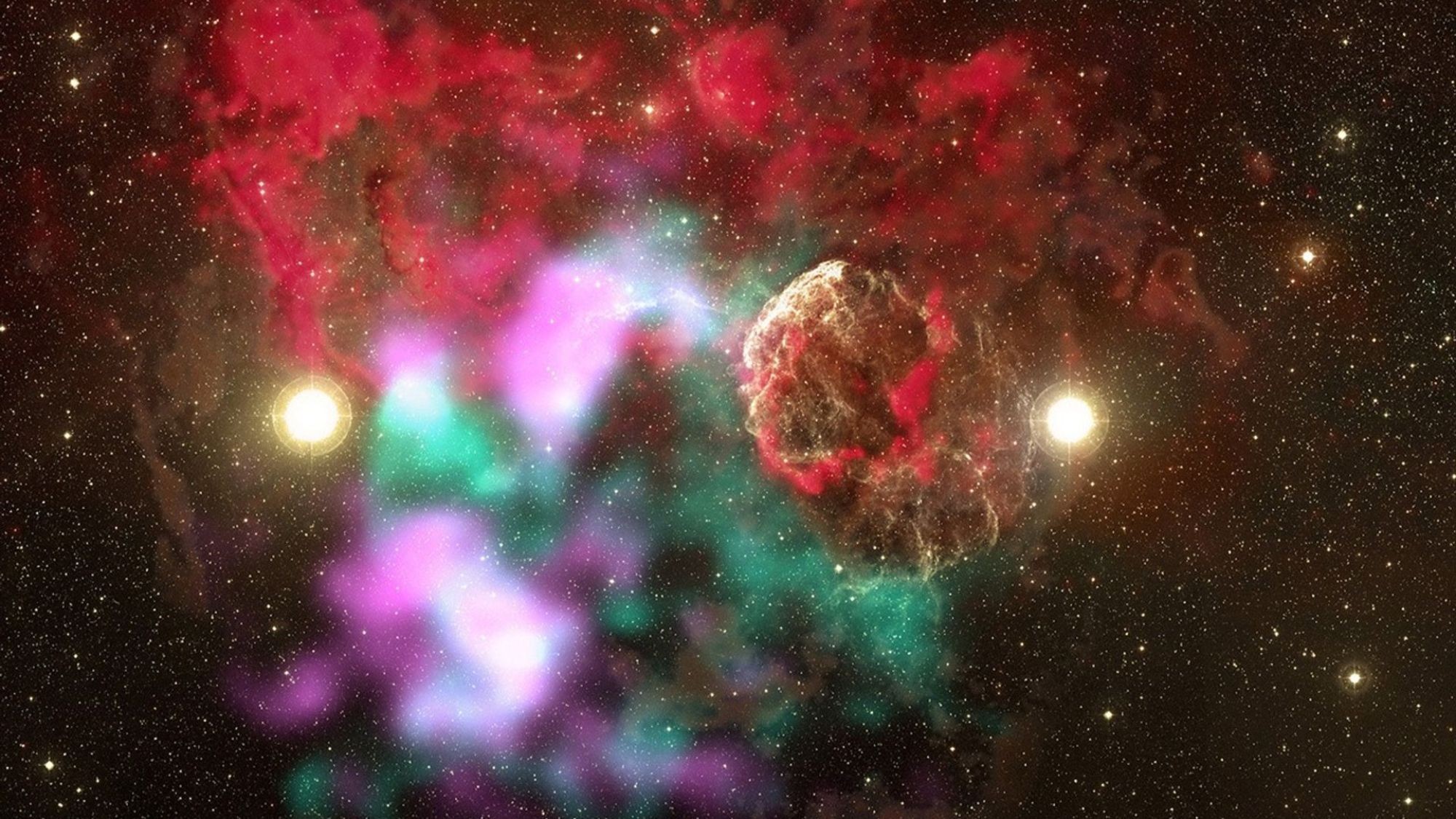
Look at the sky and see the Jellyfish Nebula. That’s IC 443. It’s a supernova remnant. Bright. Messy. Complex. Shockwaves from a dying star slammed into gas and dust. Creating concentric shells. Like ripples in a pond.
IC 443 is wellstudied. Everyone knows it.
But nearby? Something faint was hiding.
For years, a dimmer object lingered in the data. G189.6+33. Discovered in 1994 by the ROSAT mission. Faint Xrays. Barely there. Then the Spektrum Roentgen Gamma observatory picked it up. Shell-like structures. It looked like another supernova remnant. But it was too weak. Too quiet.
The new study didn’t ignore it. They looked closer.
Why These Stars Were Linked
The team combined over 16 years of Fermi GammaRay Space Telescope data with older Xray, optical, and radio measurements. They weren’t just looking for light. They were looking for impact.
Both IC 443 and G119.6+33 were smashing into the same interstellar hydrogen cloud.
This is key.
If two remnants are hitting the same cloud, they’re close. Spatially linked. Not just visually overlapping in our line of sight. Actually neighbors.
Their explosion centers sit roughly 30 to 50 lightyears apart.
Random chance? Unlikely.
The probability of finding two unrelated supernova remnants this close by accident? About one in 1,000.
“One can expect many pairs,” said lead author Miltiadis Michailides of Stanford. “However, this has never been observed. Until now.”
The Age Gap Between the Dead Suns
Which star died first?
The math suggests a long gap. G119.6+3.3 is older. Its star exploded between 110,00 and 20,000 years ago. IC 443? More recent. Roughly 8,00 to 9,00 years old.
Both parent stars were giants. Twenty times the mass of our sun. Maybe more.
So what happened?
One star went supernova first. G119.6+. The explosion kicked its companion. Hard. Propelling the second star away. But not far enough to break the gravitational link completely. Or maybe the shockwaves from both explosions just happened to collide with the same patch of gas.
The system remained intact. Hidden in plain sight.
What This Means for Stellar Evolution
This discovery changes the game. We knew massive binaries existed. We knew they died. We just didn’t have a confirmed case of both dying in a detectable way within a single system.
Now we do.
Analyzing the shockwaves from G119.6 and IC 443 could reveal how much velocity the first explosion gave the second. A celestial kick.
“This suggests that our discovery is in fact the the first known binary-system supernova pair.”
It’s not just about counting dead stars. It’s about understanding the mechanics of their deaths. How they interact. How one death affects the other’s trajectory.
The Jellyfish Nebula isn’t just a jellyfish. It’s part of a dance. Two giants. One end.
More systems like this are probably out there. Waiting in the dark. Hiding in the noise. We just needed to look at the ripples differently.
Or maybe we just needed better telescopes.