We look up at the night sky and see a bright orb. It dominates our view, yet it is surprisingly dim. The Moon’s surface reflects only 7% of the sunlight that hits it. That low albedo makes it darker than worn asphalt. We perceive it as brilliant only because of the stark contrast against the blackness of space. This visual trick masks the raw physics of our nearest neighbor.
Earth’s sole natural satellite orbits at a mean distance of roughly 384,400 kilometers. That is about 238,900 miles away. In cosmic terms, that is practically next door. But physically, the Moon is a diminished version of its host planet. It is less than one-third the size of Earth. Its equatorial radius measures just 1,738 kilometers. Mass-wise, it is a fraction of Earth’s bulk, sitting at about 1/81st of our planet’s total weight. Yet it is surprisingly dense, clocking in at about two-thirds Earth’s density. This density creates a surface gravity that is only one-sixth of what we feel here. Step onto that regolith, and you could leap over a car.
How the Moon’s Gravity Shapes Our Planet
That gravitational pull is not just a curiosity for astronauts. It is the primary engine behind Earth’s tides. Without the Moon’s tug, our oceans would be far calmer, and life on land might look very different. The Moon rotates on its axis in 27.3 days. This matches exactly the time it takes to complete one orbit around Earth. This synchronous rotation means the Moon always presents the same face to us. We never see the “dark side,” a misnomer since that side gets plenty of sunlight.
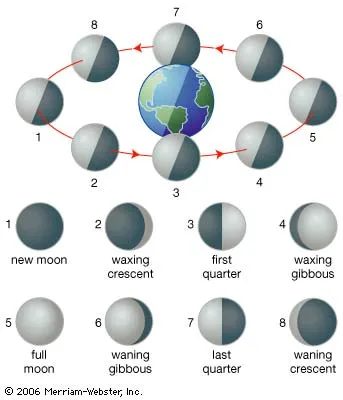
The face we do see changes. As the Moon revolves, the Sun lights it from different angles. This creates the familiar cycle of phases, from new moon to full moon and back again. But the surface itself is ancient and scarred. Most astronomers agree on a violent origin story. The Moon likely formed from debris ejected into Earth’s orbit when a Mars-sized body collided with the proto-Earth early in the solar system’s history. This giant impact hypothesis explains the Moon’s composition and its isolation from Earth’s core.
A History Written in Craters and Lava
Humanity has studied the Moon for centuries. Galileo first pointed a telescope at it in 1609, revealing mountains and valleys. He proved it was not a perfect celestial sphere. For most of history, that was as close as we got. Then came the Apollo program. Twelve U.S. astronauts walked on the surface during six successful landing missions. They brought back rocks, samples, and data that revolutionized planetary science.
The dominant force shaping that surface has been impact. Micrometeorites bombard the Moon constantly, grinding rock into fine dust. Larger meteorites have punched craters across the landscape. These scars were mostly formed over four billion years ago, during a period of intense bombardment. Interspersed among the highlands are the maria. These are vast, dark plains created by ancient lava flows. They fill the basins left by massive asteroid impacts long ago.
Could Water Exist on the Moon?
For decades, scientists thought the Moon was bone dry.