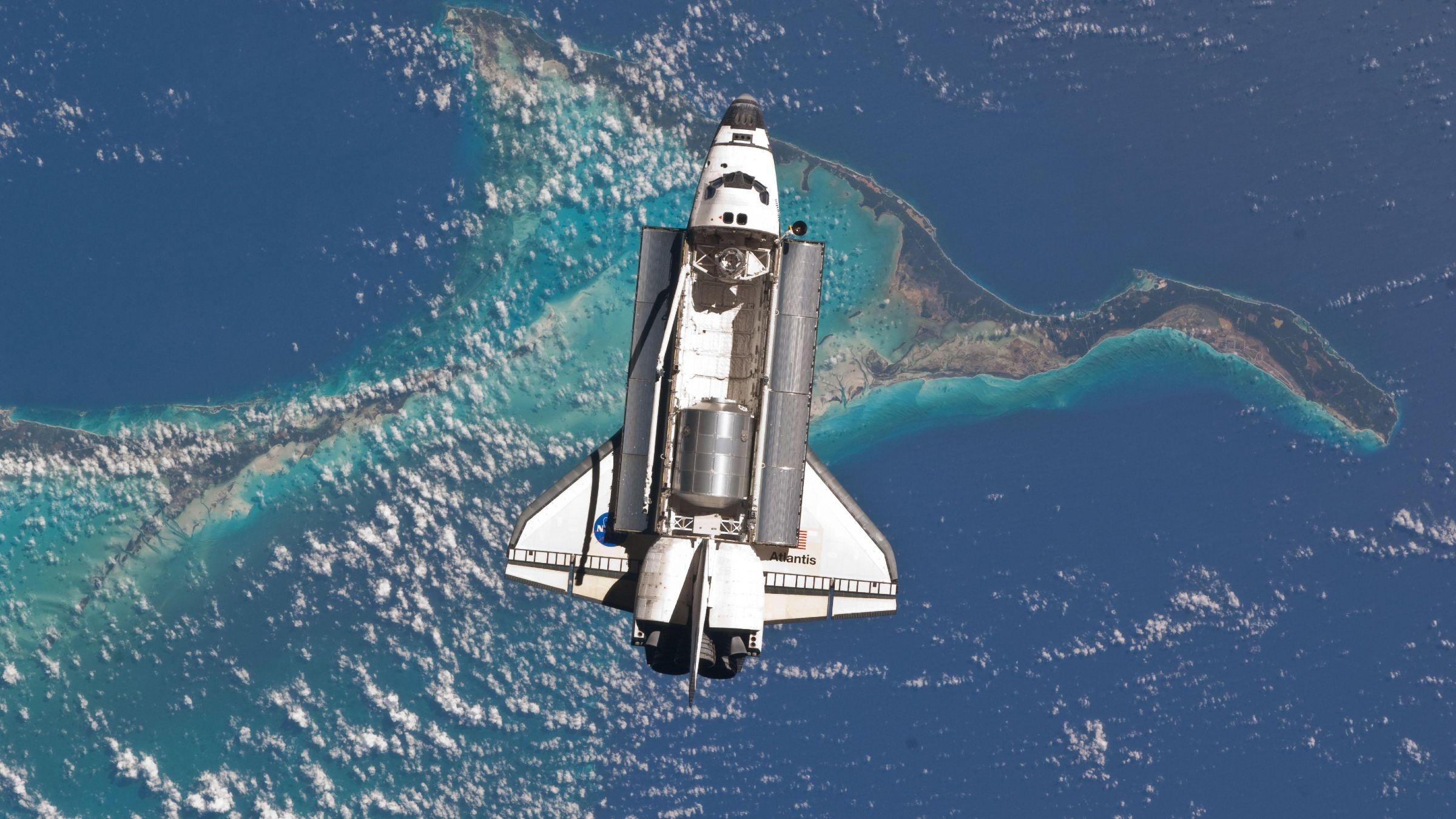
Look at that photo. It’s clean, sharp, and utterly final.
Fifteen years ago today, one of NASA’s iconic workhorses slipped into view during an astronaut’s leisurely glance at our planet. A photobomb from the machine that got us here. This isn’t just any ship though. It was Atlantis. The last one.
A Heavy Machine in the Blue
NASA built five of these things. Columbia. Challenger. Discovery. Atlantis. And Endeavour. They flew from 1981 to 2011. One hundred thirty-five missions in all. Over thirty-two thousand hours floating above us. They put the ISS together, piece by painful piece, before they started ferrying people back and forth like a spacefaring taxi service.
They deployed Hubble too. That’s probably their most famous trick. But this photo? It’s about the end of the line.
Atlantis Does the Thing
Here she comes. Atlantis. She’s got the most miles behind her after Discovery. Thirty-three flights. Respect.
In the picture, she’s gliding toward the International Space Station, passing over that specific, startling turquoise water found only around the Bahamas. The doors in her belly are wide open.
Why? Heat management, mostly. The radiators need space to bleed off thermal energy in Low Earth Orbit. But those doors had another job. They let the docking mechanism engage with the station. It created a pressurized tunnel so humans could crawl from one metal tube to another without needing a spacewalk suit for every bathroom break.
Up and Down Again
July 8, 2011. That’s when this began. Atlantis shot vertically off Kennedy Space Center, strapped to an orange fuel tank and twin boosters like a missile.
It came down July 21. Not on fire this time. A glider touching down on concrete. Now? It sits behind glass at the visitor complex, silent and polished. A relic.
Think about the math. Forty-eight hundred forty-eight orbits. Nearly one hundred twenty-six million miles. You could fly from Earth to the moon five hundred and twenty-five times in that span.
We visited Russia’s Mir. We sent Magellan to Venus. Galileo went to Jupiter. We touched distant worlds.
Why We Look
These images speak to people.
That’s what NASA said. In 2011 no less. They liked these “punctuated snapshots” because they had a frame. A human frame. A shuttle door edge or a handrail gives you scale. Without it? Just a ball of gas. With it? Our ball of gas.
Did it end well? Well. Yes. No.
It cost billions to keep the rusting jets alive. The station was built, the job mostly done. So NASA killed the program. Citing cost. Citing utility.
But remember Challenger in ’86. Remember Columbia in ’03. All of them. The program bled twice before it faded out.
No other winged spacecraft has carried humans into the void since. Just us. Those five planes. They’re gone.
The photos stay.
You see the Bahamas. You see the curve of the world. And you see the ghost of a machine that used to get us there.
What comes next looks very different.