They finally know.
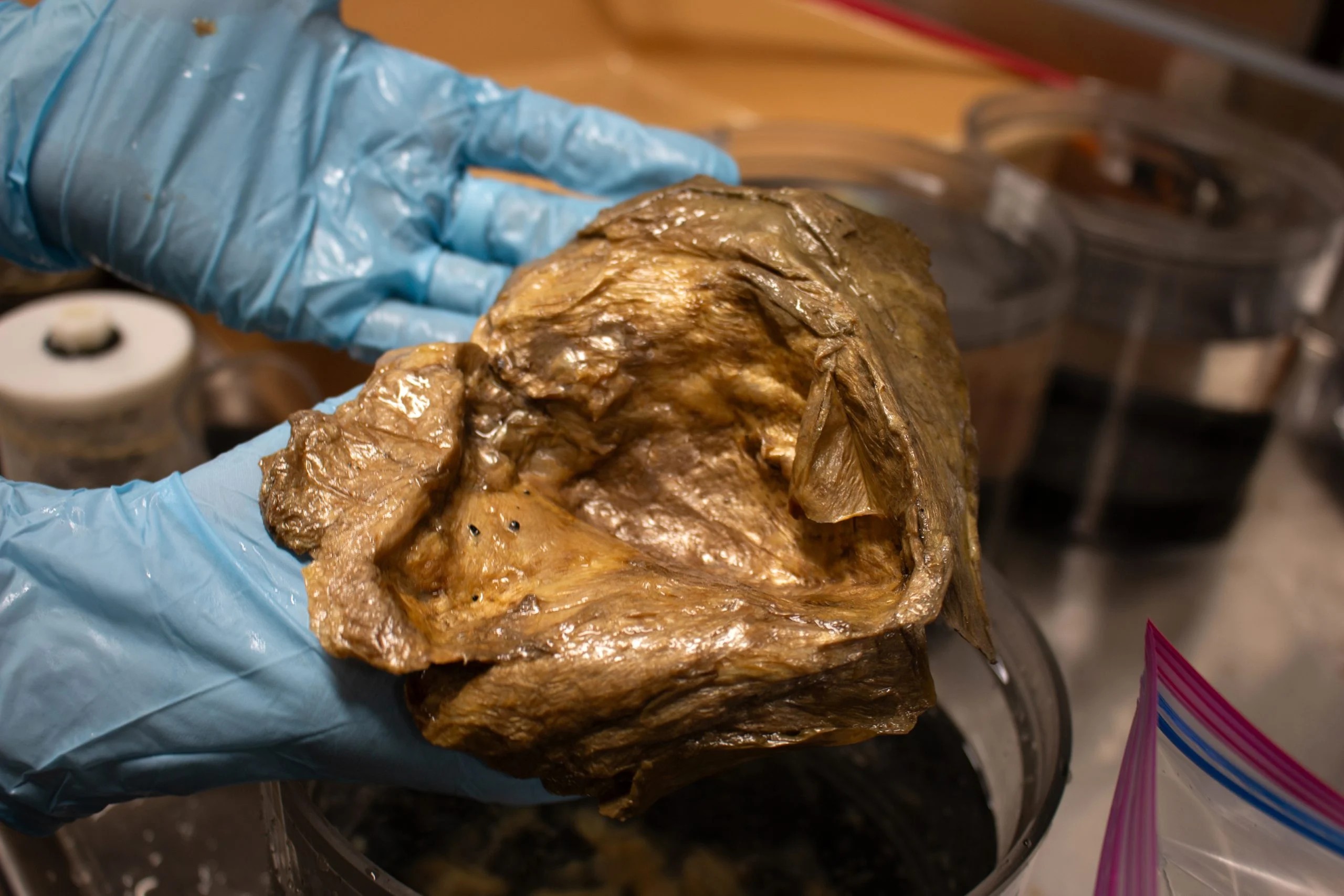
After more than two years, the mystery is dead. That strange golden orb found deep in the Gulf of Alaska isn’t an egg case. It isn’t a sponge. It wasn’t alien, though for a while it might as well have been.
It is trash. Well. Not quite.
It’s the remains of a giant deep-sea anemone named Relicanthus daphneae. Specifically, the dead cells left behind where the creature anchored itself to the rock floor.
Stumped by the Deep
2023 was a bad year for sleep.
Scientists aboard the NOAA Ship Okeanos Explorer were doing routine work. Surveying. Looking at things. Then they looked at a golden lump, two miles down.
Smooth. Hole in the middle. Shiny.
Everyone had opinions. Nobody knew the truth.
Was it a cocoon? Did something crawl inside and vanish? Did something break out? The team used a suction sampler to pull the weird ball up. Sent it to the Smithsonian. Waited.
It resisted classification.
Anatomy of a Puzzle
Allen Collins runs the National Systematics Lab inside the museum. He handles hundreds of samples. Most are easy. This one wasn’t.
“This turned into a special case,” Collins says.
They needed experts from every angle. Morphology. Genetics. Deep-sea logistics. Bioinformatics. All of them had to agree.
At first, DNA barcoding failed. Contaminated probably. Microscopic hitchhikers muddying the water. So they sequenced the whole genome.
The physical evidence was telling. Fibrous tissue. Stinging cells. Not just any stinging cells though. Spirocysts. These only exist in Hexacorallians. Corals or anemones.
Abigail Reft, a scientist at the lab, spotted them under the microscope. A similar sample from a 2021 trip by the Schmidt Ocean Institute confirmed the shape. The cells matched.
But the DNA had to match too.
Whole-genome sequencing did the trick. The animal DNA connected straight to Relicanthus daphneae. Mitochondrial genomes proved it nearly identical.
The orb was a shell. A leftover anchor point. The anemone had moved on or died, leaving this golden husk behind.
Still Unknown
William Mowitt of NOAA Ocean Exploration says we keep going. Not just for the curiosity. But for resources. For security.
“With advanced techniques like DNA sequencing, we were able to solve more of them,” Mowitt explains.
He’s right. We solved this one.
The ocean is still dark though. Two miles down is only the start. There are thousands of species we haven’t even seen yet.
We identified the golden ball. Fine.
But what about the silver ones we haven’t found?
Or the invisible ones?