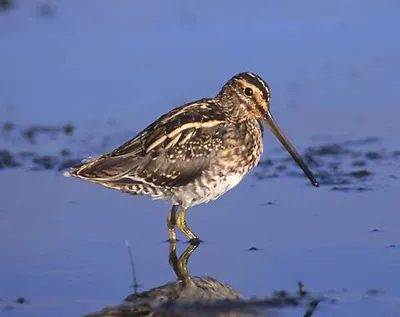
You won’t see a snipe easily. These birds are masters of concealment, blending into wet meadows and marshes with striped brown, black, and white plumage. They are chunky, short-legged shorebirds with rear-set eyes and pointed wings. But the most distinctive feature is the bill. Long and flexible, it probes mud for worms. This is the defining tool of the Scolopacidae family, one of about 20 species found in temperate and warm regions worldwide.
The Acrobatics of Courtship
Snipes are solitary when breeding. They vanish into reeds and wet grass. But migration changes the dynamic. Several may appear together on mud flats. This grouping is technically called a “wisp.” They share space with other shorebirds during this phase.
The real spectacle, however, happens during courtship. It is a display of aerial acrobatics. The courting male circles high above. Then he dives toward the female on the ground. The sound comes not from his beak or throat. It comes from his tail feathers.
The male “drums” or “bleats” the air with specialized tail feathers.
This sound is a byproduct of flight. The outer tail feathers are stiff and narrow. Air rushing past them creates a vibrating noise. It sounds like a drumroll or a bleat. This happens at dusk. It occurs in moonlight. Or on overcast days.
Identifying Key Species
The common snipe, Gallinago gallinago, is widespread. It inhabits temperate regions. It is related to the woodcock. The bird is about 30 cm long, including the bill. It is considered fair game for hunters. When disturbed, it springs up with an unnerving squawk. It flies a twisted course. Then it drops suddenly to cover.
This species includes several subspecies. Wilson’s snipe lives in North America. The Eurasian snipe spans Europe and Asia. The South American snipe covers parts of the continent.
Other species have distinct traits. The great snipe, Gallinago media, is heavier. It has barred underparts. It lives in northern Europe. The pintail snipe, Gallinago stenura, is found in India. The jacksnipe, Lymnocryptes minima, ranges across Eurasia. There is also the painted snipe, though it belongs to a different family entirely.
Why It Matters
Snipes are indicators of healthy wetlands. They need mud to probe. They need reeds for cover. Their presence signals that these ecosystems are functioning. Their flight behavior reveals how evolution shapes survival strategies. The drumming sound is not just noise. It is a biological mechanism. It is a way to attract mates without relying on visual cues alone.
The flexibility of the bill allows them to extract food from deep mud. This specialization reduces competition with other shorebirds. It defines their niche.
Where else do you find birds that turn their own flight into music? The answer lies in the wings and tail feathers. The mechanics are simple. The result is complex.
The common snipe persists. The great snipe struggles in some areas. The pintail snipe faces habitat loss. Their future depends on the mud. It depends on