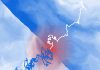
George Clooney played it cool as Captain Billy Tyne in 2000’s The Perfect Storm. He commanded the Andrea Gail into a nightmare where three storms collided in the Atlantic. The movie showed us the fury of the ocean. It also showed us the cost. All six crew members died. That story came from real life. It paved the way for something else. Something messier.
“Deadliest Catch” hit Discovery Channel in spring 2005.
It wasn’t about swordfish. It was about crab. Specifically, king crab and snow crab in the Bering Sea. The show dropped viewers onto the decks of fishing vessels off the Alaskan coast. It aired in 150 countries. The show pulled in up to 3 million US viewers weekly. Thom Beers created it. He worked with Original Productions out of Los Angeles. Beers got the idea while filming “Extreme Alaska” on the boat Fierce Allegiance.
The title isn’t a marketing gimmick. It’s a statistic.
In the 1980s, commercial crab fishing was a death sentence. An average of 37 fishermen died each year. Safety regulations changed. Permit systems shifted. The death toll dropped. But it didn’t disappear. Between 2003 and 2008, 11 fishermen died annually at sea.
Drowning accounts for 87 percent of those deaths.
Most drownings happen because men go overboard. Or boats sink. The other 13 percent come from deck injuries. The deck is a minefield. You risk being crushed by a swinging 800-pound crab pot. You could get tangled in a winch. A hydraulic lift could smash you. A bait-cutting machine could suck you in.
It sounds brutal.
It is.
To understand what happens on those boats, you need the language. These fishermen don’t have time for explanations. They spit jargon fast. If you don’t know what they’re saying, you’re lost. Here is how to translate the chaos.
Standard Boat Lingo
First, get your bearings.
* Aft : The rear end of the boat. Also called the stern.
* Bow : The front.
* Starboard : The right side when facing forward.
* Port : The left side.
* Windward : Toward the wind.
* Leeward : Away from the wind.
* Head : The bathroom.
* Galley : The kitchen.
The Crabbing Dictionary
The rest is specific to the biz.
- Clean crab : Crabs free of barnacles. They fetch premium prices.
- Cleaning house : Removing ice buildup from the boat.
- Deck : The main outdoor fishing area. Workers here are deckhands. They are led by the deck boss.
- Engine room : Below the deck and sleeping quarters. Houses the engine.
- F/V : Short for fishing vessel. It precedes the boat’s name in print.
- Fleet : All boats fishing for crab in the Bering Sea.
- Greenhorn : A new, inexperienced deckhand. They have it rough. The show loves featuring them.
- Honey hole : A secret spot where a captain knows crab is abundant.
- IFQs : Individual Fishing Quotas. The amount of crab each boat can catch per season.
- King and opilio (opie) : The two crab types allowed on “Deadliest Catch” permits. Opies are snow crabs.
- Pot : The crab cage. It weighs roughly 800 pounds empty. It costs about $1,000 to replace.
- Setting back : Pulling a pot, emptying it, and dropping it back in the same spot.
- Wheelhouse : The bridge. The captain drives from here. A camera mounts here to record the captain’s commentary.
Now, if someone yells, “That greenhorn is so bad, he couldn’t drop a pot in a honey hole,” you’ll know what’s wrong. If the crew doesn’t clean house faster, they might miss their quota.
“That greenhorn is so bad, he couldn’t drop a pot in a honey hole.”
Kick the greenhorn out of the wheelhouse. Click ahead. We’re looking at the boats and crews next.
Out of the Shadows
Captains watch for rogue waves. These waves are at least twice the size of others in the same area. They used to be sea lore. Then science stepped in.
In 1995, the “Draupner Wave” was measured. It happened at the Draupner oil platform off Norway. The North Sea was churning with 40-foot waves. The Draupner rolled in at nearly 84 feet. 25 meters.
Rogue waves can topple boats instantly. They are still considered a natural phenomenon. Researchers are trying to pinpoint the cause. But for now, they remain a threat.
Boats and Captains
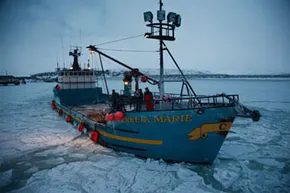
The Discovery Channel is back with season seven of “Deadliest Catch” in 2011. The Bering Sea doesn’t care about ratings, and neither does the crab. Here is who is on the water and who is steering the wheel.
The Harris Legacy Shifts
The F/V Cornelia Marie has lost its patriarch. Captain Phil Harris died from a stroke during the filming of season six. He was gone.
For over 17 years, Phil co-owned the 128-foot vessel. He was a grizzled veteran with 30 years of experience. He lived in Seattle between seasons. He rode his Harley. He built custom birdhouses. He wasn’t a TV person, but the show made him one.
Now, the helm belongs to his sons. Josh and Jake Harris took over co-ownership. They worked as deckhands under their father. Captain Derrick Ray is the new helmsman. The boat remains in the series. The family remains in the frame. The grief is real. The fishing continues.
The Hansen Family Standard
The F/V Northwestern is still owned by the Hansen family. Sig Hansen is the captain. His brothers Edgar and Norman are on board as deck boss and deckhand.
The boat has changed. It started at 108 feet. It could carry 156 pots. Now it sits at 125 feet. It carries the maximum 250 pots. The fleet grew to handle the load. The Northwestern has been in all seven seasons. It is steady. It is reliable. It is a blue-chip stock in a volatile market.
Humor in the Ice
The F/V Time Bandit brings the laughs. Captains Andy and Johnathan Hillstrand are likely the funniest guys on the show. They split the seasons. John takes the king crab run. Andy handles the opilio.
Their brother Neal works as engineer, cook, and relief captain. John’s son Scott is on deck. The boat was built from their father’s design. It has amenities most crabbers don’t see. Queen-sized beds. Staterooms. A sauna. It has been in all seven seasons. You might not want to crab on it, but you’d watch it.
From Navy to Fishing
The F/V Wizard has history. It wasn’t always a fishing boat. It was a U.S. Navy ship in World War II. It converted to crab fishing in 1978.
Captain Keith Colburn started as a deckhand in 1988. He became captain in six years. He bought the boat in 2005. His brother Monte is on board as deckhand and relief skipper. The Wizard has been on the show since season three. It’s old steel. It’s working hard.
The Newcomers
Two new boats enter the fray this year.
The F/V Ramblin’ Rose is helmed by 28-year-old Captain Elliot Neese. The crew is young too. The boat is registered in Juneau, Alaska. It’s 108 feet long. It has 960 horsepower. It has a reputation for parties, not just pots. Will it catch crab or just break up? Time will tell.
The F/V Seabrooke is also new. Captain Scott Campbell Jr. is 36. He seems overconfident. Maybe he is. The boat is 109 feet long and 30 feet wide. He enters the season troubled. A deckhand was lost at sea. The weight of that loss hangs over the bridge. Can he lead? Can he heal?
These men drop their pots in the honey holes. They fight the weather. They fight the gear. And they fight the clock.
Commercial Crab Fishing
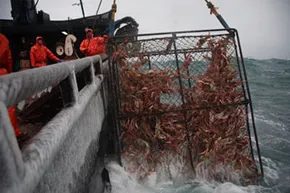
Catching a crab isn’t magic. It’s mechanics. It’s patience. And it’s terrifyingly heavy.
Theory says it’s simple. You bait a trap. You drop it in the ocean. You wait. Execution? That’s where the bones get broken.
Season starts in Dutch Harbor. Unalaska. Alaska. The captains launch into the gray churn of the Bering Sea. They aren’t looking at maps. They’re looking at instinct. Weather reports mean nothing if you don’t trust the gut feeling of a man who’s spent forty years watching tides. They plot a course for a spot that smells like opportunity.
Once there, the work begins.
Deckhands drop pots. One after another. A line stretching for dozens of miles. Each one marked by a buoy. Colored. Floating. A beacon in the fog.
Setting the Trap
Each pot is a monster. Seven by eight feet. Two point one by two point four meters. It weighs eight hundred pounds empty. You don’t lift that. You lift it with a manually operated crane.
The lift takes over. It’s a flat metal plate. Hydraulics do the heavy lifting. The hinge on one side attaches to the boat’s side rail. Deckhands secure the pot. They toss codfish into a bag in the center. Bait. Something hungry. They shut the trap door.
The lift tilts up. The pot slides. Into the water. Down it goes. To the ocean floor.
A deckhand throws the shot. That’s the rope. Long. Heavy. Attached to the pot and the buoys. It’s the lifeline. Another deckhand throws the buoys last. The pot is set.
Now it waits. It soaks.
Twenty-four hours. Forty-eight. More. The crabs come for the cod. They come whether you want them to or not.
Hauling It In
The soak ends. The captain navigates back to the start of the string. The hauling begins.
You spot the buoys. A deckhand throws a grappling hook. It catches the short length of rope suspended between the buoys. That rope connects to the pot’s shot. He pulls it in. Attaches it to a mechanical winch.
The winch hoists the pot up. Onto the lift.
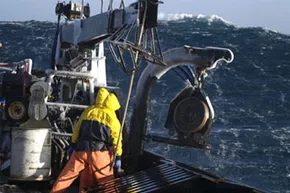
This is the dangerous part. The heavy pot swings. Bad weather turns it into a pendulum of death. It tosses around like a cardboard box. The deckhand has to grab it. Secure it. If he misses, he goes overboard. Or worse.
The lift tilts. The pot angles up. The trap door opens.
Crabs spill out. Onto a large metal table.
The Sort
It’s fast. It’s brutal. It’s efficient.
The crew sorts by size. Immediately.
Only adult male king and opilio crabs can be kept. Female? They go back. Small? Back into the ocean. The population must survive. If they keep the wrong ones, there are fines. Real fines. So they hold only the keepers.
The survivors are sent through a hole in the deck. Into a saltwater holding tank. Alive. Chilled. Waiting for delivery.
The Deadliest Catch Myth
People hear the title and they nod. They assume.
It’s called “Deadliest Catch.” But is it?
According to a study by the National Institute for Occupational Safety and Health (NIOSH), no.
The Dungeness crab industry off Oregon, Washington, and Northern California is worse. Twice the death rate of the Bering Sea since 2000.
Why?
Dungeness boats don’t need Coast Guard safety inspections for permits. Voluntary. Most don’t bother. Of the twenty-three vessels lost between 2000 and 2006, only three had that inspection.
There’s no quota system like Alaska’s. The waters are crowded. Inexperienced captains. Small boats. It’s a chaotic mess.
So the Bering Sea gets the fame. The drama. The TV contracts.
But out west, in the Dungeness waters, the death toll is higher. The conditions are quieter. Less televised. Just as deadly.
You think you know where the danger is? Think again.
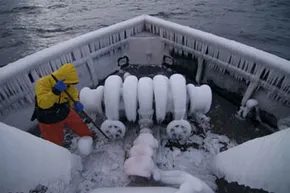
The Bering Sea’s Brutal Climate
The weather in the Bering Sea doesn’t just change. It attacks. During the king and opilio crab seasons in Alaska, which run through October and January, conditions turn hostile almost immediately. Strong winds and snowstorms batter the decks, while 20- to 40-foot waves toss boats around like toys in a washing machine.
Ice is the real enemy here. When temperatures drop between zero and 20 degrees Fahrenheit, freezing spray accumulates rapidly. That buildup doesn’t just add weight. It shifts the boat’s center of gravity, making capsizing a very real threat. A single pot loaded with ice can add massive weight. Combine that with a full load of pots, and you’re looking at an extra 45 tons on the vessel. That’s not even counting the ice already frozen onto the hull. Crews spend hours swinging sledgehammers to keep the deck clear. And don’t forget the overhead. Equipment freezes over. If the sun breaks through, that ice melts and drops. A 50-pound block falling from 20 feet up can kill a deckhand instantly.
Ice packs form at sea too. When surface water hits 28.5 degrees Fahrenheit, the top layer freezes. Spray collects on that ice, creating a massive sheet that can grow up to 25 square miles a day. Moving through it is dangerous enough. The real cost comes when buoys and pots get trapped under the ice, drifting up to 100 miles from their drop point. Losing gear is expensive. Replace a single pot, and you’re out about $1,000.
Exhaustion as a Hazard
Physical fatigue is just as deadly as the cold. Captains push crews hard when the catch is good. Working for two days straight without sleep is common. You’re dealing with backbreaking labor while the boat bounces over waves that wash right over the rails. Exhaustion makes people careless. And in this environment, a single mistake is fatal.
Slip up with a rope line, and you’re pulled overboard. Look away from the bait cutter, and your arm gets sucked in. Doze off for a second while a heavy pot swings toward you, and you’re crushed. It’s a simple equation. Tired workers make fatal errors.
The Quota System
To curb the chaos, the Alaska Department of Fish and Game introduced a quota system. It used to be a free-for-all. Up to 250 boats of all sizes would race against each other in a derby-style format. Everyone tried to catch as much as possible in a set window. The waters were too crowded. It was inefficient and dangerous.
Now, each boat has a specific limit. The number of active vessels has dropped to around 80. Quotas vary based on a boat’s size and fishing history. The goal was to reduce the competition and, hopefully, the accidents that came with it.
Film Crew
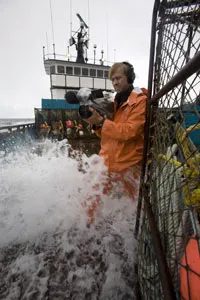
Living on Deck: The Harsh Reality of Bering Sea Filming
Getting a show like Deadliest Catch off the ground requires more than just pointing a lens at a crab boat. The film crew usually arrives in Dutch Harbor about a week before the fishing season kicks off, often beating the actual vessels to the port. This window is critical for lead preparation. Teams spend those early days rigging cameras, taking inventory of tape stock, and ensuring everyone is up to speed on safety protocols.
Once the boats arrive, the scramble begins. Each vessel has at least four remote cameras attached to various parts of the ship. A friendly but fierce competition has evolved among the two-man camera and producer teams. The goal? To dream up the most extreme camera rig and snag the best shots before the storm hits.
Contrary to what some viewers might assume, the crew doesn’t hop into a water taxi at the end of the day for a warm hotel room. They live on the boat for the entire crab run. This usually lasts between three and five weeks. Quarters are tight. Captains generally do not allow more than two film crew members onboard at any given time.
The Tech Struggle: Salt, Ice, and Broken Cameras
Because space is at a premium, there is no dedicated soundman. Audio is captured entirely with camera microphones and small mics clipped to each deckhand. Helicopters and other boats also capture footage, but the on-deck teams handle the gritty, close-up work.
The crew must be tough as nails. Being a skilled cameraman isn’t enough. You also need to be personable enough to get along with the boat crew and able to repair gear on the fly. One adventurous cameraman even stepped up to fill in as a deckhand after a greenhorn quit working mid-run.
The equipment takes a beating. The show uses about 50 Sony HDV cameras per season. Most are lost or inoperable by the end of the run. Saltwater and ice are not good for high-definition cameras or tiny viewing screens. That’s why only cameras with LCD viewing screens are used. It’s a safety issue. You can’t stay aware of your surroundings if you’re constantly looking through a small viewfinder.
Real-Time Reactions and Producer Storylines
Camera teams weatherproof the gear as best they can. They refrain from using underwater camera housings because of the weight and bulk they bring. Each day, teams report back to headquarters at Dutch Harbor by satellite phone.
Producers keep track of storylines from land. They suggest footage ideas that help flesh out the narratives. If a greenhorn on the Time Bandit is floundering while another on the Northwestern is doing great, the producers have their storyline ready. The land crew also helps organize footage for the exhausted camera team. After weeks at sea, crew members often don’t even know what day it is, much less what they’ve been shooting.
One thing sets Deadliest Catch apart from other reality TV shows. The camera teams get interviews and reactions in the moment. Most reality shows tape interviews after the show has finished principal photography. The producers believe this brings immediacy. It creates a genuine reality that’s missing from most other shows in the genre.
The Cost of Filming in a Dead Zone
There’s nothing you can do; that camera is toast. So bury it at sea. The loss rate is high. The environment is unforgiving. But the footage tells the story.
Special Thanks
Thanks go to Ryan McNeil for his assistance with this article. McNeil worked as an associate producer on seasons two and three of Deadliest Catch and is currently a director for General Assembly Pictures. Viva Ryan.
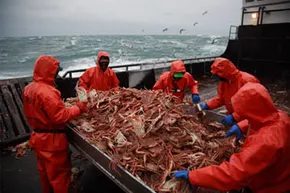
How Deadliest Catch Filming Actually Works
The production machine doesn’t wait for the crew to clock out. Once cameras roll, the schedule belongs to the film crew. If that means 24-hour shooting days, so be it. Cameras are rigged everywhere, capturing every angle from a constantly moving vessel. There’s no midnight tape swap to get fresh storage back to the editing team. Instead, raw footage is moved to a safe location and stays there until the boat docks in Dutch Harbor. This creates a massive backlog, but the editors make up for it with a blistering turnaround once they finally get their hands on the tapes.
The key to making sense of the chaos? Notes. Camera teams keep copious logs to ensure no standout shot or interview gets lost in the shuffle.
Back at headquarters, producers build a rough season template based on daily phone calls from ship to shore. Safety is always a concern, which is why a dedicated camera team stays with the Coast Guard crew in case of accidents. Those accidents do happen. One cameraman stepped backward and fell into a crab dump hole, cracking some ribs. He kept shooting. Per fishing tradition, he also had to buy beer for the crew for his clumsiness.
The Business of Fame
Captains and crew seem generally content with their new status. They insist they are fishermen first, TV personalities second. They believe the show sheds light on a grueling profession and has earned them respect. Many boats even launched their own websites for fan interaction and merchandise. Who doesn’t need a Cornelia Marie hoodie?
The Hanson family took it further, releasing Deadliest Catch: Alaskan Storm for Xbox 360 and PC in June 2008. It put players in the captain’s chair during a storm. While there was occasional grumbling among other captains about the show’s focus, the production team suspects most of them secretly wanted to be on it.
How Much Do Deckhands Actually Make?
The pay structure is straightforward but high-stakes. Deckhands traditionally get 30 percent of the take, while the boat keeps the other 70 percent.
Consider a $500,000 season, which is close to average. The deck splits $150,000 among five men. That’s $30,000 per person for two months of work. Plus unlimited Beanie Weenies, Hot Pockets, and coffee. With two such seasons per year, the average deckhand makes $60,000. In big years, some have raked in up to $100,000.
Captains take the lion’s share, but they also eat the costs. Bait, insurance, maintenance, fuel, and food are on them. It costs about $50,000 to fill the Time Bandit with fuel. That fuel ideally lasts the whole season. Another $80,000 goes toward insurance and permits.
After all expenses, a $500,000 run yields about $230,000 for the boat owner.
Deadliest Catch FAQ
Why is filming so dangerous?
Beyond the weather, managing heavy, swinging pots is a major hazard. Rough seas toss them around like cardboard boxes. Deckhands have to grab and secure them on the lift. Falling ice is another constant threat.
Does the cast get paid a salary?
No. They work on a share basis. Two months per season puts deckhands at an average of $60,000, though top earners can hit $100,000 in profitable years.
Who is the richest captain?
According to CelebrityNetWorth.com, Captain Sig Hansen has the highest net worth at $4 million.
How many deaths have occurred?
Seven people who appeared on the show have died for various reasons, according to People magazine.
The ocean doesn’t care about your net worth. It just keeps pulling.