Paleontologists have uncovered a rare glimpse into the ancient oceans of the Ordovician period, identifying a new species of soft-bodied organism that lived approximately 450 million years ago.
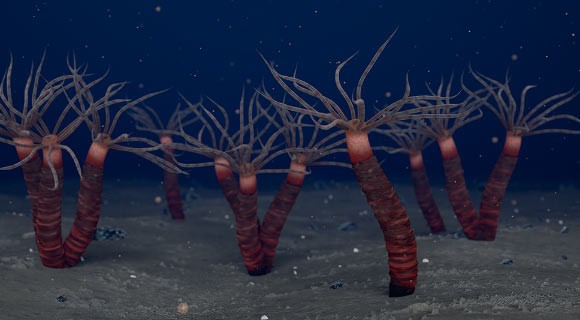
Found in the Neuville Formation near Quebec City, Canada, the newly named Paleocanna tentaculum is a specialized polyp—a relative of modern jellyfish—that lived inside upright, protective tubes.
A Rare Window into Soft-Bodied Evolution
The discovery is particularly significant due to the biological nature of the creature. Paleocanna tentaculum belongs to the cnidarian group, which includes jellyfish, corals, and anemones.
Unlike animals with shells or bones, cnidarians are composed of soft tissue. In the fossil record, these organisms are notoriously difficult to preserve; they typically decay long before they can be turned into stone. This creates “gaps” in our scientific understanding of how complex life evolved.
“Because their bodies are soft, they almost never fossilize, leaving gaps in our understanding of their origins,” explains Professor Christopher Cameron of the Université de Montréal.
Anatomy and Lifestyle
The researchers analyzed 15 limestone slabs containing roughly 135 specimens, revealing a unique way of life for these ancient creatures:
– Tubicolous Habit: The animals lived inside vertical tubes, either living in isolation or gathered in clusters.
– Physical Structure: The polyp itself was long and slender, featuring a ring of tentacles that reached out above the rim of its tube to capture food.
– Evolutionary Placement: By comparing these fossils to modern species, scientists determined that Paleocanna tentaculum is more closely related to modern box jellies, true jellyfish, and stalked jellyfish than to other extinct tube-dwelling relatives.
This connection places the species much closer to the modern branch of the jellyfish family tree than most previously known fossil polyps, providing a vital “missing link” in the evolutionary timeline.
The Importance of the Quebec Fossil Record
The discovery was made in a small quarry within the Neuville Formation, a site recognized as one of the most species-rich fossil localities for the Ordovician period globally.
For researchers, this find challenges the perception that Canada’s fossil wealth is concentrated solely in western provinces like British Columbia or Alberta. Louis-Philippe Bateman, a graduate student at McGill University, noted that the exceptional preservation of these delicate specimens proves that Quebec remains a frontier for significant paleontological breakthroughs.
Conclusion
The discovery of Paleocanna tentaculum provides rare, high-resolution evidence of how soft-bodied cnidarians functioned in ancient ecosystems. By bridging the gap between extinct polyps and modern jellyfish, this find helps refine our map of the evolutionary history of life in the ocean.