Jupiter. Even the name alone adds weight. This gas giant, named after the most powerful god in Roman mythology, controls the Solar System. Their size is larger than all the other planets combined. It really leaves them in its shadow. It has fascinated people for years. He ran after him. It made me wonder.
Why is this planet so important? Just because it’s big? No. Its existence is a key to understanding how the Solar System formed. We compiled them all.
Physical Properties and Structure of Jupiter
Jupiter is a gas giant orbiting fourth from the Sun. Its outer layers consist of hydrogen and helium. There is no solid surface inside. It probably has a rocky core. But even this core could be at least twice the size of Earth.
Its pressure is so high that hydrogen turns into metal. This metal conducts hydrogen and electricity. This is what creates Jupiter’s strong magnetic field. Its magnetic field is 20,000 times stronger than Earth’s.
If you look at the numbers:
– Diameter: 142.984 km.
– Mass: 2.5 times the combined mass of all other planets.
– Rotation time: The fastest rotating planet. A day only takes 10 hours.
This rapid rotation causes the planet to bulge in its equatorial region. It flattens from the poles. This is one of the key factors determining Jupiter’s shape.
Jupiter’s Atmosphere and the Great Red Spot
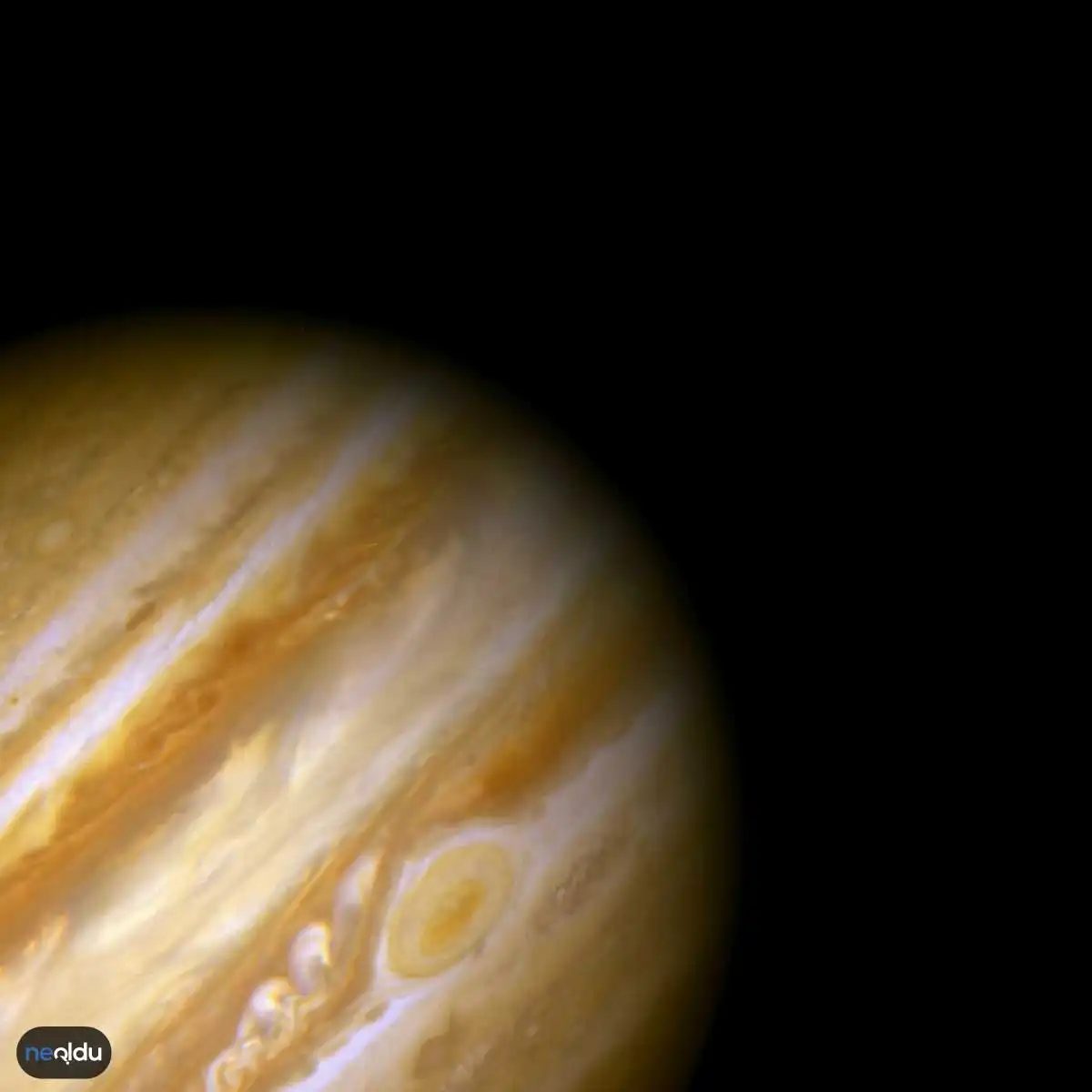
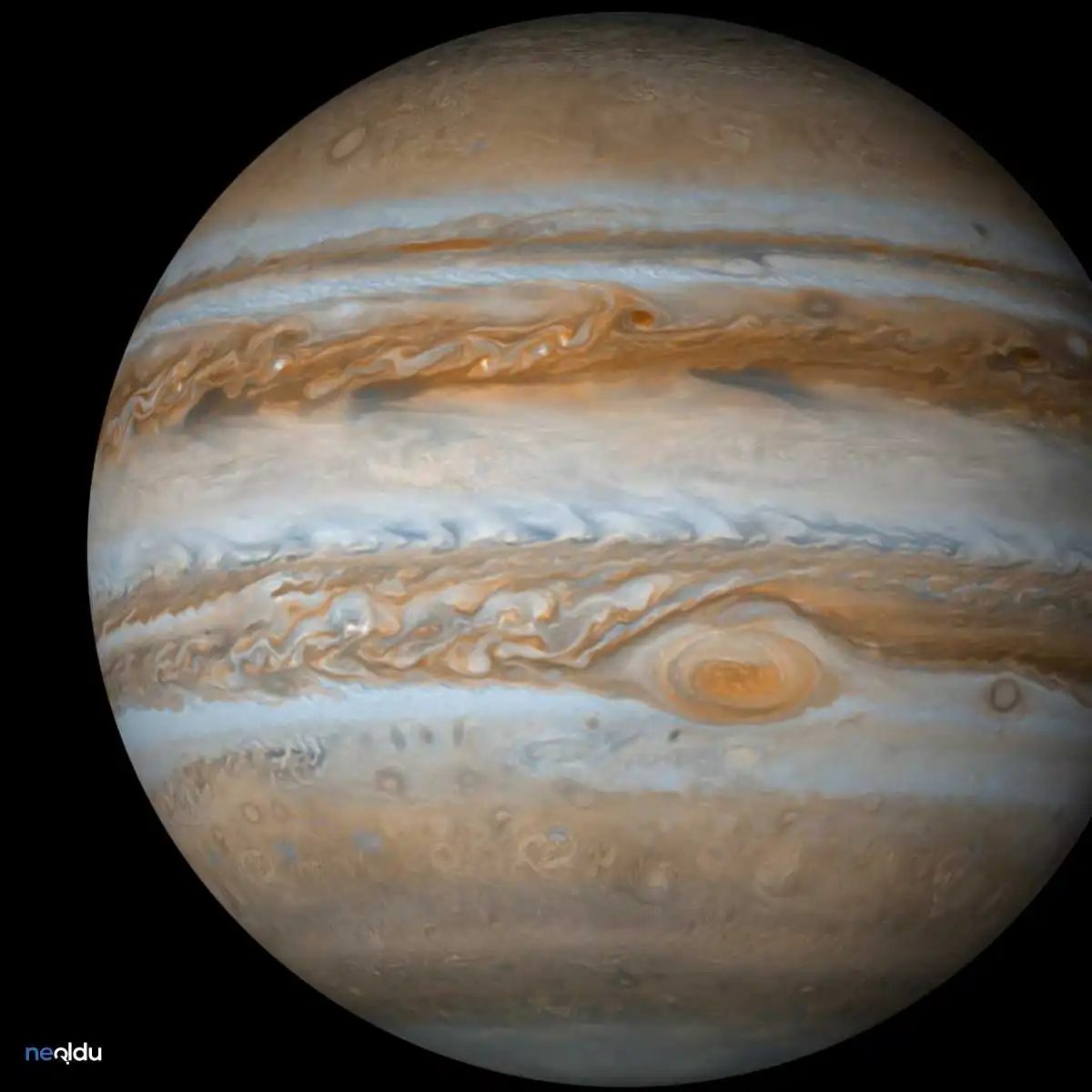
Jupiter’s atmosphere is full of dynamic and violent storms. The most famous feature is the Great Red Spot. This is an anti-cyclonic storm that has been going on for centuries. Its size is so large that the Earth could fit here. Even two Earths.
How did this storm form? It cannot be known exactly. But it may be fed by the effect of the magnetic field and internal heat sources. Why is the color red? It may be caused by ammonia and other compounds reacting with sunlight.
Other stripes are also noteworthy. Light colored zones and dark colored zones. These stripes show different levels of temperature and pressure in the atmosphere. Storms rotate between these bands. Some can last for hours, some for weeks.
of Jupiter
Jupiter is not only the largest, but also one of the fastest rotating planets. A full tour takes 10 hours. This is the shortest day-night cycle in the solar system. The huge, rapidly rotating ball of gas makes it difficult to understand what’s going on inside. But scientists know why this structure is important.
Jupiter’s enormous size and structure
Jupiter is the largest planet in the solar system. Its diameter is approximately 69,911 kilometers. Almost ten times the size of Earth. Its mass is 318 times that of the Earth. This makes it a “gas giant”. But what kind of gas giant exactly?
Its atmosphere consists of layers of gas and liquid hydrogen. These layers are under invisible but powerful pressure. Jupiter’s internal pressure is so high that hydrogen becomes liquid here. Even deeper, it becomes metal-like. This is one of the key factors fueling the planet’s magnetic field.
Clouds? They have. And storms too. Clouds of various colors appear in Jupiter’s atmosphere. Red, brown, white tones. These colors are formed by the action of chemicals such as ammonia and hydrogen sulfide. Huge plains are also here. These are long-lasting storm systems. The most famous is the Great Red Spot. A storm that has been raging for centuries.
Jupiter’s magnetic field is one of the strongest in the solar system. This area is shaped by the rapid rotation of the planet and the movement of the inner layer of liquid hydrogen. The magnetic field protects the planet from solar winds. But it also creates powerful radiation belts. This radiation can be dangerous for spacecraft.
What have we learned about rovers and Jupiter?
Because of its long orbit throughout the solar system, Jupiter has been visited by many rovers. During these visits, more information was obtained about Jupiter’s atmospheric conditions, magnetic field, and moons.
The first visits began with Pioneer 10 and 11. Then Voyager 1 and 2. Then Galileo. Then Juno. Each of them viewed Jupiter from a different perspective.
Pioneer made the first close passes. Confirmed the size. He measured the intensity of the magnetic field. But details were missing.
Voyager took more photos. It showed the dynamic nature of the Great Red Spot. He discovered some of its moons. Io’s active volcanoes, Europa’s icy
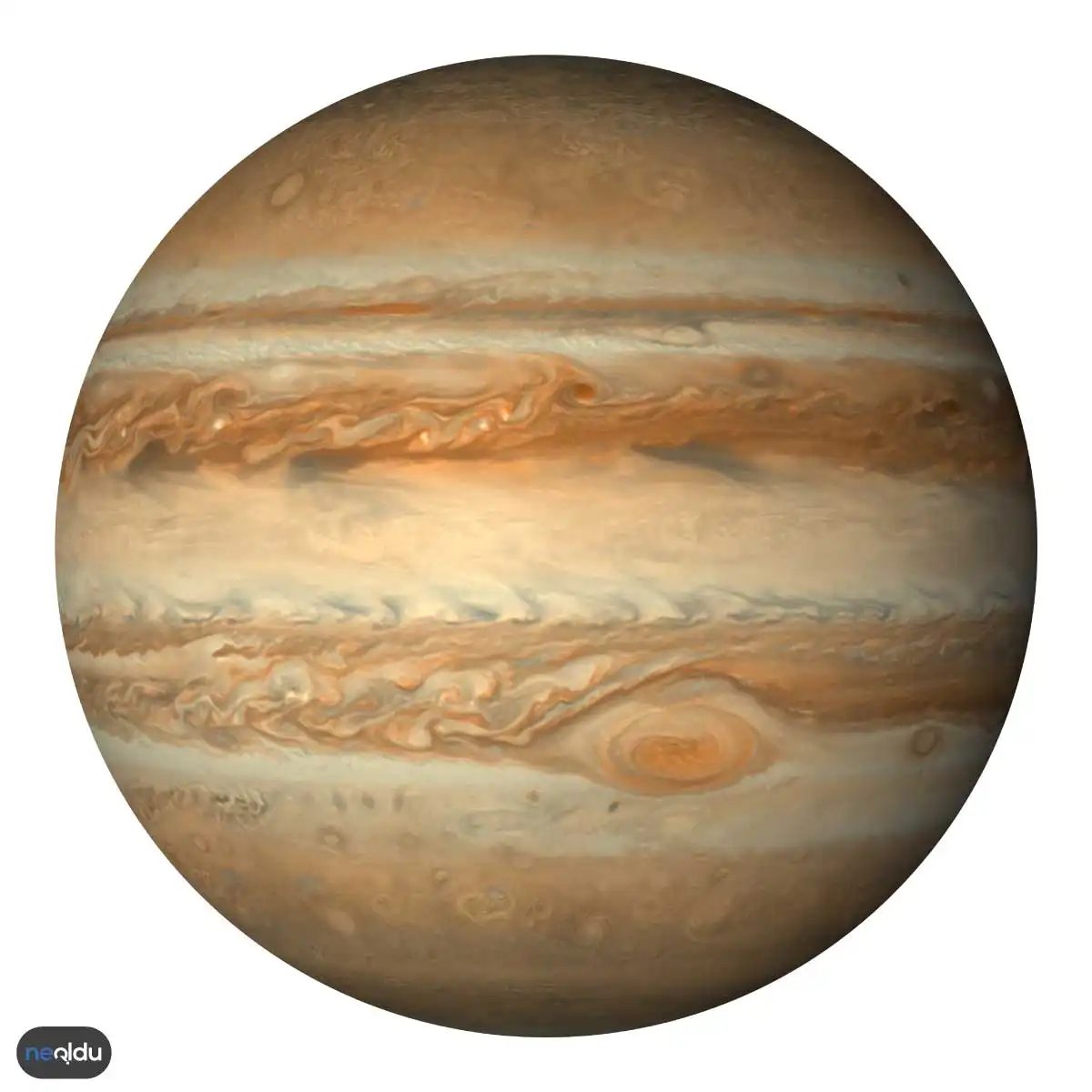
Jupiter, the largest planet of the Solar System, attracts attention not only with its size but also with the dark and dynamic structures it contains. Its diameter is approximately 142,984 kilometers. This figure is almost 11 times the diameter of the Earth.
When it comes to its mass, things get even more surprising. Jupiter has 2.5 times the combined mass of all other planets in the system. So, why does such a heavy celestial body have such low density? The answer is simple: Its volume is very large. Its density is only 1.33 grams/cm³. This number proves that the planet consists largely of hydrogen and helium, meaning it is a true gas giant.
Jupiter’s Internal Structure and Layers
When you say gas giant, don’t just think of clouds. Deep inside Jupiter, there is a dense region called the “core.” This is a region of matter where hydrogen and helium are compressed under extreme pressure and heat.
Its atmosphere is divided into four main layers. Each has different conditions.
Lower Cloud Layer: Cold Hearts
The deepest cloud layer is the coldest region of Jupiter. Its average temperature is -145 degrees Celsius. The materials here are dull and heavy.
Principal Cloud Layer and Winds
Higher up is the actual cloud layer that creates the planet’s most iconic image. Those famous bands are not a coincidence. Layers of gas in the atmosphere rotating at different speeds cause strong winds. These winds create visual patterns on the surface.
Jupiter’s atmospheric dynamics are much more complex and unpredictable than on Earth due to its lack of a stable surface.
Stratosphere and Ozone Protection Layer
As we move upwards, we reach the stratosphere. High-speed jet streams blow in this layer. Another interesting detail is the ozone layer. This layer, located in areas close to Jupiter’s magnetic field, protects the planet from the harsh effects of the radiation belt.
Thermosphere and Light Show
In the thermosphere, which is the uppermost layer, there is interaction with the outermost boundary of the atmosphere. Gases become ionized under the influence of the solar wind. This process can lead to flares and similar optical phenomena.
Jupiter’s Orbit and Spin Rate
Physical properties of Jupiter
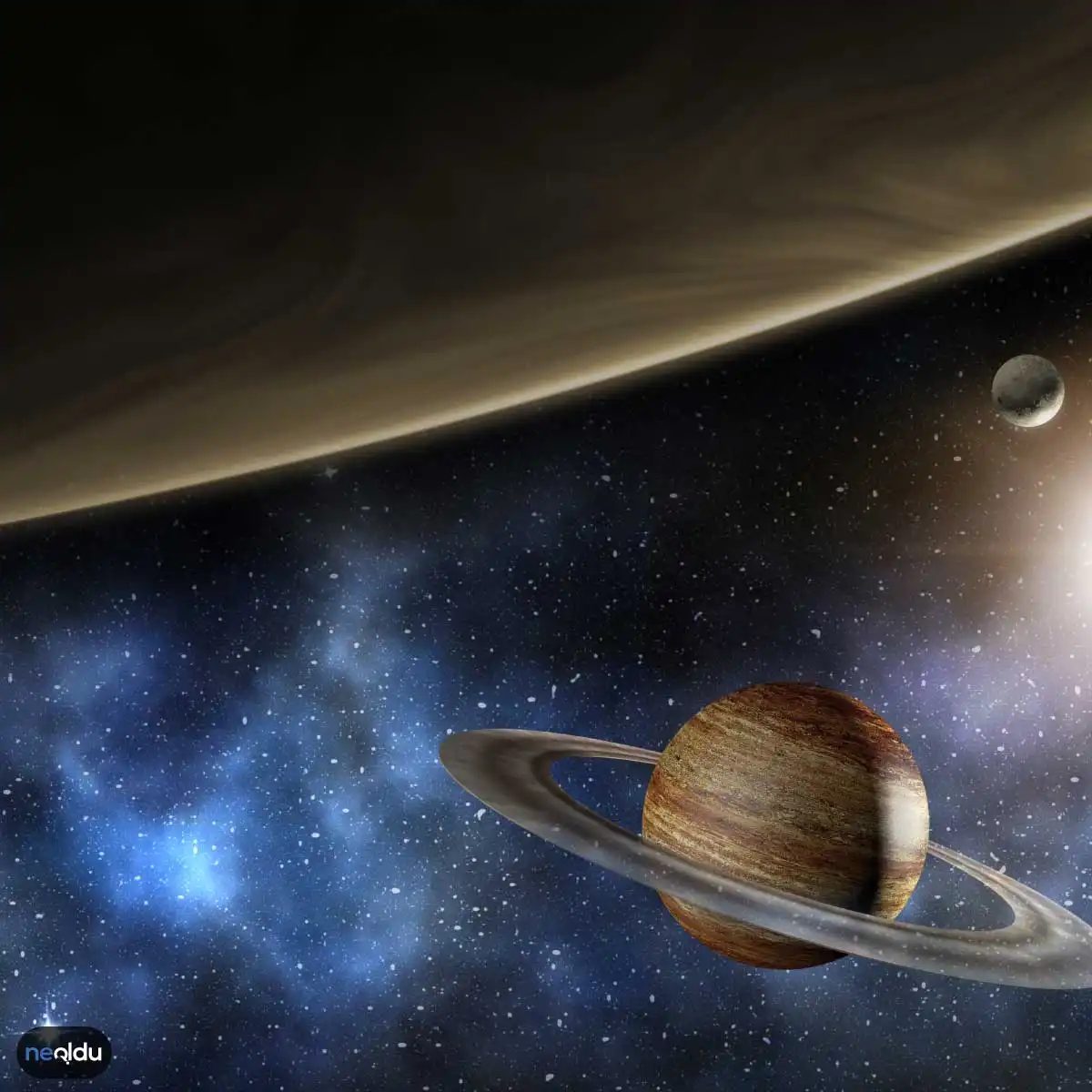
Fast Rotation and Position in Space
Jupiter is a single title. It is the superstar of the Solar System, both with its mass and rotation speed. It orbits at a distance of 5.2 Astronomical Units (AU), five times the distance between the Earth and the Sun. Its orbit is almost a perfect circle. So does this mean a slow turnaround? No.
One year on Jupiter is equivalent to 12 Earth years. This means 4,333 Earth years. Our planet, which prides itself on its rapid rotation, has a much different tempo on its own axis. A Jovian day lasts only 9 hours and 56 minutes. It’s about 2.5 times faster than the Earth rotates around itself.
The effect of this speed is not just a numerical detail. It drives atmospheric flows at the poles crazy. Strong winds are blowing. From where? Because fast rotation creates great friction and energy transfer in the atmosphere. The structure that heralds these storms is the Great Red Spot. A huge atmospheric formation. A storm raging in Jupiter’s atmosphere, not its surface.
Jupiter’s Atmosphere
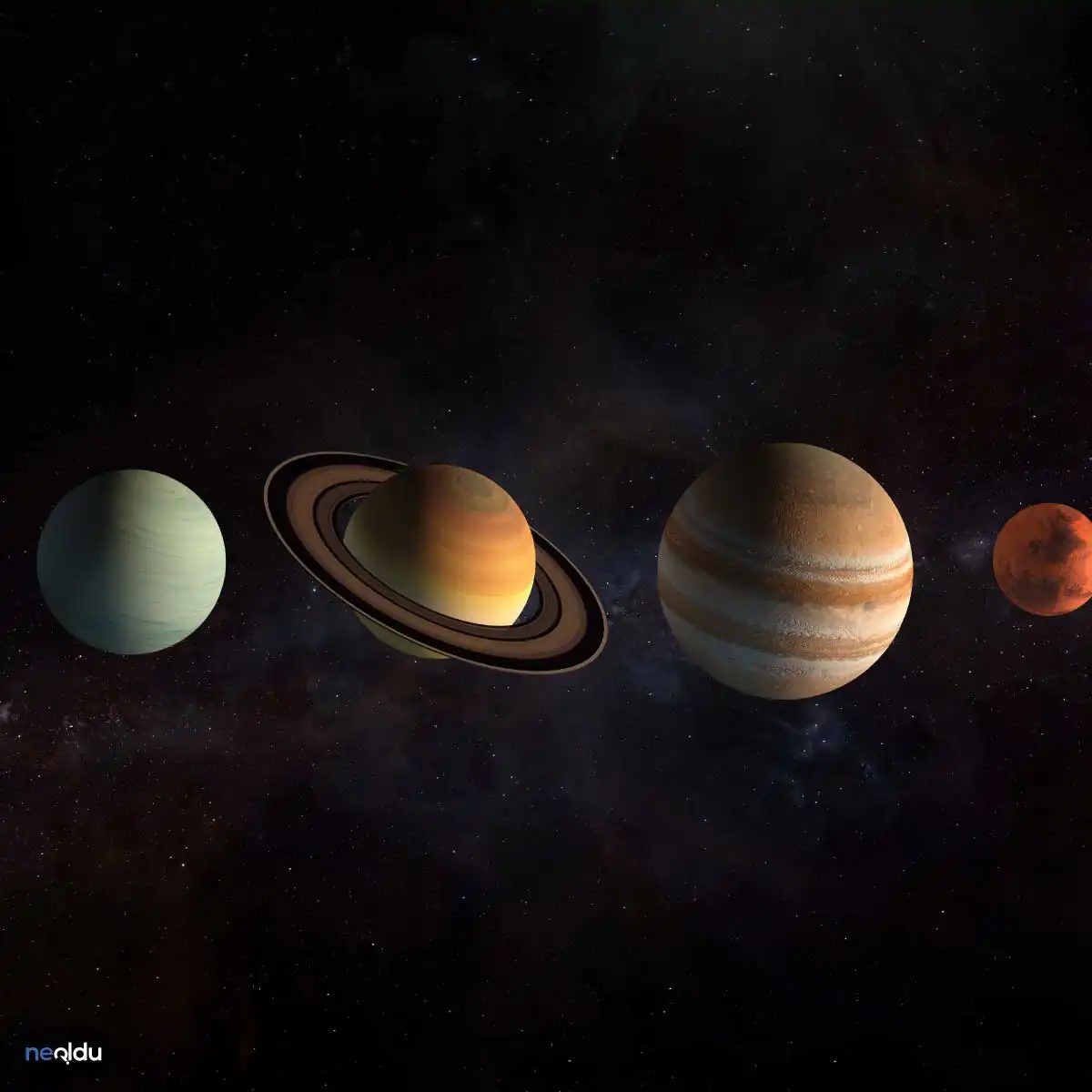
Jupiter, the largest among the solar system giants, attracts attention not only with its mass but also with its atmospheric complexity. The density of gas giant status turns this planet’s outer layers into a difficult-to-study but highly dynamic laboratoryum. Even though its main components are 90% hydrogen and 10% helium, you encounter much more than just an ordinary gas cloud. When traces of water vapor, methane and ammonia are added to this mixture, its chemical structure becomes a puzzle that scientists have been trying to solve for decades.
Why Does the Big Red Spot Last So Long?
The most iconic feature of Jupiter’s atmosphere is undoubtedly the Great Red Spot. It is a gigantic antelope, comparable in size to the Earth itself. So why is it taking so long?
Data shows that this storm has continued uninterrupted for at least 350 years. Some observations extend this further back to the 17th century. The ability of an antelope to remain stable for so long is due to the interaction of the energy flow resulting from Jupiter’s internal heat with the outer atmosphere. Seeing reddish tones when viewed from the outside is a result of chemical reactions; possibly the interaction of ammonia crystals and other compounds with sunlight.
This storm is not alone. Other systemic storms and eddies observed throughout the atmosphere reinforce the windy nature of the planet. But the Great Red Spot acts like a giant standing at the center of this chaos.
600 Kilometers per Hour: Why Are Jupiter’s Winds Different from Earth’s?
Winds on Jupiter dwarf even Earth’s strongest hurricanes. Jet streams can reach speeds of up to 600 kilometers per hour. So how do they reach such high speeds?
The answer lies in the planet’s rotation speed around its axis and its internal heating mechanism. Jupiter completes a rotation approximately every 10 hours. This rapid rotation stabilizes the wind bands, strengthening the Coriolis effect. Storms on Earth are often powered by external sources, such as steam from the oceans or land-to-sea transitions. Jupiter uses its own internal heat. This internal energy keeps the atmosphere in constant motion.
“Jupiter’s atmospheric conditions are influenced more by external interactions.”
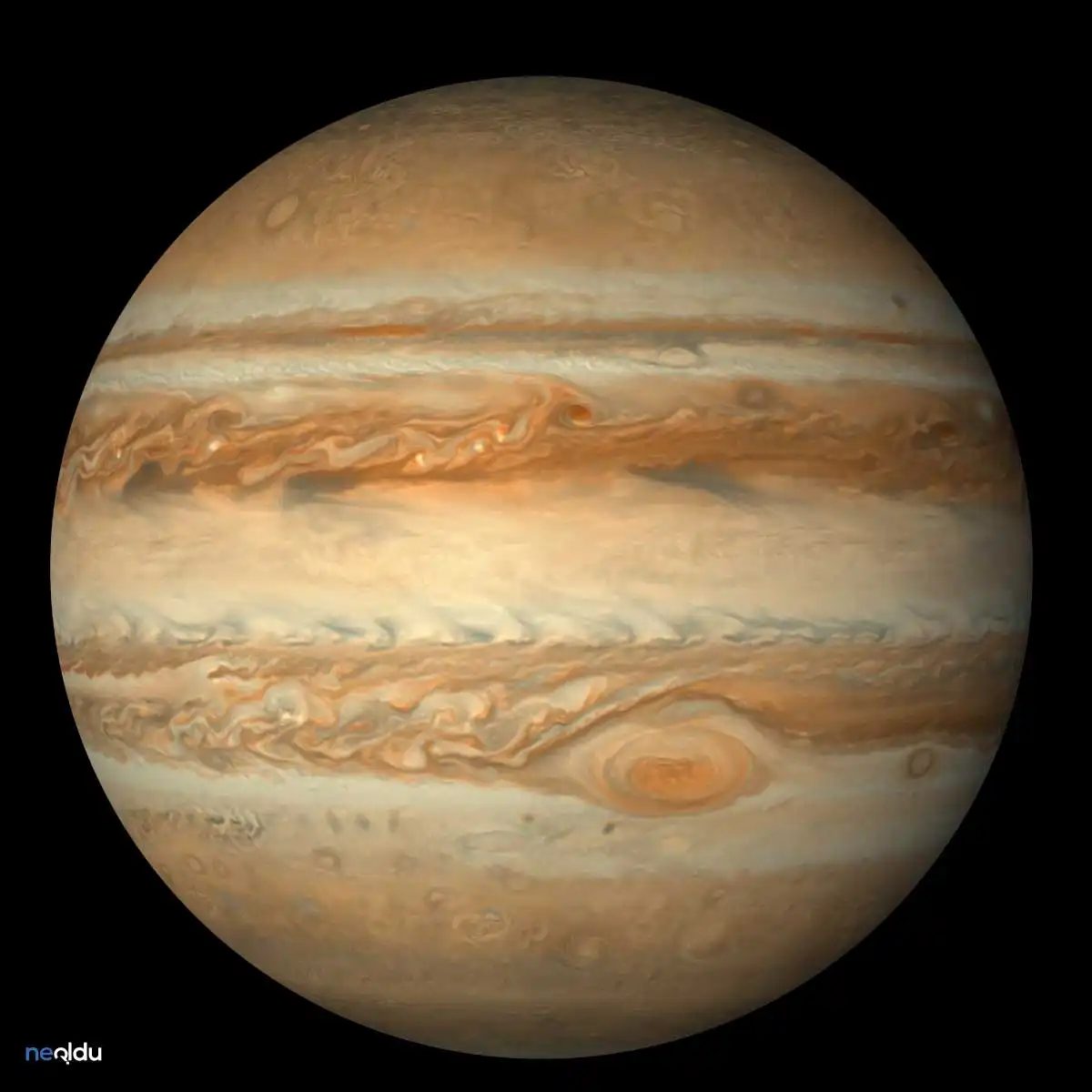
Jupiter, which rules the Solar System with its enormous weight, is not only a masterpiece in itself. It hosts the kingdom of 79 satellites around it. These are small worlds that are about much more than the planet. The most well-known are Ganymede, Callisto, Io and Europa. But the rest are not rocks suspended in space. Most are small and rocky. However, giant ones like Ganymede and Callisto are so large that they are sometimes referred to as “satellite-planets.” Its mass is close to that of Jupiter. Almost equal. This takes them beyond ordinary landscapes.
Ganymede: Alone with a Magnetic Field
As if being the Solar System’s largest moon wasn’t enough, Ganymede is also larger than Mercury. Its diameter is large. But its internal structure is more interesting. Its surface is like a battlefield. Craters. Mountains. And huge regions of water ice. These ices keep the surface cold.
What really attracts attention is its magnetosphere. It is the only satellite with a magnetic field in space. This proves that it has a large metal core deep inside. The magnetosphere interacts with Jupiter’s strong magnetic field. This is a feature that completely distinguishes Ganymede from others. The magnetic shield required for life must be on a satellite. This is an achievement in terms of astrophysics.
Callisto: Owner of the Crooked Surface
Callisto is a different story. One of the most distant large moons of Jupiter. Its surface is one of the oldest and most distorted in the Solar System. It is full of craters. The ice crust has left cracks along the crevasses. This crust is one of the thickest layers of ice in the system. Its thickness is kilometers.
Callisto’s interior is unclear. But there is old age on its surface. Each crater is a timestamp. Since it is relatively further away from Jupiter’s magnetic field, its radiation effect is not as destructive as other moons. This ensures that the surface remains the same for millions of years. Where time stands still.
Io: Kingdom of Volcanoes
Jupiter’s innermost moon Io. And the most active volcanic body. When we say activity, we are not talking about a calm surface. Io’s surface is constantly changing. Volcanic eruptions are regular. Most of these are electric currents caused by Jupiter’s strong magnetic field.
The Secret of Jupiter’s Rings: A Dark Circle
Jupiter, the king of the Solar System, is not only big but also mysterious. One of its most interesting features is that it has no visible shine. These rings were not known until the first photographs taken by Voyager 1 in 1979. Since then, we’ve collected more data about those thin, dark structures.
The rings lie in the equatorial plane of the planet. Their width is approximately 20,000 kilometers. They are dark in color and almost transparent. The most obvious is the “main ring”. It is thicker than other rings but still exhibits the art of invisibility.
The formation mechanism is still unclear. However, scientists believe that material from the satellites is feeding the rings. Io is a moon exposed to radiation from Jupiter’s strong magnetic field. This radiation triggers volcanic activity on Io’s surface.
“The radiation effect causes the emission of gas and dust from Io.”
These dust clouds are scattered around Jupiter. This powder forms the rings. It’s a continuous cycle. Source satellites eject material into space. The material remains in orbit around the planet. Rings are formed from these remnants.
NASA’s Galileo spacecraft allowed us to better understand these structures. When it reached Jupiter, it took high-resolution images of the rings. These images allowed us to analyze the structure and composition of the rings. The details are clearer now.
Basic Information About Jupiter
Jupiter is the fifth planet in the Solar System. It’s also the biggest.
Dimensions and Scale
Its diameter is approximately 142,984 kilometers. Its radius is 69,911 kilometers. It is twice the mass of all other planets in the Solar System combined.
Surface and Atmosphere
It has a dense atmosphere composed of liquid hydrogen and helium. Since it is a gas giant, it does not have a solid surface. Therefore, the concept of “surface” cannot be precisely defined for Jupiter. As you go deeper, the pressure increases. Gases turn into liquid. Perhaps layers of metallic hydrogen are reached.
Magnetic Field and Satellites
The strongest magnetic field in the Solar System belongs to Jupiter. This area forms radiation belts. Moons like Io are trapped within these belts.
By 2022, Jupiter will be 7