Right here. In our cosmic backyard. 🏠
There is a black hole that isn’t playing nice. It is sitting in the galaxy SDSS J10546.0-7+1450224, about 1.8 billion light years from us, and it is eating. Not snacking. It is voraciously stripping matter, acting like the supermassive beasts from right after the Big Bang.
Scientists usually only see this behavior in ancient, distant objects. Here, the titan is close enough to study without waiting decades for the light to arrive.
SDSS J1105 has been broadcasting bright radio waves for years. That radiation is the smoking gun. It reveals just how hard this black hole is feasting.
“By observing these jets and outburths, we can study physical processes in extreme environments.” – Kovi Rose, University of Sydney
Rose puts it bluntly. These high energy events give us insight. The environment is harsh, exotic, and rare to observe up close.
Messy eaters
Every large galaxy has a heavy hitter in its center. Millions of suns worth of mass, sometimes billions. They just don’t always eat.
Our Milky Way’s central hole, Sagittarius A, is practically anorexic. If it were human, it would consume one grain of rice every million years. *Sad.
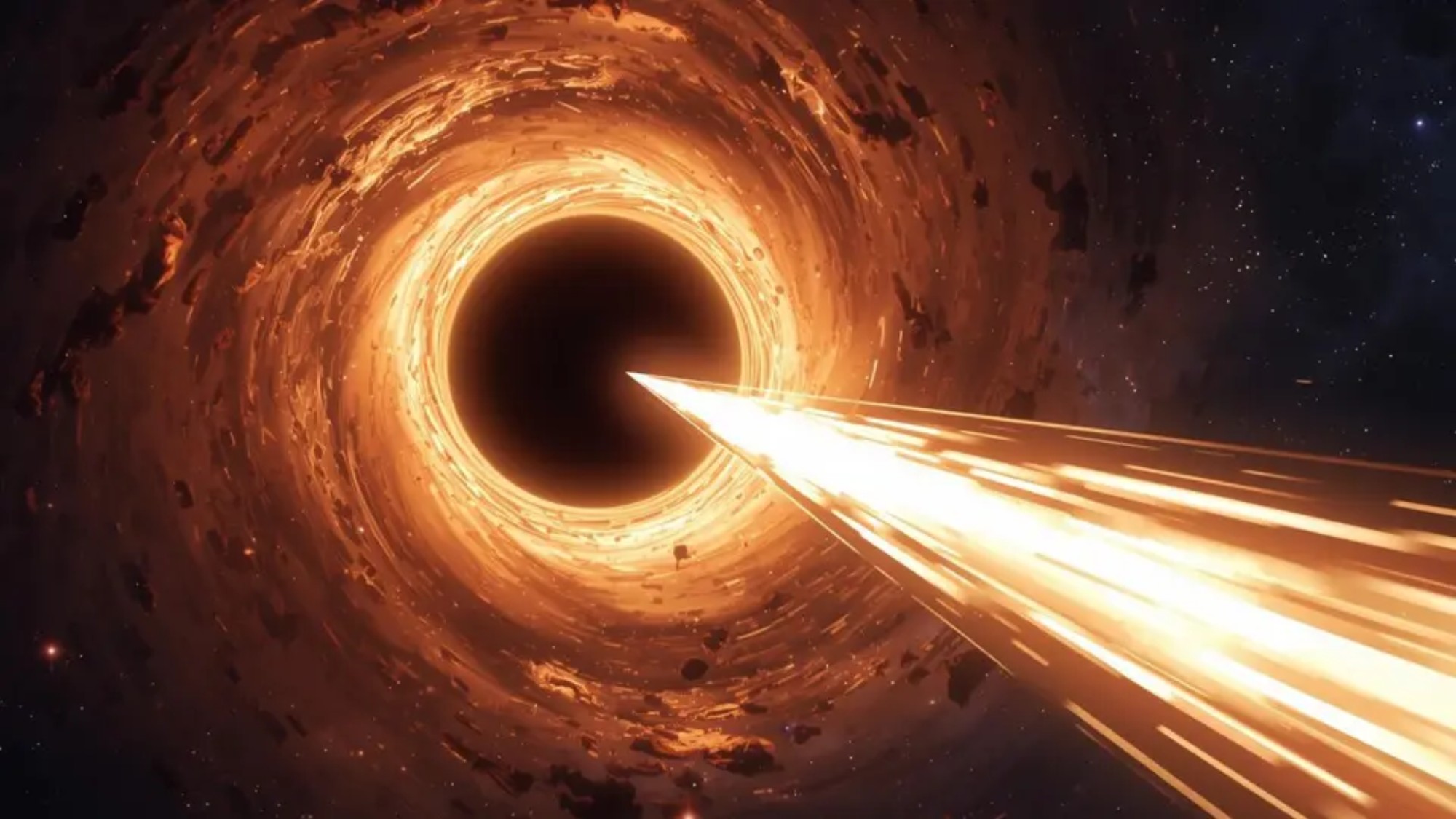
This distant guy? Different story. When a black hole has plenty of gas and dust around it, gravity pulls that material in. It forms a swirling cloud called an accretition disk. This disk gets hot. Glowing hot. Across the spectrum. Radio waves, X rays, the works.
But these holes are messy. They don’t swallow everything cleanly. Some of the material gets channeled to the poles. Blasted out. Plasma jets traveling near the speed of light shooting into the void. This creates even more electromagnetic noise.
SDSS J115 recently did something wild. Around eight years ago, its radio brightness spiked. Not a little bit. Twenty-fold. The intensity jumped to 10 quadrillion times that of our Sun’s radio output. And it hasn’t stopped. Still bright. No signs of dimming.
“We are looking at the prototype for a new class of galaxy,” Phil Edwards of CSIRO said.
Team leader Stefanie Komassa agrees. Rapid growth in lightweight black holes usually results in rare, bright radio emissions. Seeing them transition into this long-lasting radio-bright state is unprecedented.
So, what caused the flare up? More food falling in. The increased mass ingestion likely triggered the plasma jets we see today. The rate of growth mimics what only happens in the early universe.
That makes SDSS J15 a prime target for astronomers. A local proxy for the chaotic infant cosmos.
Komossa thinks sensitive tools like the incoming SKA telescope will find more like this one. Identifying these transients fills the gaps in what we know about the early universe. Or does it. The gaps are stubborn things. We keep peeling back layers, finding new weirdness. The universe doesn’t care if our models fit.