


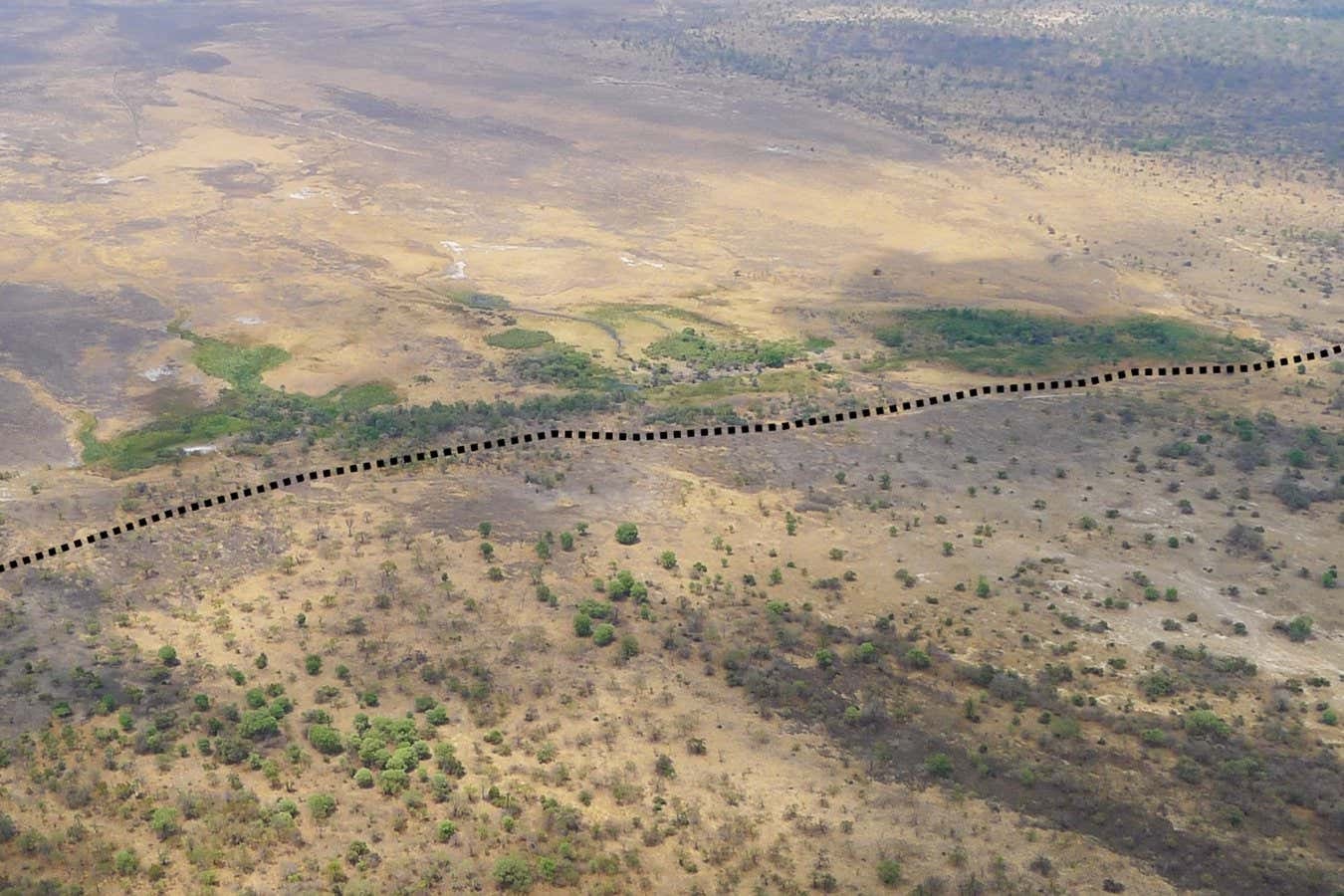
The African continent is in the process of tearing itself apart, but the action isn’t limited to the well-known East African Rift. Deep beneath central Zambia, geochemical evidence suggests a new tectonic plate boundary is beginning to form. This discovery not only reshapes our understanding of continental geology but also highlights a rare opportunity: the emerging rift is releasing significant concentrations of helium, a critical resource for modern technology and medicine.
The “Awake” Ground Beneath Zambia
For decades, geologists have monitored the East African Rift Valley, a massive fracture zone stretching from the Red Sea to Mozambique where the African plate has been splitting for tens of millions of years. However, finding a site where this process is just beginning is rare.
Recent research led by Rūta Karolytė of the University of Oxford points to the Kafue Rift in Zambia as such a site. Part of a 2,500-kilometer-long rift zone extending from Tanzania to Namibia, the Kafue Rift has long shown geological oddities: low-gravity anomalies, high sub-surface temperatures, and minor seismic activity. Until now, however, there was no direct geochemical proof that the crust was actively tearing.
Karolytė’s team analyzed gas samples from five hot springs and three geothermal wells in central Zambia. The results were definitive. The helium and carbon isotope ratios in the gases matched those found deep within Earth’s mantle—up to 190 kilometers below the surface. This indicates that fluids from the mantle are rising through fractures in the crust, a clear sign that the tectonic plates are moving and the rift is geologically “awake.”
“What our data confirms is that this system is currently ‘awake’ and geologically active,” says Karolytė. “Having an active rift developing doesn’t necessarily mean that in 100 million years you’re going to have an ocean there. But it is a possibility.”
Why This Matters: The Helium Connection
The geological significance of the Kafue Rift extends beyond tectonics; it has immediate economic implications. The early stages of continental rifting release gases that have been trapped in rocks for millions of years, including helium.
Helium is not just a party balloon filler; it is a non-renewable resource essential for:
– Cooling superconducting magnets in MRI machines.
– Cryogenics in quantum computing and particle physics.
– Leak detection and high-tech manufacturing.
Global helium supplies are tight, and finding new sources is difficult. The Kafue Rift is producing fluids with helium concentrations as high as 2.3 percent —a level high enough to attract serious industrial interest.
“It’s hard to find these tectonic conditions that are just right to concentrate and release helium in a way that it can be captured,” Karolytė notes. The specific geological setup of the rift allows mantle-derived helium-3 (a rare isotope) to rise through faults and accumulate, creating a potential mineable resource in a region previously overlooked for this purpose.
A Rare Geological Snapshot
Patrice Rey of the University of Sydney supports these findings, noting that while the region lacks active volcanoes or major earthquakes, the landscape is undeniably tectonically active. The new geochemical data confirms that mantle fluids rich in primordial helium are rising through the crust.
This discovery offers scientists a rare opportunity to study the very first stages of continental breakup in real-time. While the East African Rift shows us what happens millions of years into the process, the Kafue Rift provides a window into the initial fractures that eventually split continents.
Conclusion
The emergence of the Kafue Rift as an active tectonic boundary illustrates the dynamic nature of our planet’s crust. It serves as both a scientific laboratory for understanding how continents break apart and a potential source of vital industrial resources. As geologists continue to monitor this “awake” system, the region may evolve into a significant plate boundary, while simultaneously offering a new avenue for securing the helium needed by the high-tech industries of tomorrow.


