It started with a simple assumption. Earth sits still. The center of everything. The rest of the universe spins around it.
This wasn’t just random guesswork by ancient astronomers. It was a calculated response to a visual problem. The sky looked perfect. Circular. Uniform. But the planets didn’t behave like perfect circles. They wobbled. They stopped. They sometimes moved backward.
Claudius Ptolemy solved this in Alexandria around 150 CE. His solution, recorded in the Almagest and Planetary Hypotheses, became the standard for understanding the cosmos for over a millennium. It was a mathematical marvel. Not physically accurate, perhaps, but surprisingly predictive.
Why the Sky Looked Broken
Ancient thinkers believed in the “perfect” circle. Straight lines were for Earth. Curves were for the divine. If you looked up, you expected uniform motion.
The Sun, Moon, and stars mostly kept this promise. But the five known planets—Mercury, Venus, Mars, Jupiter, and Saturn—did not. They exhibited irregular paths. To a pre-modern observer, this was a crisis. The heavens were supposed to be flawless.
Ptolemy’s fix was elegant. He didn’t abandon the circle. He combined them.
He proposed that what looked like an irregular path from Earth was actually a combination of several regular circular motions seen in perspective. It was a trick of geometry. A way to make the imperfect look perfect again.
The Mechanics of Epicycles and Deferents
The model relied on two main principles. The first was eccentricity.
If you move at a constant speed in a circle, but you are not at the center, your speed appears to change from the center’s perspective. You slow down when you are far away. You speed up when you are close. Ptolemy used this to explain the Sun’s varying speed through the zodiac.
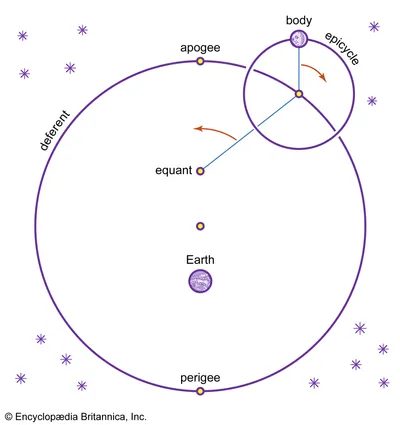
For the Moon, he added a twist. The line from the farthest point (apogee) to the closest point (perigee) slowly shifted over time.
But planets were harder. They needed a more complex solution. Ptolemy combined eccentricity with an epicyclic model.
Here is how it worked:
- Each planet moved in a small circle called an epicycle.
- The center of that small circle moved along a larger circle called a deferent around Earth.
- One half of the epicycle moved opposite to the deferent’s direction.
When the planet was on the inner half of the epicycle, it appeared to slow down. It even reversed direction. This explained retrograde motion. To an observer on Earth, Mars would seem to stop, slide backward against the stars, and then resume its forward journey.
Ptolemy refined this further with the equant. This was a mathematical point opposite the Earth relative to the center of the deferent. The center of the epicycle moved at a uniform angular speed as seen from this equant point, not from Earth or the center of the deferent.
It was a cheat. A mathematical sleight of hand. But it worked. It predicted planetary positions with high accuracy.
“Ptolemy’s model explained this ‘imperfection’ by postulating that the apparently irregular movements were a combination of several regular circular motions seen in perspective from a stationary Earth.”
The Controversy of the Equant
The equant point was controversial. It violated the core tenet of uniform circular motion centered on a single point.
Islamic astronomers in the medieval period struggled with this imaginary point. They wanted a physical explanation, not just a numerical fix. Nicolaus Copernicus also objected. He found the varying speed philosophically offensive.
Copernicus tried to fix it. He added more circles. He tried to restore pure uniform motion around Earth-centered or Sun-centered points. He kept the complexity Ptolemy tried to simplify, just with a different center.
Ironically, this obsession with the equant’s “error” led to the truth. Johannes Kepler studied these discrepancies. He realized that if you give up the circle, the equant disappears. Ellipses fit the data better. The varying speed wasn’t a glitch in a circular model. It was a feature of elliptical orbits.
Nested Spheres and Empty Space
Ptolemy didn’t just deal with math. He tried to build a physical universe.
He believed the heavenly bodies were attached to solid, transparent spheres. An epicycle was the “equator” of a spinning sphere nested between other shells.
He calculated the distances. He nested the spheres of the Moon, Mercury, Venus, Sun, Mars, Jupiter, and Saturn inside one another. No empty space. Just a tight packing of cosmic machinery.
His estimate for the Moon’s distance was roughly correct. His estimate for the Sun’s distance was off by a factor of twenty. The largest sphere, containing the fixed stars, sat at 20,000 Earth radii. That was the edge of his universe.
This idea of nested spheres persisted through Islamic astronomy into medieval Europe. It was the standard cosmology.
But it couldn’t survive observation.
In 1577, a bright comet appeared. Tycho Brahe calculated its path. It passed far beyond the Moon. If it passed through the nested spheres, it would have destroyed them. Or the spheres were not solid. Or they didn’t exist.
Copernicus had already abandoned the nested spheres for a heliocentric model. He could not fit empty space between solid objects.
The comet killed the solid sphere theory. The math survived.
Why It Matters
We often dismiss the Ptolemaic system as a primitive error. A mistake that kept humanity in the dark until Copernicus and Kepler.
That’s wrong. It was a highly successful predictive model. It allowed astronomers to map the sky with precision. It framed scientific inquiry for 1,400 years.
It also shows how hard it is to let go of intuition. We feel like Earth is stationary. We expect perfect circles. Ptolemy built a massive, intricate machine to accommodate our biases.
Kepler didn’t just find a better shape. He had to admit that the sky wasn’t what it looked like.
The Ptolemaic system wasn’t just wrong. It was a bridge. A complex, beautiful, flawed bridge between what we see and what is true.
And maybe that’s the point of science. Not to be right immediately. But to build models good enough to survive the next observation.
The comet came. The spheres broke. The math held.
We are still building models. They just look different now.