Balance is essentially a ladder. It is a graduated series of notes, notes, or intervals that divides an octave into predictable chunks.
When you listen to music, the selected sounds are not random. They reveal a pattern. This pattern can be described as a series of fixed distances (intervals) from one note to another within an octave.
Interval ratios are the DNA of the scale. they define it. Changing the interval changes the scale. Other factors, such as range, accentuation of certain notes, or the presence of notes together (harmony) or consecutively (melody) do not change the scale. They just explain how it “works”.
In theory, you can create almost infinite scales. In reality, culture chooses some. These choices are traditional. Over time, a single vocal scale represents the tonal system of an entire culture.
Simple scales appear in ancient musical and non-literary traditions. Complexity on a large scale occurs in what we call the world’s most advanced cultures. It’s not a question of good or bad. It’s all about structure.
The distance relationship between the pitches of a scale is its fundamental property, and a specific distance pattern defines each scale.
Music is not born in a vacuum. It is built. In the world of pop culture, we get so caught up in the next hot product or viral sample that we often forget its exact structure. Researchers have been trying to decipher the DNA of folk music for centuries. However, the problem is that people who make music don’t know that they use a “scale”. they were just singing.
This confuses the research question. If the creator doesn’t understand the theory, researchers have to study real sounds to reverse the logic. This is detective work. Contrast this with classical music or “high culture music”. The rules are well known there. Composers compose fully aware of conventions. They are not guesses. They follow the plan.
The universal math of Intervalss
人間の歌は多種多様であるにもかかわらず、実際の音階の種類は驚くほど少ないです。 西洋以外の音楽にも目を向けてください。 インターバルは通常、西洋のポップ ミュージックやロック ミュージックで慣れ親しんだ全音と半音を反映します。 彼らがdivergeときは? 音楽学者は違いを測定するために「セント」を使用します。 平均律では、100 セントは 1 半音に相当します。これは、現代のピアノの調律を支配する 12 音のグリッドです。
これらのスケールを特定することは、必ずしも明確であるとは限りません。 間隔が大きく異なる場合もあります。 また、歌唱テクニックによって、従来の記譜法ではまったく捉えられないピッチが生成される場合もあります。 たとえば、ドイツの音楽学者カート・サックスがオーストラリアのアボリジニの歌で「tumbling strains」と表現したものを考えてみましょう。 音程空間を流れ落ちるメロディー。 標準的な楽譜ではそれらを識別することはできません。
From two notes to complex systems
Technically,您至少需要两种不同的音调才能开始谈论音阶。 单音音乐——没有和声的单一旋律线——通常使用只有一两个音程的音阶。 这些微小的结构无处不在。 您可以在锡兰、西伯利亚东部、加州印第安文化中以及乌拉尔山脉附近找到它们。 通常,范围很窄。 音高以半音、全音或小三度分隔。 跳跃更大? 不太常见。
那么鳞片是如何变大的呢? 通常,这是为了填补空白。 如果旋律跳得太远,就会自然地在中间插入音符。 或者,作曲家可能会采用一个简短的旋律片段(一个动机)并将其移调到不同的音高水平。 这种重复增加了新的scale degrees。 它在不改变核心思想的情况下扩展了调色板。
有时,特定的notes更有分量。 一段旋律可能会痴迷于 G 和 C,不断地重复它们。 这种强调并非来自简单的transposition。 这是故意的。 这些“加权”音阶通过将某些音高用作边界或将它们放置在部分的末尾来突出某些音高。 他们主持这首歌。
The architecture of art music
In sophisticated cultures, scale is more than just an descriptive tools. These are pre-existent assumptions. Composers belonging to highly developed traditions don’t discover the scale. they start with it. Knowledge was transmitted through music theory treatises and oral traditions. Professional performers maintain continuity. Even in the West, where we love constant innovation, change happens within acceptable limits. The scale evolves, but it does not disappear.
Complex systems for governing these scales exist all over the world. In the Far East. India. Iran. The Muslim world. The West. Although the styles are very different, the functionality is the same. Every culture has a basic Intervals patterns.
In India these are called grāma. In Iran Dastgah. In The Muslim worldic culture maqām.
multiple modes are created from the basic scale. The Intervals structure remains the same, but the melodic focus changes. Some notes become primary. Others are secondary. This hierarchy creates more modes than the basic scale. The terms maqām and dastgah are often used to refer directly to these modes. The Indian equivalent is jāti.
And that’s not all. In some traditions, these modes serve as the basis for more specific melodic types. Improvisation can develop them further. In India these are rāgas. In Iran, gūsheh.
Of course, Western art music has its own scales and modes. However, melody types with same systematic rigidity are not used. We don’t think of them in the same way as conscious, pre-defined frames. The structure is looser. More fluid.
Does this cause a less disciplined in Western music? Or is it just a differently organized? The answer depends on who you ask. But the math remains the same. Intervals. Pitch. Weight. The building blocks are universal. How you stack them reflects your culture.
Why pentatonic scales rule the world
Pentatonic scales—the five-note variety—are the heavyweights of music. They are used more widely than any other scale formation, period. It is actually rare to find them dominating Western art music, which is one of the few traditions that doesn’t lean on them. Instead, you see pentatonic structures everywhere else. They are especially notable in the Far East and throughout European folk music.
The most common versions are anhemitonic, meaning they use major seconds and minor thirds but exclude half steps. Take C–D–E–G–A as a standard example. The scale is so pervasive that melodies based on four-note (tetratonic ) structures often just sound like pentatonic ones with one note left out.
Six-note (hexatonic ) scales? Those are rare in folk music and nonliterate cultures. When you do find them, they often look like incomplete fragments of the seven-note Western diatonic scale.
Heptatonic scales and the roots of Western music
Seven-note (heptatonic ) scales are where the world’s major art-music traditions live. The tone systems of India, Iran, and the West are entirely heptatonic. Other cultures use seven-note scales in their art music without relying on them exclusively. Think of the ritsu scale in Japan or the pelog scale in Java.
Western art music has largely stuck to one specific heptatonic scale: the diatonic scale. This has been the case for most of its history, with a few exceptions in both the distant and recent past. Its origins trace back to ancient Greece. It was partly shaped by acoustical principles.
In Western music, the octave is usually divided into 12 equal half steps. You can build the characteristic intervals of the diatonic scale on any of those 12 pitches. These transpositions are what we call keys.
Major vs. minor: How the modes evolved
Before the 17th century, musicians used up to 12 different mode permutations of the diatonic scale. Now? Only two modes dominate. They are called major and minor. They have been in general use for most of the last 300 years.
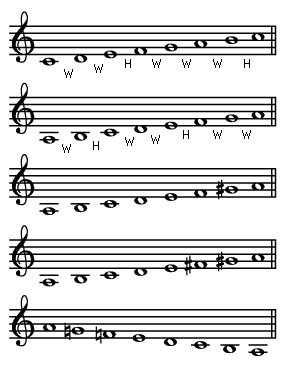
The diatonic scale itself is built on five whole steps and two half steps. The half steps break up the whole steps into groups of two or three.
The major scale follows the sequence W–W–H–W–W–W–H. The minor scale uses W–H–W–W–H–W–W.
In practice, the minor scale is rarely played straight. It is usually altered to emphasize specific pitches. There are two main ways this happens.
The harmonic minor scale raises the seventh note by one half step.
The melodic minor scale raises both the sixth and seventh notes by one half step when ascending. When descending, those notes return to their original, unaltered state. This creates a distinct sound depending on the direction of the melody.
The minor scale is not a static entity. It bends and shifts to create tension and resolution, specifically through these harmonic and melodic alterations.
Does the choice between harmonic and melodic minor matter in modern pop? It shouldn’t. But if you listen closely, the shift defines the mood. One feels like a resolved chord. The other feels like a journey. The scale itself is just a tool. The intention behind it is what stays.
The push for notes outside the standard diatonic framework intensified throughout the 19th and 20th centuries. This shift didn’t just add color; it forced composers to invent entirely new systems. They needed alternatives to the familiar major and minor keys.
Arnold Schoenberg, an Austrian-born composer, was pivotal here. He articulated the principles for composing within the chromatic scale early in the 20th century. The chromatic scale includes all 12 half-steps in an octave. His work provided a structural foundation for music that no longer relied on traditional tonality.
But Schoenberg wasn’t working in a vacuum. Experimentalists were testing boundaries elsewhere.
The Whole-Tone Experiment
Claude Debussy and other French composers popularized the whole-tone scale. This system uses six whole steps. It creates a dreamlike, ambiguous sound because it lacks the half-step tension that defines traditional harmony.
The technique spread beyond France. English composers adopted it too. It became a staple for creating specific atmospheres rather than following strict functional progression.
Microtones and Quarter Tones
Somewhere between the whole-tone experiments and Schoenberg’s chromaticism lay microtonal scales. These require intervals smaller than a conventional half-step. They appeared sporadically in the 20th century.
Which microtonal structure proved most significant? Quarter tones. Equal to half the distance of a half-step, they offered a new granularity of pitch. Composers used them to explore textures that felt neither fully diatonic nor fully chromatic in the traditional sense.
Defining the Term ‘Scale’
The word scale itself carries more weight than just a list of notes. In performance practice, it often refers to exercises. Musicians practice ascending and descending patterns to build technical proficiency on their instruments. These are scalelike drills, not necessarily compositions.
Sometimes, scale describes passages consisting of consecutive scale degrees in order. It’s a structural descriptor for melodic movement.
In rare cases, the term stretches to cover non-pitch elements. Take Klangfarbenmelodie. This concept arranges a succession of different tone colors rather than just pitches. It treats timbre as the primary organizational principle. The “scale” here is a gradient of sound quality, not just frequency.
Music theory keeps evolving. The boundaries between these systems blur. A composer might borrow a microtonal interval for a single chord. Or use a whole-tone fragment to break a chromatic line. The tools are all there. The question is what to do with them.