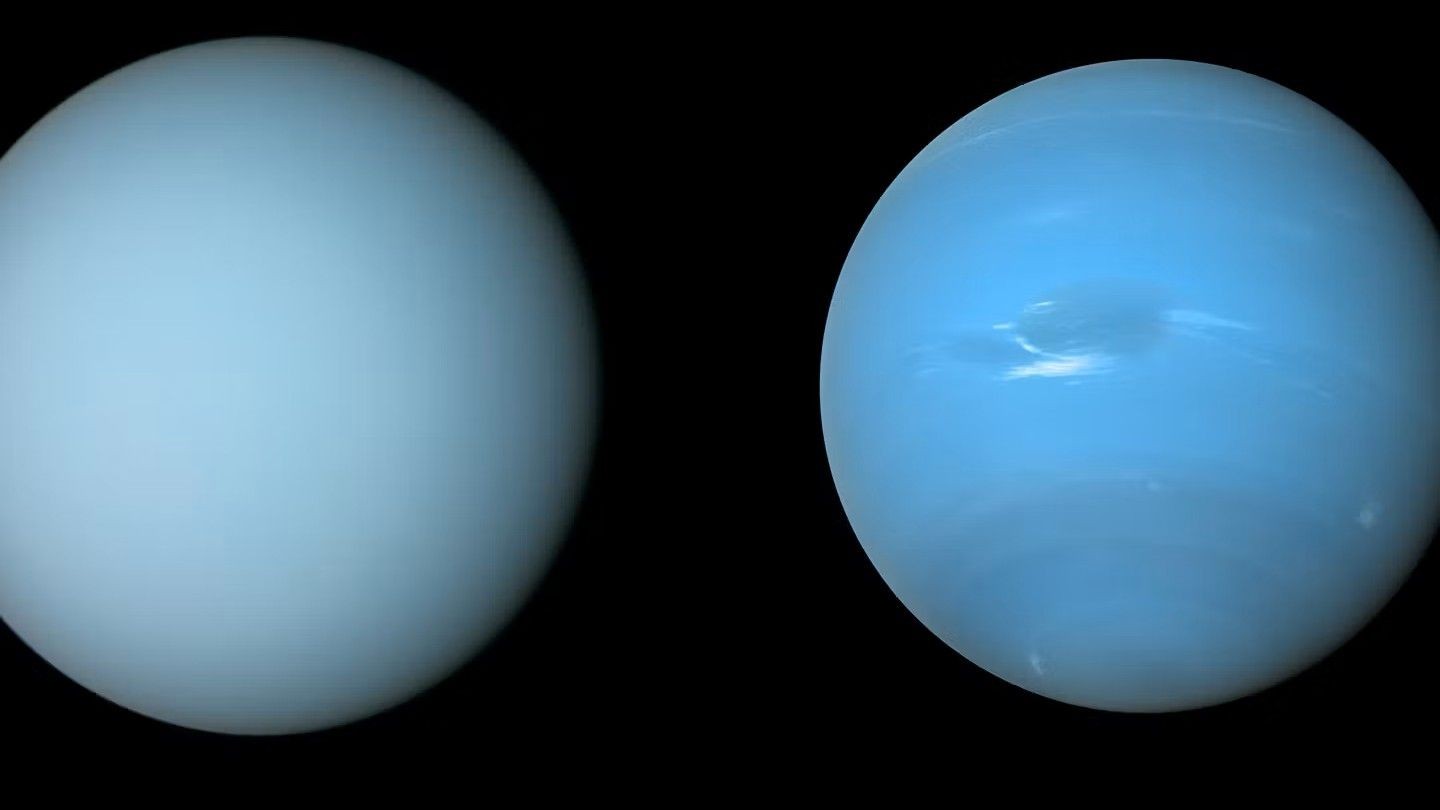
For decades, astronomers have categorized Uranus and Neptune as “ice giants,” distinct from the gas giants Jupiter and Saturn due to their higher proportion of volatile elements like water, ammonia, and methane. However, a new study challenges this long-held classification, suggesting that these distant planets may be significantly rockier than previously thought.
Research led by Yamila Miguel of the Netherlands Institute for Space Research indicates that the outer shells of both planets are composed largely of rock, hydrogen, and helium gas. This finding contradicts the conventional model, which posits that these planets are dominated by icy mantles surrounding rocky cores.
The Case for Rocky Atmospheres
The traditional understanding of Uranus and Neptune describes them as having inner rocky cores surrounded by icy mantles, all enveloped in thick atmospheres of hydrogen, helium, and methane. In high-pressure zones, these gases transition into fluid states. Yet, the new study proposes that these atmospheres are not just fluid; they are littered with condensed rocky material.
The team arrived at this conclusion by modeling the internal composition of both planets, simulating their envelopes, mantles, and cores. By analyzing temperature conditions throughout the atmospheric envelopes, researchers found that specific areas possess the right conditions for silicate clouds to condense into solid rock.
“We found out that both Uranus and Neptune have their outer shells made mostly of rocks (and hydrogen and helium gas),” Miguel explained. “This goes against the common belief that they are ice-giant planets.”
Context from the Outer Solar System
The motivation for re-examining these planets stems from recent discoveries in the trans-Neptunian region—the icy expanse beyond Neptune. Previous studies have revealed that objects in this region, including Pluto, comets, and Kuiper Belt bodies, are more rocky than icy.
This trend prompted the researchers to question whether the larger bodies in the same region might share similar compositions. “We thought, if those objects are made mostly of rocks, maybe Uranus and Neptune [are] as well?” Miguel noted. The study suggests that the “ice giant” label may be a misnomer born from limited data on the broader population of outer solar system objects.
Rethinking Planetary Classification
While the planets likely still contain significant ice in their deep interiors, the study asserts that they are “definitely not completely icy as we used to believe.” This discrepancy raises the question of whether current planetary classifications remain accurate.
Miguel suggests that the astronomical community should consider re-classifying these worlds to avoid misleading terminology. Instead of labeling them as “icy” or purely “rocky,” the researcher proposes terms like “minor giants” to better reflect their complex, mixed composition.
Why This Matters
This research does not definitively change the official classification of Uranus and Neptune overnight, but it highlights a significant shift in our understanding of solar system formation. If these planets are indeed rock-dominated in their outer layers, it implies that the building blocks of the outer solar system were richer in silicates than previously assumed.
In conclusion, while Uranus and Neptune remain mysterious, this study suggests they are far rockier than their “ice giant” title implies, prompting a necessary re-evaluation of how we define and categorize the giants of our cosmic neighborhood.