Richard Feynman loved a paradox.
The legendary physicist had no patience for stuffy academia when a silly question was on the table. Can math dictate the optimal lunch order? Can humans track scent trails like a dog by sniffing their own footprints?
Now, decades after his death, a team of researchers has finally settled one of his most famous riddles. They looked at the physics of the “silly” sprinkler.
It’s a simple concept that drove people crazy for years. Take a standard lawn sprinkler. It spins in a circle as it shoots water out. Easy. But flip it around. Hook it to a vacuum. Make it suck water in instead. Which way does it spin?
Does it go backward? Or does it keep spinning forward, defying intuition?
Feynman was a grad student at Princeton in the 1940s when he first toyed with the idea. He rigged up a glass sprinkler in a lab. He turned on the vacuum. It gave a tiny tremor. Then it did nothing. He cranked up the pressure until the glass shattered. The experiment failed to answer the question. It just broke expensive glass.
For decades, nobody could agree on the outcome.
Some tests showed the sprinkler spinning forward. Others showed it spinning backward. Some jittered. Some stayed dead still. It depended entirely on how you built the rig. The ambiguity lingered until 2024.
Testing Feynman and Mach’s theories
That year, a team at New York University, led by physicist Leif Ristroph, took a crack at the problem. They tested the reverse sprinkler using a standard S-shaped nozzle.
They found it spins opposite to a forward-moving sprinkler.
But the study had a flaw. It only used the classic S-shape. It hadn’t tested the two competing theories head-on.
Theory number one traces back to Austrian physicist Ernst Mach. It argues that the total angular momentum of water swirling inside the arms must be balanced. The sprinkler should spin one way to cancel out the water’s spin the other.
Theory number two is linked to Feynman. It focuses on pressure and suction forces right at the nozzle tips. The water hits the end of the tube, creating a recoil.
Ristroph’s team asked a simple question: What if we stop using standard sprinklers?
What if the arms spiraled? What if they bent the wrong way? What if they curled into themselves?
The goal was to break the assumptions of both Mach and Feynman.
The spiral experiment
In a new study published in the Proceedings of the National Academy of Sciences (PNAS), the team built seven bizarre sprinklers. These weren’t your average garden gadgets.
They designed arms with unusual geometries to stress-test the theories.
One sprinkler had arms that spiraled several times. This was designed to maximize the angular momentum of the water, specifically to test Mach’s idea.
If Mach were right, this spiral design should have spun wildly.
It didn’t.
The fluid inside carried substantially more momentum. The solid structure barely moved. The spiral was unyielding.
Another design featured a counter-bend at the nozzle tip. This was meant to test Feynman’s suction theory. If Feynman were correct, reversing the bend should have flipped the direction of the spin.
That didn’t happen either.
“We were forced to say, ‘Feynham and followers, you guys are off,'” Ristroph told Live Science.
The hub is where it happens
Both theories were dismantled. The reverse sprinkler is neither a simple Mach balance nor a Feynman recoil.
The evidence points elsewhere.
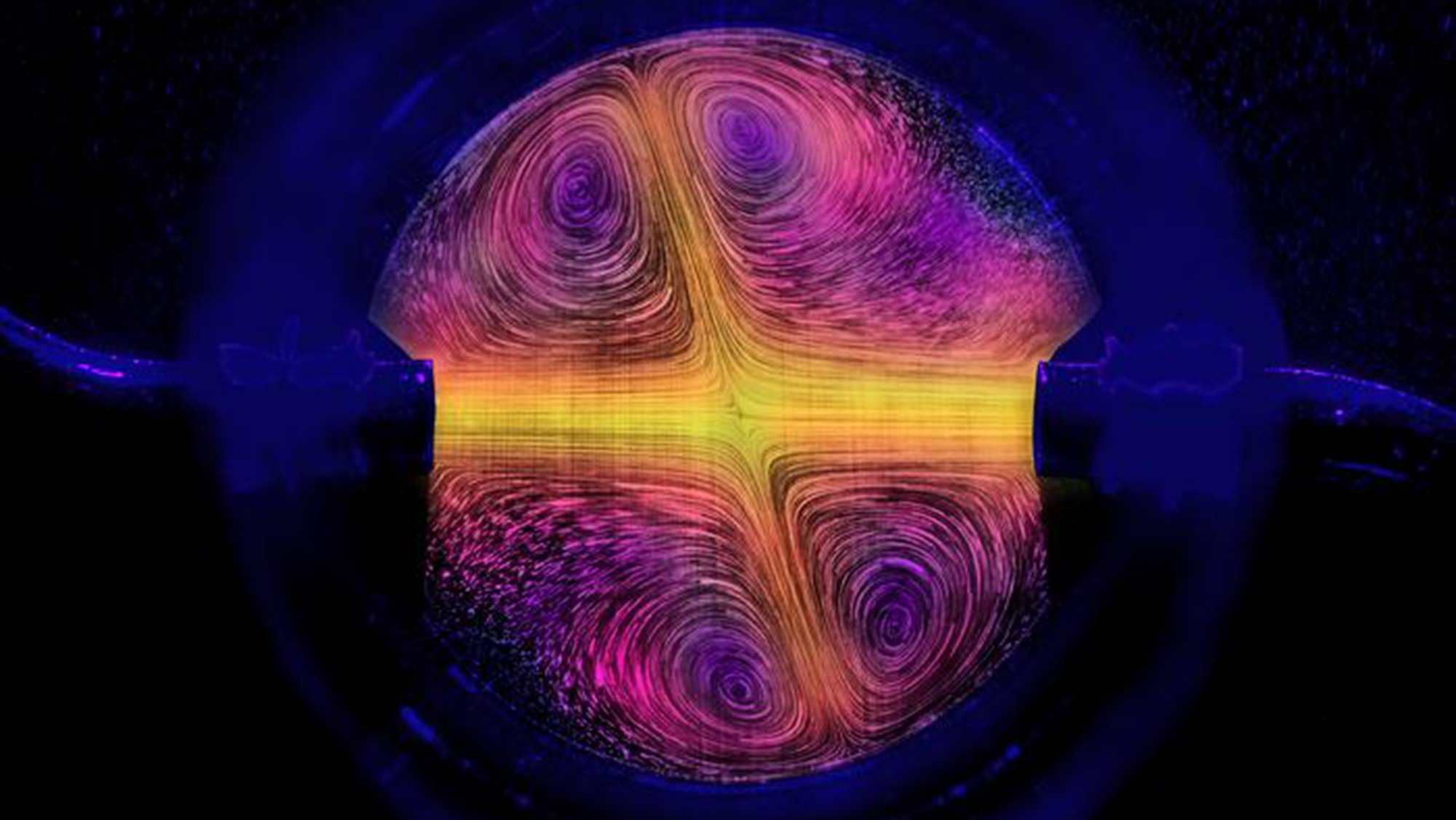
All three measurements across the seven different designs pointed to the central hub. This is where the arms meet the core. Here, incoming water collides and swirly. It generates a flux of angular momentum inside the device.
The solid structure of the sprinkler pushes back against this internal flux.
This suggests the reverse sprinkler is just an inside-out version of the forward version. It’s governed by the same physics. The forces are just playing out at opposite ends of the arms.
It turns out the answer was hiding in plain sight all along. The details matter less than the central interaction.
Why this matters for energy
This wasn’t just an academic exercise in frustration. The work required real skill.
Ristroph credited Jesse Smith, a NYU physics PhD candidate, along with a small group of students. They also worked with Brennan Sprinkle, a computational fluid dynamics experts from the Colorado School of Mines. (The last names coincided. That was just bad luck for introductions.)
Now, the team is moving to computer simulations. They want to see if the momentum-flux model holds up under different flow conditions. They hope to derive the behavior directly from fundamental fluid dynamics equations eventually.
But the real world has applications here.
Understanding how curved channels convert fluid flow into rotation isn’t just theory. It helps engineers design better turbines. It helps devices that harvest energy from wind or water currents.
“If we can do something that would help with engineering… better make use of all the huge amount of wind and water energy we have around us,” Ristroph said, “that would be a fantastic thing.”
So the silly sprinkler taught us something serious.
But does it tell you what to have for lunch?