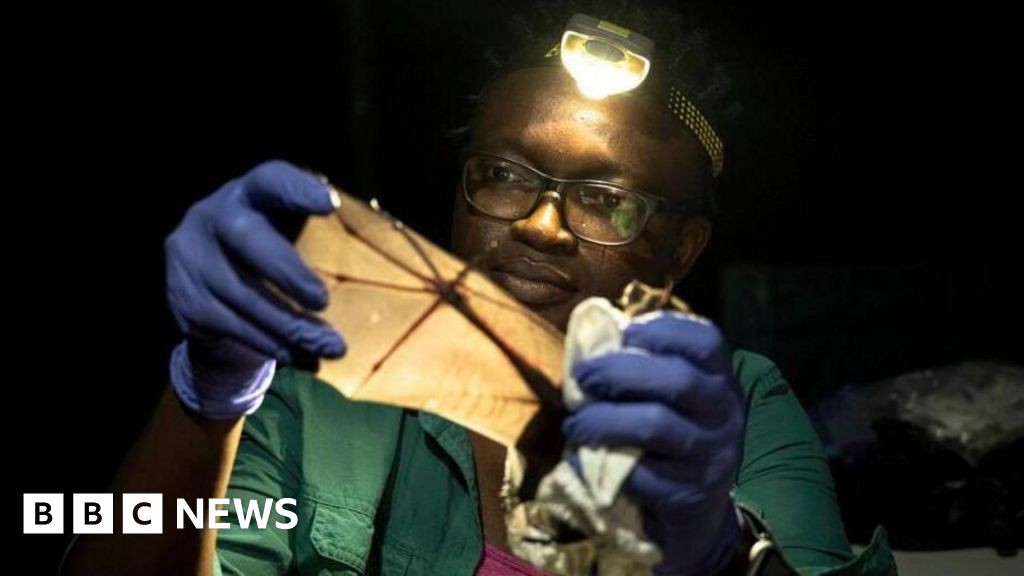
Nigerian ecologist Iroro Tanshi has been awarded the prestigious Goldman Environmental Prize, a global recognition of her efforts to protect the endangered short-tailed roundleaf bat and the ecosystems they inhabit. Her success lies not just in scientific discovery, but in her ability to turn a local environmental crisis into a community-driven conservation movement.
A Discovery Amidst the Smoke
The catalyst for Tanshi’s campaign was both a scientific breakthrough and a near-catastrophe. While working in the Afi Mountain Wildlife Sanctuary in southeastern Nigeria, Tanshi identified a population of short-tailed roundleaf bats—a species that had not been seen in the region for nearly 50 years.
However, this discovery was immediately threatened by human-induced wildfires. Tanshi noted that a fire, likely started by a farmer attempting to clear land, raged for three weeks, unchecked by rain or intervention. This event highlighted a critical tension: the very activities used to sustain local livelihoods were destroying the habitats of rare species.
Bridging the Gap: Science vs. Superstition
In many parts of Nigeria, bats are not viewed as vital ecological actors; instead, they are often stigmatized and associated with witchcraft. This cultural perception creates a significant barrier to conservation, as protecting a “hated” species is a difficult sell for local communities.
Tanshi overcame this by finding a “hook” that aligned ecological needs with human interests. She realized that the fight to save bats was inextricably linked to the fight to prevent wildfires that threaten both wildlife and human farmland. By addressing the wildfire problem, she gained the community’s trust.
To further shift local perspectives, her team has implemented several strategies:
– Community Fire Brigades: Actively preventing major wildfires in and around the 24,700-acre sanctuary.
– Targeted Education: Using various media platforms to reach different demographics, with a specific focus on educating children to foster long-term change.
– Demonstrating Economic Value: Explaining the “hidden” benefits of bats, such as their role in pollinating plants and dispersing seeds for trees used in shea butter production—a valuable commodity in both local and global cosmetic markets.
The Global Impact of Local Action
Tanshi’s work demonstrates a vital principle in modern conservation: ecological health is tied to economic stability. By proving that bats are essential for the survival of crops and trees that provide income, she transformed them from feared omens into recognized ecological assets.
Between 2022 and May 2025, her community-led initiatives successfully prevented major wildfires from devastating the Afi Mountain Wildlife Sanctuary, proving that local engagement is often more effective than top-down regulation.
“It’s really the question of: ‘How do we convince people to protect the habitat?’ In our case, it was because the wildfire problem was also a community problem — that was the hook.”
Conclusion
By linking the survival of an endangered species to the protection of local livelihoods, Iroro Tanshi has created a sustainable model for conservation that overcomes deep-seated cultural stigmas. Her work proves that environmental protection is most successful when it solves real-world problems for the people living on the front lines.