Imagine having wings. Not just wearing a cape or riding a jetpack, but owning appendages that defy gravity. In X-Men, Warren Worthington sprouts feathers and shoots into the sky. Real life? Still grounded. Virtual reality is blurring that line, though.
Yanchao Bi at Peking University has always wanted to fly. It would change your entire perspective. Her whole world would tilt.
Over coffee in spring 2023 she told Kunlin Wei about this dream. Wei runs the motor-control lab at the university. He studies how people perceive movement through VR. Two questions popped up immediately. Could humans learn to fly with wings inside a simulation? And if so how would their brains rewire?
They teamed up with neuroscientist Yiying Cai to find out. They took 25 people through a VR flight course. The results appeared in May’s issue of Cell Reports.
After training those brains treated fake wings like real limbs. Almost literally.
Jane Aspell didn’t do the study. She works at Anglia Ruskin University. She finds the adaptability wild. “The brain can adjust to something as unhuman as a wing” she notes. It hints at broader possibilities. The mind might bend to any artificial limb we can imagine.
Learning to wing it
Cai designed the training. It lasted a week. The mechanics mirrored bird flight.
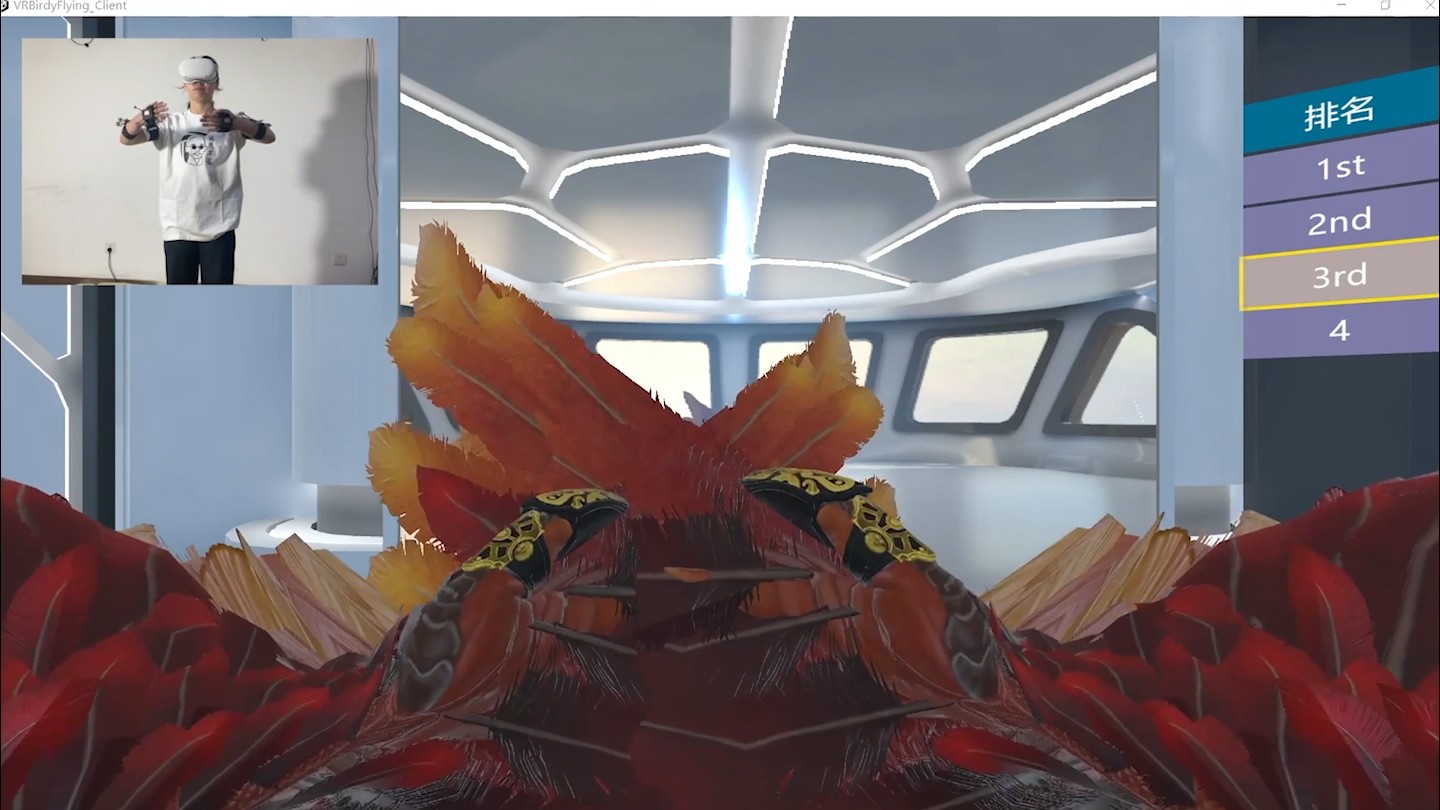
Participants wore headsets. They wore motion trackers. They looked into a virtual mirror. Inside that mirror they weren’t human. They were bird-creatures with huge rust-colored wings. Flapped an arm? The wing followed. Twisted a wrist? The feathers adjusted.
The tasks were tricky. Dodging falling airballs. Hovering over cliffs without falling. Steering through floating rings.
Some got it immediately. Others took sessions to master the coordination. You could watch the progress in real-time.
Bi’s team scanned the visual cortex. This part of the brain handles limb recognition. After the week-long regimen certain regions fired stronger when showing pictures of wings. The neural pattern shifted. The response to wings started looking like the response to arms.
“Participants began to see the wings as a part of their own body.”
This isn’t just theory. The brain accepted new geometry. It changed what was considered “self.”
This goes beyond reshaping neurons. It transforms the feeling of flight itself. Abstract knowledge doesn’t do this. Experiencing it does.
Wei thinks this matters for future tech. Maybe for artificial senses too. Our experience of “reality” might fragment into dozens of different variations.
“We may spend a great deal of in time VR in the future,” he says. “What that means for the human brain is very interesting to us.”