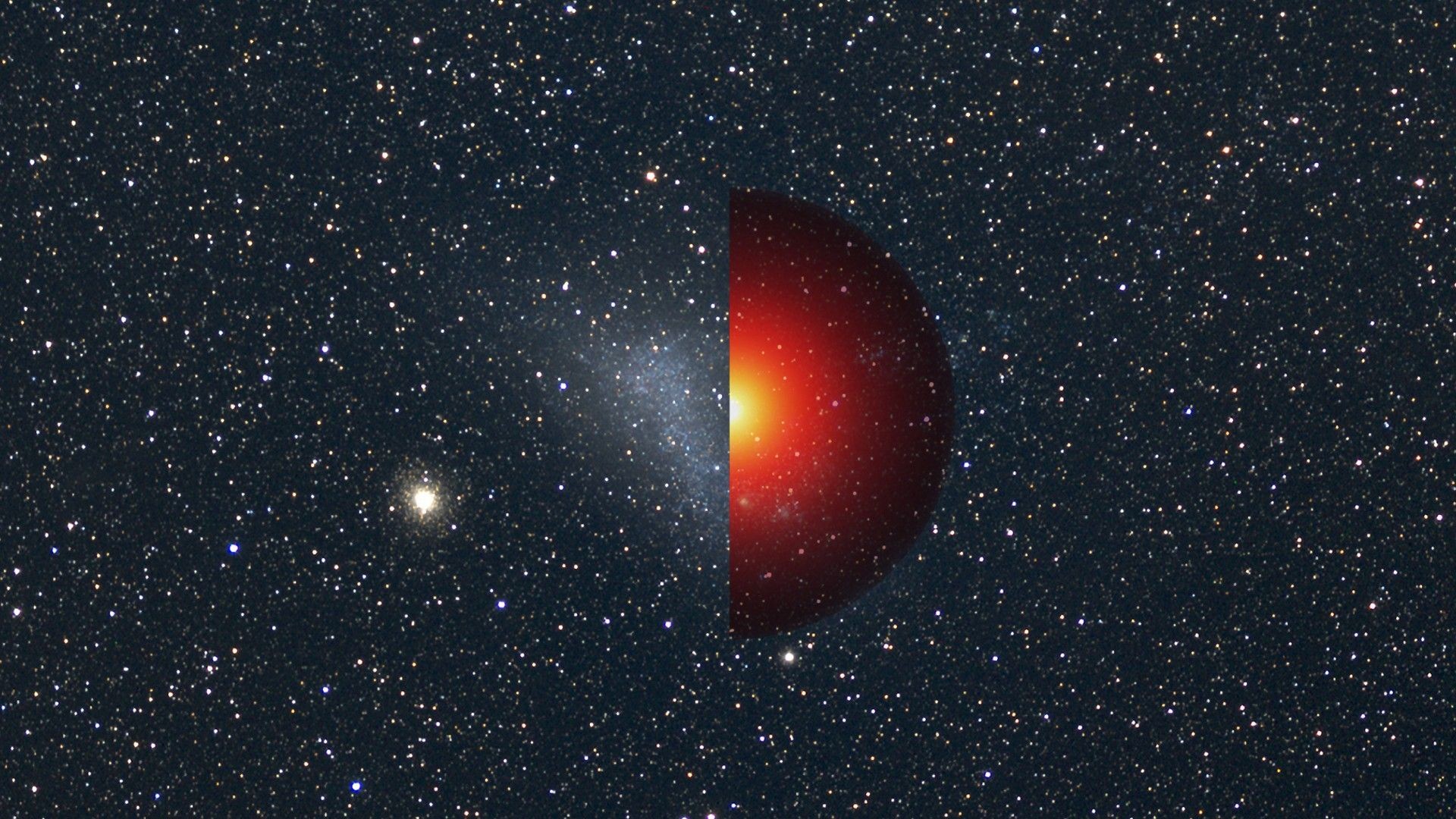
Cosmology is broken. Not catastrophically, but enough to keep the sleepless nights going for theorists. We have Lambda-CDM, the standard model that handles almost every observation we throw at the cosmos. The cosmic microwave background? Check. Galaxy distribution? Check. It’s the heavyweight champion. The problem is that capital L.
Lambda stands for the cosmological constant. Einstein’s placeholder for empty space energy. It explains why the universe’s expansion is accelerating. We just have no idea why it has the value it does.
Quantum field theory predicts a number roughly 122 orders of magnitudes larger. It’s arguably the worst prediction in the history of physics. To make matters worse, the Hubble tension lingers. Local measurements of the expansion rate don’t match the early-universe ones. Neither issue has disappeared. They’re stubborn.
Enter Savvas Koushiappas. A theoretical physicist at Brown University who just posted a new paper to arXiv with a strange idea.
Maybe the universe has its own uncertainty principle.
Here’s the pitch. The size of the universe and its expansion rate cannot both be specified with perfect precision. Heisenberg knew this about particles. Koushiappas says it applies to the cosmos, too. That fundamental fuzziness might explain dark energy. Without adding any new particles. Without invoking mysterious vacuum energy fields. Just the math.
He treats the scale factor—basically the size of space—as a quantum operator. It doesn’t quite commute with the expansion rate. In quantum mechanics, that non-commutation creates the uncertainty between position and momentum. Apply it here, and the Friedmann equation changes.
The modification is subtle. One free exponent dictates everything. If that exponent is positive? Late-time accelerated expansion emerges naturally. No dark energy needed. The geometry itself causes the push. The universe expands because it’s fuzzy.
And it gets weirder. The equation isn’t perfectly constant. It predicts the dark-energy equation of state should be slightly greater than -1. Not exactly -1 like Einstein’s original constant.
Sound familiar? Current surveys like DESI are already hinting at deviations. Next-gen telescopes could confirm this or rule it out completely.
Flip the sign? The story changes entirely. The math smooths out the early universe. The Big Bang singularity disappears. No infinite density at t=0. Instead, a “classical bounce.” The cosmos contracts, hits a minimum size, then bounces back into expansion.
Is this reality? Probably not yet.
This is a single-author theoretical proposal. The math does a lot of heavy lifting. It assumes a spatially flat universe which matches current data. But it also demands the expansion rate be a well-behaved operator.
Will the data bend? Or will the universe insist on the simple, boring value of -1? We don’t know yet. We’ll have to wait and see. 🌌