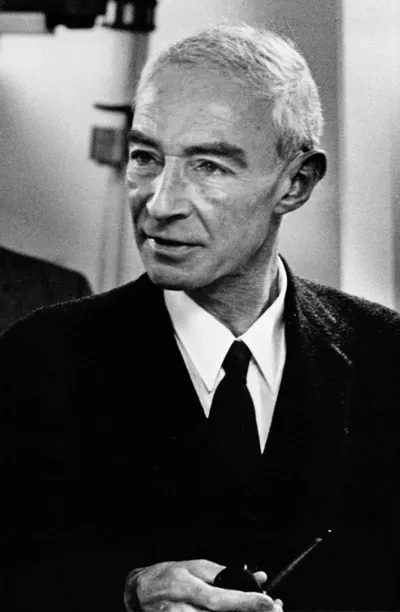
He was born on April 22, 1904. In New York City. The world was on the brink of modernity. Few could have guessed that a boy growing up in an apartment would become the architect of the atomic age. J. Robert Oppenheimer wasn’t just a physicist. He was a force.
He studied at Harvard. Then he moved to Europe. He studied under some of the greatest minds in theoretical physics. Cambridge. Göttingen. He came back to the U.S. ready to lead. Not just in theory. In action.
The Director of Los Alamos
By 1943. The war was raging. The U.S. needed a weapon. Any weapon. Oppenheimer was appointed director of the Los Alamos Laboratory. It was a secret project. Hidden in the mountains of New Mexico. The goal was simple. Build an atomic bomb before the Nazis did.
It was not simple. It was nearly impossible. He managed hundreds of scientists. Engineers. Mathematicians. All working under immense pressure. He kept them focused. He kept them creative. He created an atmosphere of intense intellectual competition. It worked. The bomb was built. The Trinity test occurred. The world changed forever.
The Fall from Grace
Victory came. But Oppenheimer did not celebrate. He feared the consequences. He spoke out against nuclear proliferation. He argued for international control. This made enemies. Powerful ones.
In 1954. A hearing took place. It was televised. It was brutal. Accusations of disloyalty flew. He was questioned about his past. His associations. His views. The atmosphere was toxic. McCarthyism was in full swing.
He lost his security clearance. He lost his position as an adviser to the government. He was effectively blacklisted. The case became a cause célèbre. It highlighted the political and moral issues surrounding the role of scientists in government. Did he have a duty to speak out? Or a duty to stay silent? The debate continues.
The Institute for Advanced Study
He did not retire. He moved to Princeton. He became director of the Institute for Advanced Study in 1947. He held this position until his death. He tried to rebuild his reputation. He tried to make sense of the power he had unleashed.
He died on February 18, 1967. In Princeton. At the age of 62. Throat cancer. The irony is not lost on historians. The man who played god with atoms was taken by a disease. A natural one.
His legacy is complex. He is remembered as the father of the atomic bomb. And as a man who regretted it. The tension between these two identities defines his story.
J. Robert Oppenheimer’s roots were as eclectic as his intellect. His father, a wealthy German immigrant, had built a fortune importing textiles to New York City. But J. Robert was destined for a different kind of currency. At Harvard, he didn’t just attend classes; he immersed himself. He mastered Latin and Greek, dove into physics and chemistry, published poetry, and studied Eastern philosophy. It was a heady mix of the classical and the spiritual that defined his undergraduate years.
By 1925, he had graduated and set his sights on England. He sailed for Cambridge University to conduct research at the Cavendish Laboratory. Under Lord Ernest Rutherford, this place was the epicenter of atomic research. Oppenheimer didn’t just observe; he collaborated with the British scientific community, helping to push the boundaries of what was known about atomic structure.
From Göttingen to Berkeley: A Rapid Rise
The trajectory of his early career shifted quickly. Max Born, a prominent physicist, invited Oppenheimer to the University of Göttingen. There, the intellectual currents were intense. He rubbed shoulders with giants like Niels Bohr and P.A.M. Dirac. It was at Göttingen, in 1927, that he earned his doctorate.
He didn’t stay put long. After brief stints at science centers in Leiden and Zürich, Oppenheimer returned to the United States. He took positions teaching physics at the University of California, Berkeley, and the California Institute of Technology. These weren’t just teaching gigs. They were launchpads.
The 1920s were a decade of upheaval in physics. Quantum mechanics and relativity were challenging everything scientists thought they knew. The idea that mass could be converted into energy—that matter could behave like both a wave and a particle—was revolutionary. The implications were barely understood, but Oppenheimer saw the potential.
His early research focused on the energy processes of subatomic particles. Electrons. Positrons. Cosmic rays. He also did groundbreaking work on neutron stars and black holes, topics that seemed almost theoretical at the time but were critical to understanding the universe’s structure. Because quantum theory was so new, Berkeley offered him the rare chance to define its significance rather than just repeat it.
He didn’t stop at research. He trained a generation of American physicists. His students learned from his leadership, his independence, and his willingness to question established norms.
Political Awakening and Personal Life
While the physics was intense, Oppenheimer’s political consciousness was also awakening. The rise of Adolf Hitler in Germany forced him to engage with the world outside the lab. In 1936, during the Spanish Civil War, he sided with the republic. It was there he met communist students, an experience that would haunt and shape his later views.
His father’s death in 1937 changed his financial reality. Oppenheimer inherited a fortune. He used this wealth to subsidize anti-fascist organizations. But he wasn’t blind to the flaws in the Soviet Union. The tragic suffering inflicted on Russian scientists by Joseph Stalin led him to distance himself from communist groups. He never actually joined the Communist Party, but the experience reinforced his belief in liberal democratic values.
Personal life complicated the political landscape. In 1939, Oppenheimer began an affair with Katharine Puening, a graduate student in botany at UCLA. She divorced her husband and married Oppenheimer in 1940. It was a union that would eventually become a liability in the years to come, but for now, it was simply part of his life as he stood on the brink of something much larger.
The Manhattan Project Begins
Why did a poet-physicist from Berkeley become the face of the atomic bomb? The answer lies in the unique convergence of his scientific genius and his political urgency. The European situation had deteriorated to the point of no return. Nazi Germany was racing for nuclear capability. The United States needed to catch up.
Oppenheimer’s ability to synthesize complex ideas and his network of brilliant young physicists made him the ideal candidate to lead this effort. It wasn’t just about the science. It was about the race. And he was ready.
The project that would become the Manhattan Project required more than just raw intellect. It needed coordination. It needed vision. Oppenheimer had both
The warning came before the war even really started in earnest for America. After Germany invaded Poland in 1939, a trio of physicists—Albert Einstein, Leo Szilard, and Eugene Wigner—did something unprecedented. They went straight to the U.S. government. They weren’t asking for funding. They were issuing a threat. If Nazi Germany built a nuclear bomb first, all of humanity was in danger.
The response was urgent. Oppenheimer was tasked with finding a way to separate uranium-235 from natural uranium. He needed to figure out exactly how much uranium was needed to create a critical mass for a bomb. By August 1942, the Army had taken over. The British and American physicists were now under military command. The effort became the Manhattan Project. Oppenheimer’s job was to build and run the lab.
He chose Los Alamos. A plateau near Santa Fe, New Mexico, isolated and perfect for secrecy.
The Security Trap
Something went wrong behind the scenes. The records are murky, but in 1942, Oppenheimer started talking to military security agents. These discussions eventually implicated some of his friends and acquaintances as Soviet agents. One of his personal friends, a faculty member at UC Berkeley, was dismissed as a result.
Years later, during his own security hearing, Oppenheimer looked back at those initial conversations with stark clarity. He didn’t defend them. He called his contribution to those discussions “a tissue of lies.”
Why lie to the people who were supposed to protect the project? The motive remains unclear, but the damage was already taking root.
The Trinity Test and Political Fallout
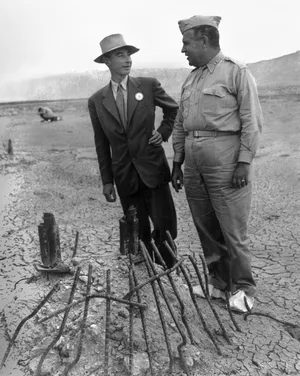
The scientists at Los Alamos had done the impossible. On July 16, 1945, at the Trinity Site near Alamogordo, New Mexico, the first nuclear explosion lit up the desert. This was after Germany had surrendered. The European war was over.
Oppenheimer resigned his post in October of that same year. He didn’t stay in the military orbit for long. By 1947, he was running the Institute for Advanced Study. He also served as chairman of the General Advisory Committee of the Atomic Energy Commission until 1952.
His stance during this period made enemies. In October 1949, his committee opposed the development of the hydrogen bomb. It was a moral stand against a bigger, more destructive weapon.
The 1954 Security Hearing
The backlash was swift and brutal. On December 21, 1953, Oppenheimer received a military security report that was heavily unfavorable. The accusations were stacked against him:
- Associating with communists in the past.
- Delaying the naming of Soviet agents.
- Opposing the hydrogen bomb.
The following year, a security hearing took place. It was a spectacle. The verdict? He was not guilty of treason. But the ruling stripped him of access to military secrets. His contract as an adviser to the Atomic Energy Commission was canceled.
“The Federation of American Scientists immediately came to his defense with a protest against the trial.”
The backlash wasn’t just professional. It was global. Oppenheimer became the symbol of the scientist who tried to grapple with the moral weight of discovery only to become the victim of a political witch hunt.
Legacy and Vindication
He spent his remaining years trying to understand the relationship between science and society. It was a quiet end to a loud life. In 1963, President Lyndon B. Johnson awarded him the Enrico Fermi Award. It was a gesture of respect, but it didn’t restore his clearance.
He retired from the Institute for Advanced Study in 1966. Throat cancer took him in 1967.
The story didn’t end there. For decades, the transcript of the 1954 hearing remained buried. Then, in 2014, sixty years after the proceedings that effectively ended his career, the U.S. Department of Energy declassified and released the full transcript.
The new documents didn’t just reveal secrets. They bolstered Oppenheimer’s claims of loyalty. They reinforced the idea that a brilliant mind had been broken by a mix of bureaucratic jealousy and McCarthy-era paranoia.
In 2022, the vindication became official. The Department of Energy formally vacated the revocation of his security clearance. Energy Secretary Jennifer Granholm stated that bias and unfairness in a flawed process had led to his exile from the nuclear establishment.
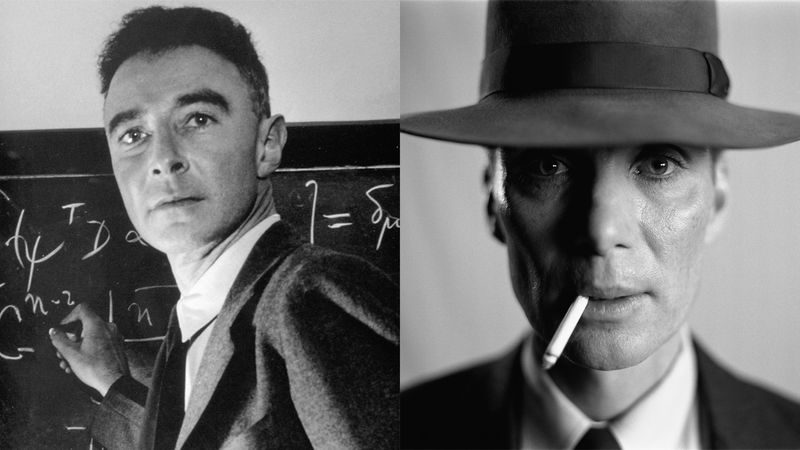
The narrative was cemented again in popular culture. Christopher Nolan’s 2023 film Oppenheimer, starring Cillian Murphy, brought the complex role he played in developing the atomic bomb and the subsequent political persecution back into the public eye.
History has softened on him, but the scars of the 1950s remain a stark reminder of how quickly scientific achievement can turn into political liability.