You have a nucleus. Your cells do too. That makes them eukaryotic. And inside almost all of them lives a busy little organelle that never takes a break. It is called the Golgi apparatus. Or the Golgi complex. Scientists use both names interchangeably. But what does it actually do?
It acts as the post office of the cell.
Proteins and lipids are made elsewhere. Specifically in the endoplasmic reticulum. The ER synthesizes these molecules. Then it ships them off. The Golgi receives them. It processes them. And then it sends them where they need to go. This is the core function of the how the Golgi apparatus processes proteins. Without this system, cells would be dumping raw materials everywhere. Chaos would ensue.
Structure and Location
The Golgi is not a single blob. It is built from stacks. These stacks are called cisternae. They look like flattened sacs. Elongated piles of membranes. The structure is precise.
Its location is strategic. You will find it close to the nucleus. It hovers near the cell membrane. And it sits right next to the rough endoplasmic reticulum. This proximity matters. The rough ER produces vesicles full of newly made proteins. The Golgi sits there waiting. It catches these vesicles. It pulls them in.
The position is crucial, since it receives vesicles from the endoplasmic reticulum to perform its main function.
If the Golgi were far away, the transport would be inefficient. The cell needs speed. It needs precision. The current setup delivers both.
The Three Zones of Processing
Once inside, the cargo does not just sit there. It moves through a pipeline. The Golgi is divided into three distinct zones. Each zone has a specific job.
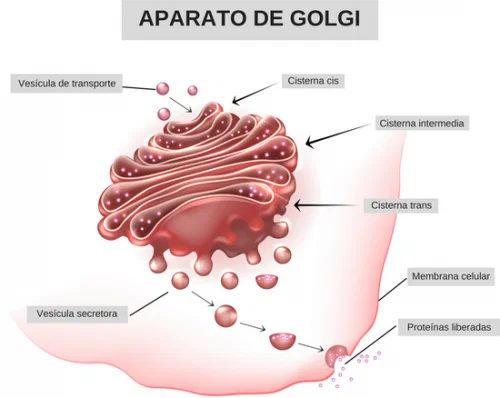
First is the cis cisterna. This is the receiving end. It faces the ER. It accepts the incoming vesicles.
Next comes the intermediate cisternae. The material moves forward. Modifications happen here. Chemical groups are added. Scaffolding is adjusted. The proteins are being prepped.
Finally, the trans cisterna. This is the shipping dock. The modified proteins and lipids are packed into new vesicles. These vesicles bud off. They travel to the cell membrane. Or they go to other organelles. The goal is export. The goal is distribution.
Why does this matter to you? Because your body relies on this machinery every second. Insulin. Enzymes. Antibodies. They all pass through the Golgi. They all get the final touches before they leave the cell.
The process is continuous. Vesicles arrive. Cisternae process. Vesicles depart. It is a logistical marvel built on a microscopic scale. And it happens in billions of your cells right now.

Think of the Golgi apparatus as the sorting facility inside your cells. It doesn’t just sit there. It works.
It is especially active in cells with high secretory demands. Nerve cells need it. Endocrine cells need it. They pump out chemicals constantly. The apparatus modifies, stores, and exports proteins synthesized in the endoplasmic reticulum. Without it, those proteins would just drift aimlessly. Or worse, end up in the wrong place entirely.
The structure exists in both animal and plant organisms. Animal cells tend to have a more complex setup. Plant cells scatter theirs out. But the job is the same.
A Brief History of Discovery
The name comes from Camilo Golgi. He was a biologist and pathologist. He identified the organelle in 1898. He didn’t know exactly what it did back then. He just saw it. He presented it to the scientific community. Now we know it is a central hub for cellular logistics.
How the Golgi Apparatus Processes Proteins
Proteins enter the apparatus. They don’t just float in. They are transported along a series of cisternae. Think of these as flattened sacs.
Enzymes act on the proteins here. They add fragments of carbohydrates or lipids. This creates glycoproteins, glucolipids, and lipoproteins. It is a chemical makeover.
Then comes the packaging phase. The proteins are wrapped in membranes. Two main types of vesicles form:
- Secretory and exocytic vesicles. These carry proteins to the outside of the cell.
- Storage vesicles or lysosomes. These keep proteins in the cytoplasm until they are needed for export to other organelles.
But how does the vesicle know where to go? It uses a process called phosphorylation.
A phosphate group is attached to the protein. It acts as a shipping label. The vesicle reads the label. It heads to the correct destination.
The function of the Golgi apparatus is similar to a post office. It receives, sorts, and distributes correspondence.
There are other jobs too. The apparatus produces lysosomes. These handle cellular digestion and sometimes apoptosis. That is programmed cell death.
In plant cells, it synthesizes polysaccharides for the extracellular matrix. It also regulates DNA repair, mitosis, and cell death. Some vesicles even merge with the plasma membrane. They bring new proteins and lipids to the cell surface.
Structure: The Cisternae Layout
The apparatus is made of stacked cisternae. These are flattened sacs. The number varies by species.
In vertebrate animal cells, the Golgi is grouped in one spot. It is centralized. In plant cells, it is scattered. These small clusters are called dictyosomes.
The cisternae are divided into three zones. Each has a specific role.
The Cis Face
The cis cisterna is closest to the rough endoplasmic reticulum. It receives transition vesicles. These contain the proteins and lipids waiting to be modified.
This region is primarily a receiver. It is the intake dock.
Intermediate Cisternae
These sit between the cis and trans zones. Here, the real work begins.
Proteins and lipids start packaging. They get labeled. Glycosylation happens here. Carbohydrates are added. Phosphorylation also occurs. Phosphate groups are attached.
Other processes take place too. Lysosome synthesis starts here. So does polysaccharide synthesis.
The Trans Face
The trans cisterna is closest to the plasma membrane. This is where vesicles exit.
Before proteins leave the apparatus, final packaging and labeling happen. Every protein must have the correct phosphate group or marker.
Without these labels, the vesicles cannot navigate. They would be lost in the cytoplasm. The Golgi ensures precision. It sends things exactly where they are needed.
The system relies on this accuracy. A misplaced protein can cause dysfunction. A missing label can lead to disease. The Golgi apparatus does not tolerate errors well. It sorts with a precision that rivals any human logistics network.
Yet, we still have much to learn about how some of these pathways are regulated. The machinery is complex. And it is always working.