


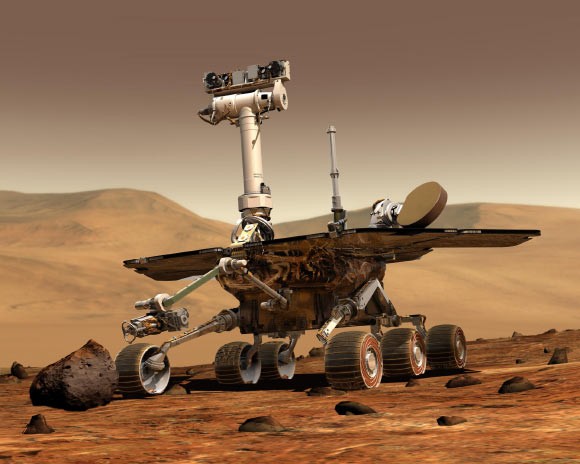
The dust of Gusev crater holds secrets. For over twenty years, scientists have been staring at archival data from NASA’s Spirit rover, looking for proof that the Red Planet was once wet. They found clues. They just missed them in real time.
A new study suggests the Martian soil contains more water-altered minerals than anyone realized. Iron-bearing phases like hematite and altered magnetite were there all along. They were just too faint for the instruments to pick up against the noise.
Professor Paulo de Souza at Edith Cowan University didn’t just re-read the data. He rebuilt it.
How Hidden Hematite Changes Our View of Mars
The key lay in MIMOS II, a miniaturized Mössbauer spectrograph carried by Spirit. It measures how iron atoms absorb gamma rays to identify minerals. It’s sensitive stuff. But the rover was resource-strapped.
Limited power. Limited memory. Limited time.
Each measurement was brief. The resulting spectra had poor statistics. Minor iron phases, those that make up only a fraction of a soil sample, got lost in the noise. Scientists couldn’t see them then.
So Professor de Souza did something clever. He took readings from 32 undisturbed targets at Gusev crater. These were collected over 2,062 sols (Martian days). The temperatures ranged from 180 to 3 K.
Temperature swings of about 10 Kelvin don’t distort basaltic spectra enough to matter. So he merged the data within those windows. Then he combined all the temperature ranges into one master dataset.
The consolidated spectrum pointed to the presence of common Mars soil minerals such as olivine and
pyroxene, along with a
poorly crystalline, paramagnetic
iron-bearing phase.
The result? Roughly six days worth of measurement time packed into a single picture.
Why This Matters for Past Habitability
The consolidated spectrum told a richer story. It confirmed the expected basaltic ingredients: olivine, pyroxene, and that poorly crystalline iron phase. But it also revealed something clearer.
Signatures of magnetite. Crystalline hematite.
These are the things you can’t easily miss if you look long enough. Hematite, specifically, often forms in water.
“One of the most important discoveries was
finding crystalline hematite
in ordinary Martian
soil,” Professor de
Souza said.
“This mineral’s widespread presence
suggests not only
that water
was present, but
that significant
areas
of
Mars
may have once
been
covered
by
water.”
This isn’t just about confirming wetness. We already knew that. It’s about scale. If hematite is widespread in ordinary soil, water didn’t just trickle through in isolated events. It may have covered significant areas. Perhaps even stood in bodies of water.
The limitations of the original mission become the strength of the reanalysis. By aggregating what was once considered “noisy” or “insignificant” due to low count rates, the signal emerges. The planet’s history becomes less ambiguous.
Spirit touched down in 2004. It explored until it stopped in 2010. The data sat in archives, shared between instruments and time constraints. Now, with enough computational patience and statistical merging, it speaks louder.
The journal Interactions published the findings. P. de Souza. 2016. A consolidated Mössbauer
spectrum for undisturbed soils
from Gusev
Crater,
Mars.
The Red Planet was wet. Maybe not everywhere. Maybe not all the time. But certainly enough to leave these iron fingerprints in the dust.
Does more data from Spirit wait in the dark? Or are the next clues in the dust storms that buried it?


