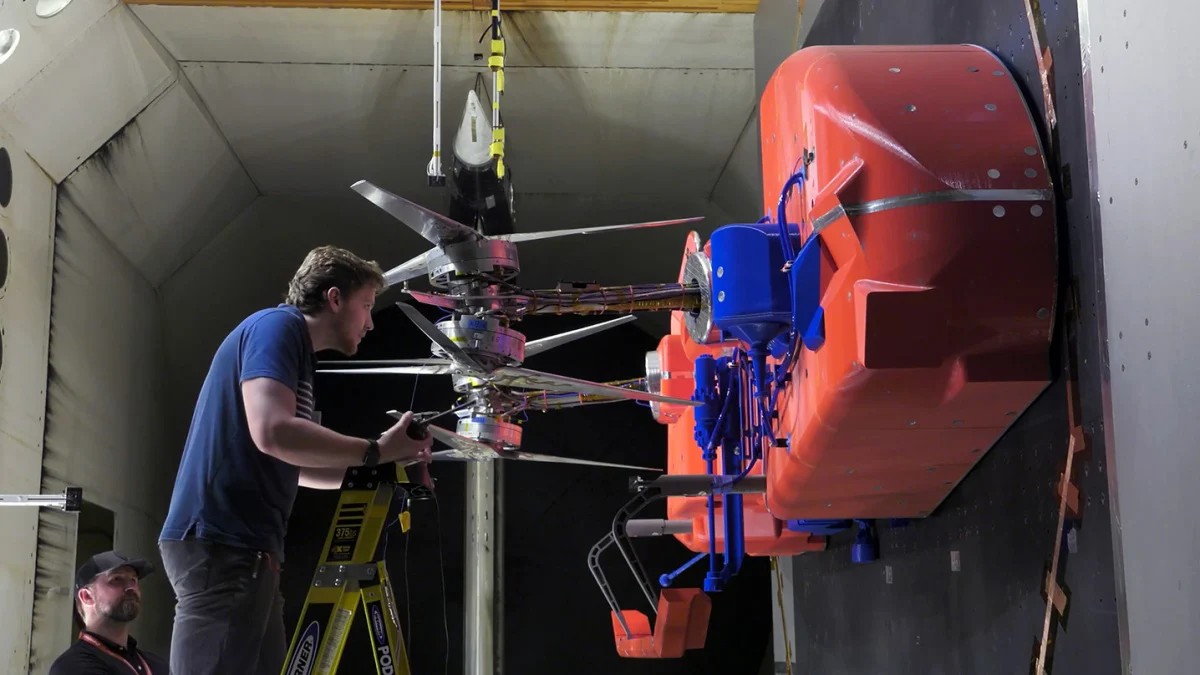
NASA is fundamentally changing how we explore distant worlds. For the Dragonfly mission, scheduled to launch as early as 2028, the agency has abandoned the traditional rover design in favor of an eight-rotor helicopter. This shift isn’t just a change in aesthetics; it is a strategic necessity driven by the unique and extreme environment of Titan, Saturn’s largest moon.
As assembly begins on the spacecraft’s honeycomb body and engineers finalize parachute drop tests, the mission represents a bold leap in planetary exploration. By trading wheels for blades, NASA aims to cover vast distances on a world where traditional ground vehicles would be hopelessly slow.
The Physics of Flying on Titan
The decision to build a flying robot rather than a wheeled rover stems from Titan’s unusual atmospheric conditions. Located approximately 886 million miles from Earth, Titan is the only moon in our solar system with a substantial atmosphere. However, unlike the thin air of Mars, Titan’s air is incredibly dense—about 1.5 times the pressure at Earth’s sea level and roughly three times as dense.
This density, combined with Titan’s low gravity (just one-seventh of Earth’s), creates a perfect storm for aviation. In such an environment, lift is generated with minimal effort. As Charles Malespin, who leads the team building the sample analysis hardware, noted, the thick atmosphere makes flying remarkably easy.
“That’s why an octocopter is primed for that, because you could fly very easily through it. We could cover a huge amount of terrain and explore a much larger area.”
This contrasts sharply with NASA’s previous drone efforts on Mars. The Ingenuity helicopter, which ended its mission two years ago, struggled against an atmosphere 100 times thinner than Earth’s. To achieve lift, Ingenuity required ultra-lightweight construction and long blades, leaving almost no room for scientific instruments. On Titan, engineers can exploit the dense air to build a robust, SUV-sized vehicle packed with heavy scientific tools.
A Mobile Chemistry Lab
Dragonfly is not just a transporter; it is a sophisticated laboratory on the move. The $3.35 billion mission carries a compact chemistry suite designed to drill into Titan’s rock-hard ice and analyze the samples on-site.
The onboard lab features:
* A carousel of 40 sample cups to store diverse materials.
* Tiny ovens to heat samples for analysis.
* A laser system to study organic molecules.
This setup allows Dragonfly to perform complex chemical analyses at multiple locations before lifting off to the next site. This mobility is crucial. While Mars rovers like Curiosity and Perseverance cover only about half a football field per day, Dragonfly is designed to traverse miles, accessing diverse geological features that a wheeled vehicle could never reach in a single mission lifetime.
Searching for the Building Blocks of Life
The primary scientific goal of Dragonfly is to study prebiotic chemistry —the chemical processes that may lead to the emergence of life. Titan acts as a frozen time capsule for early Earth. Its methane-rich atmosphere constantly produces complex organic molecules that settle on the surface, creating dunes and deposits of carbon-based material.
On Earth, geological activity and biological processes have erased much of the evidence from our planet’s early history. Titan, however, remains cold and static, preserving these ancient chemical reactions. Scientists hope Dragonfly will reveal how simple ingredients evolve into more complex molecules, potentially identifying familiar building blocks of life such as:
* Amino acids
* Nucleobases
* Fatty acids
One key target is an ancient crater where water and organics may have mixed. Melissa Trainer, the lead for the DraMS mass spectrometer instrument, highlights the potential of this environment:
“There was a melt pool that may have lasted up to about 1,000 years. That is a lot of time for chemistry to happen between the organics that are depositing in it and the water. Who knows what we could make in a 1,000-year chemistry experiment?”
Why the Sands, Not the Seas?
While Titan features liquid methane and ethane lakes near its north pole, Dragonfly will not visit them. Instead, the mission focuses on equatorial dune fields. This choice is deliberate. Many of the complex organic materials scientists seek do not dissolve well in liquids. By analyzing the “organic sand” particles in the dunes, researchers believe they can access a richer record of chemical evolution than they would by sampling the lakes.
“We want to go to the sand,” said deputy project scientist Shannon MacKenzie. “Those organic sand particles are probably the end result of a lot more of that chemistry than what we would be able to slurp up out of the lakes.”
The Long Road Ahead
The Dragonfly mission is a test of patience as much as engineering. The journey to Titan alone will take nearly seven years, followed by three years of active exploration. During this time, the team will wait for data that could fundamentally reshape our understanding of how life begins.
By leveraging Titan’s unique atmosphere to fly rather than drive, NASA is maximizing the scientific return of its investment. Dragonfly promises to deliver a comprehensive survey of prebiotic chemistry across a landscape that has remained unchanged for billions of years, offering clues to the origins of life that are no longer available on Earth.