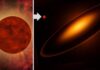
Astronomers have observed a stunning, naturally formed heart shape in space, ejected by a dying star approximately 300 light-years from Earth. The phenomenon, captured by the European Southern Observatory’s (ESO) Very Large Telescope (VLT) and the Atacama Large Millimeter/submillimeter Array (ALMA), showcases a red giant star, Mira A, shedding its outer layers in an unexpectedly symmetrical and massive burst.
Unexpected Symmetry in Stellar Death
Mira A, nearing the end of its life cycle, is in the red giant phase—a stage where stars expand and lose mass as they prepare to become white dwarfs. While mass loss is typical for stars of this type, the scale and precision of Mira A’s ejection surprised researchers. The expelled material, estimated at roughly seven Earth masses, has formed a distinctly heart-shaped cloud of gas and dust.
“We were very surprised to see this structure,” stated Theo Khouri, the lead author of the study from Chalmers University. “We also see that the star’s illumination of the surrounding dust varies in an unexpected way, which implies that the star acts like a lighthouse – illuminating its environment unevenly.”
Dynamics of Stellar Outflow
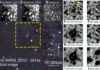
Observations collected between 2015 and 2023 revealed that gas fills the heart’s interior, while dust outlines its edges. The star’s light sweeps across the cloud, causing it to glow as if radiating energy into space. This irregular, powerful ejection challenges current models of stellar mass loss in late-stage stars.
The implications are significant: previous theories underestimated the scale and speed of such events. Stars like Mira A enrich the cosmos with heavy elements formed within their cores, which are essential building blocks for future stars and planets. This discovery provides new insights into how stars die and contribute to the universe’s evolution.
A Cosmic Valentine
The heart-shaped plume is not only visually striking but also dynamically interesting. Astronomers will continue monitoring the expanding cloud, as its growth may eventually affect Mira B, the star’s white dwarf companion, by accumulating the ejected material.
“We will keep monitoring the expanding cloud around Mira A, as it is becoming so large that it may start to affect its companion star, the white dwarf Mira B,” said Khouri. “It is already gathering some of the material ejected by Mira A.”
The discovery serves as a reminder that even in the violent processes of stellar death, the universe can create unexpectedly beautiful and romantic phenomena. The heart-shaped outflow from Mira A underscores the ongoing cycle of stellar evolution and cosmic enrichment.