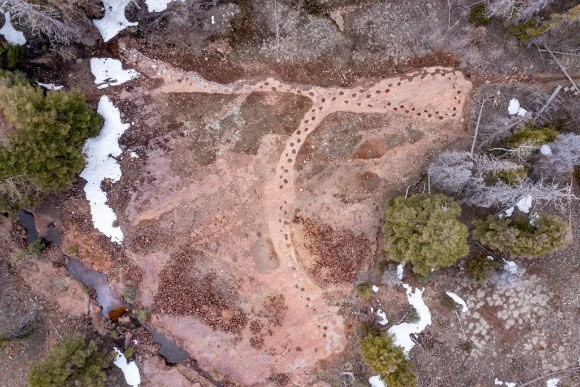
Paleontologists have uncovered compelling evidence that a massive sauropod dinosaur walked with a limp approximately 150 million years ago. The discovery, made at the West Gold Hill Dinosaur Tracksite in Colorado, is based on an exceptionally well-preserved trackway – a nearly complete loop of over 95 meters long. Researchers used advanced drone technology and 3D modeling to analyze the dinosaur’s movements with unprecedented accuracy.
The Unique Trackway
The tracks, left by a long-necked dinosaur like Diplodocus or Camarasaurus during the Late Jurassic period, form a full loop, an unusual occurrence for fossilized footprints. This looping path allowed scientists to study how the massive animal maneuvered a tight turn and then resumed its original direction.
“This trackway is unique because it is a complete loop. While we may never know why this dinosaur curved back on itself, the trackway preserves an extremely rare chance to study how a giant sauropod handled a tight, looping turn before resuming its original direction of travel.” – Dr. Anthony Romilio, University of Queensland.
High-Resolution Analysis
The sheer scale of the trackway presented a challenge. To overcome this, the team employed drones to capture high-resolution images, which were then used to generate a detailed 3D model. This allowed for millimeter-scale analysis of the dinosaur’s gait within the lab.
Evidence of Uneven Gait
The reconstructed model revealed subtle but consistent differences in the dinosaur’s left and right footprints. Variations in step width – from narrow to wide – suggest a natural shift in movement as the animal turned. More significantly, researchers detected a persistent difference in step length of about 10 centimeters (4 inches) between the left and right sides.
This difference could indicate a limp, though it’s also possible the dinosaur simply preferred using one side more than the other. The team emphasizes that short trackway segments with consistent widths may not always reflect an animal’s typical walking style, highlighting the importance of analyzing complete patterns like this one.
Implications for Paleontology
The study demonstrates the power of modern technology in unlocking behavioral insights from ancient fossils. The same method could be applied to other long dinosaur trackways worldwide, revealing previously inaccessible clues about how these giants moved and interacted with their environment.
This discovery isn’t just about one limping dinosaur; it’s about refining our understanding of how paleontologists can extract meaningful data from even the oldest footprints, opening new avenues for behavioral research in paleontology.