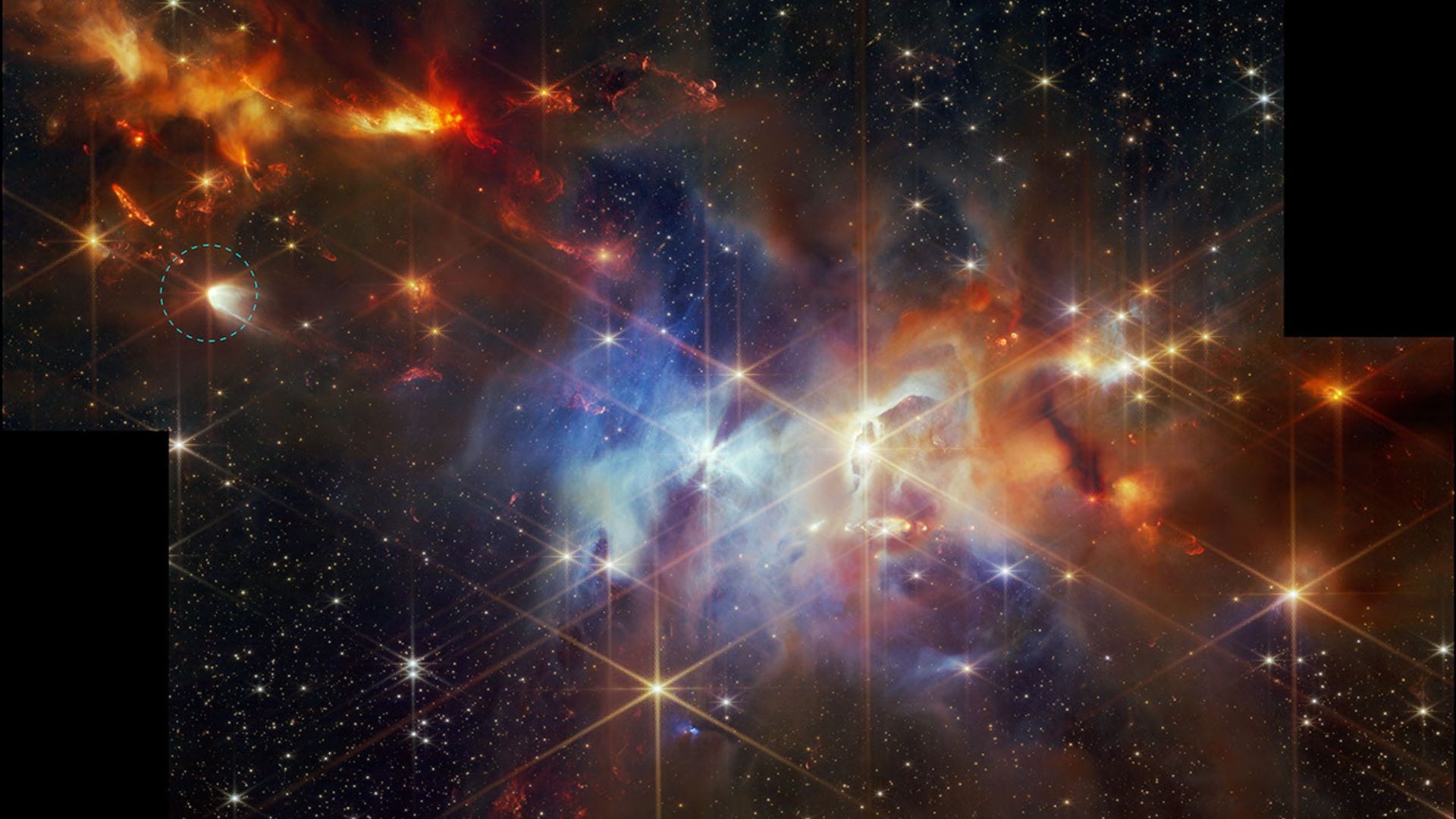
For the first time, astronomers have observed a young star forging microscopic crystals in intense heat and then launching them into the frigid outer reaches of its planetary disk. This discovery, made by NASA’s James Webb Space Telescope, offers a critical link between the origins of crystalline silicates found in comets—including those in our own solar system—and the dynamic processes within star-forming regions.
The Birthplace of Crystals
The protostar, EC 53, is located about 1,300 light-years away and is surrounded by a disk of gas and dust where planets are forming. The Webb telescope’s Mid-Infrared Instrument mapped the creation and movement of crystalline silicates within this disk. Observations revealed that the inner disk, where Earth-like planets would form, is where these crystals originate.
A Cosmic Conveyor Belt
Powerful stellar winds act like a conveyor belt, carrying the newly formed crystals outward. These winds are particularly energetic during bursts that occur approximately every 18 months, lasting for roughly 100 days. During these bursts, EC 53 rapidly pulls in material and then ejects some as jets and winds, forging silicate crystals in the process.
“EC 53’s layered outflows may lift up these newly formed crystalline silicates and transfer them outward, like they’re on a cosmic highway,” explains lead author Jeong‑Eun Lee.
Solving a Long-Standing Mystery
Astronomers have long detected crystalline silicates in comets and other star disks, but the mechanism that transports them from hot inner regions to cold outer ones remained a mystery. Webb’s observations provide the first direct evidence linking crystal formation to outward transport, confirming that these minerals are actively distributed by the star itself.
Implications for Planetary Formation
The study demonstrates that young planetary systems are incredibly dynamic, with stars actively reshaping their environments. By observing protoplanetary disks like EC 53, astronomers can gain deeper insights into the building blocks of planets and comets across the universe. The crystals, each smaller than a grain of sand, are crucial ingredients for icy comets, suggesting that stars play a direct role in seeding these bodies with essential materials.
The findings from the Webb telescope confirm that stars aren’t just passive observers in planetary formation; they are active participants, actively distributing the key components for future comets and planets.