Astronomers have, for the first time, directly observed a massive star collapsing into a black hole without a supernova explosion – a long-hypothesized phenomenon now confirmed through archival data from NASA’s NEOWISE mission and follow-up observations. This discovery challenges previous assumptions about the inevitable explosive death of supergiant stars and provides crucial insights into black hole formation.
The Vanishing Star: M31-2014-DS1
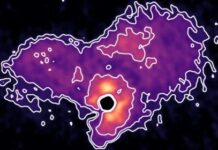
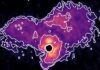
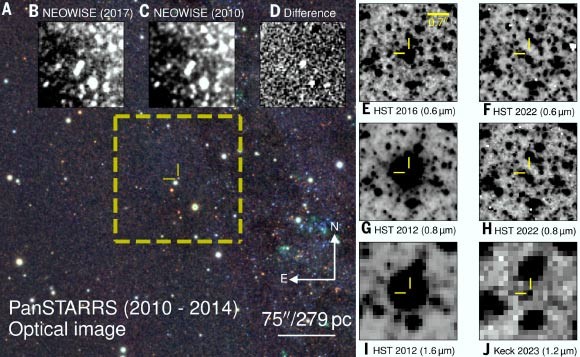
The star, designated M31-2014-DS1, was located in the nearby Andromeda galaxy. Between 2017 and 2022, it underwent a dramatic and sustained dimming, fading by a factor of 10,000 in visible light and 10 times in total emissions. Unlike typical supernovae, which blaze brightly before fading, this star simply disappeared from view. Subsequent observations with the Hubble Space Telescope and ground-based observatories revealed only a faint, red remnant, heavily shrouded in dust – a ghostly echo of its former brilliance.
This is significant because it suggests not all massive stars end their lives in spectacular explosions. Instead, some collapse directly into black holes, a process previously theorized but rarely observed.
Failed Supernovae and the Role of Convection
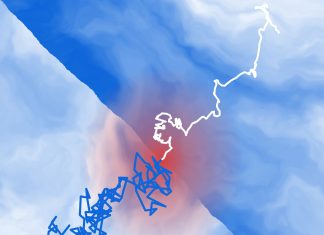
The research team, led by Kishalay De at Columbia University, identified another star, NGC 6946-BH1, exhibiting a similar pattern. This led to a key understanding: the outer layers of the star didn’t fall inward immediately. Instead, convection – the movement of hot and cool gases within the star – played a critical role.
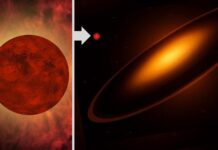
The core collapse didn’t trigger a supernova because the star’s internal convection prevented the outer layers from immediately imploding. The rapidly moving gases formed a rotating disk around the nascent black hole, slowly accreting material over decades rather than months. This process creates observable infrared brightening due to dust formation, which lingers long after the star vanishes.
Implications for Black Hole Formation
This discovery has broader implications for understanding stellar evolution and black hole demographics. The finding suggests that the fate of massive stars isn’t predetermined. Stars with similar masses may either explode as supernovae or collapse directly into black holes, depending on complex internal dynamics involving gravity, gas pressure, and shock waves.
“The dramatic and sustained fading of this star is very unusual, and suggests a supernova failed to occur, leading to the collapse of the star’s core directly into a black hole,” stated Dr. De. The slower accretion rate caused by convective material also means that the resulting black holes may be detectable for longer periods than previously thought.
The findings, published in the journal Science, represent a pivotal step forward in our understanding of how black holes form. By directly observing this process, astronomers can refine their models and better predict the population of stellar-mass black holes in galaxies beyond our own.
The study highlights that the universe is far more nuanced than once believed – even the death of stars can defy expectations.