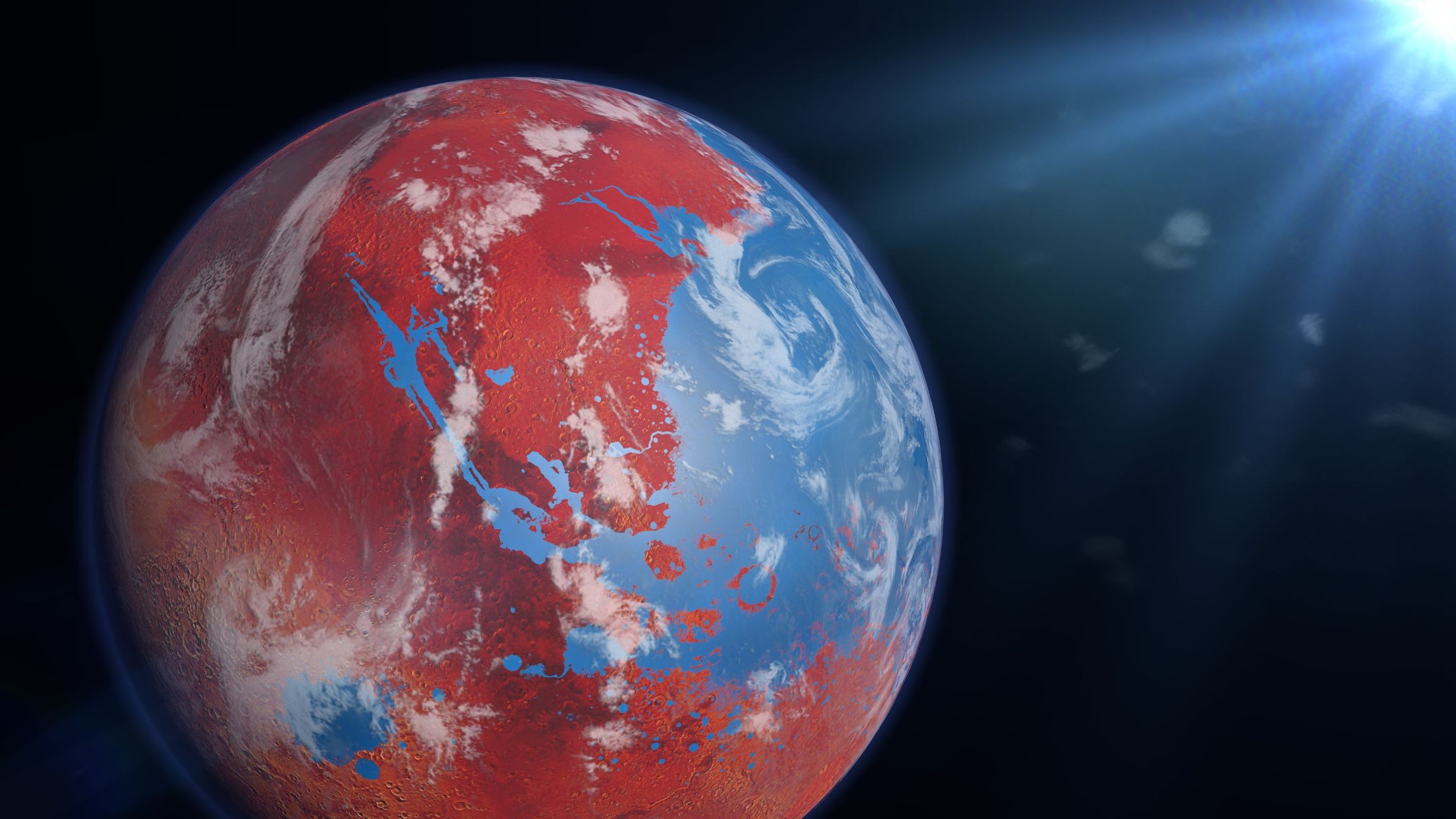
New high-resolution images from Mars orbiters strongly suggest that a massive ocean, comparable in size to the Arctic Ocean, once covered the planet’s northern hemisphere. The findings, published January 7 in NPJ Space Exploration, provide compelling evidence of a past “blue planet” scenario, radically different from the dry, dusty Mars we know today.
Key Findings: River Deltas and Shoreline Evidence
Researchers at the University of Bern analyzed images from multiple Mars orbiters, including the ExoMars Trace Gas Orbiter, Mars Express, and the Mars Reconnaissance Orbiter, focusing on the Valles Marineris – the largest canyon system in the solar system. They identified structures resembling river deltas near the canyon’s edge, structures that would form where rivers flow into standing bodies of water.
These formations represent the mouth of a river into an ocean. The study provides clear evidence of a coastline, and consequently, of an earlier ocean on Mars.
The team mapped these deposits at elevations between 3,650 and 3,750 meters (11,975 to 12,300 feet), dating them back approximately 3.37 billion years. Their consistent elevation and location within the northern lowlands and Valles Marineris strongly suggest they mark the boundaries of an ancient shoreline.
Why This Matters: A Shift in Understanding Martian History
The confirmation of a large, ancient ocean on Mars has significant implications for understanding the planet’s past habitability. Liquid water is a fundamental requirement for life as we know it, and the presence of such a vast ocean suggests that Mars may have once possessed conditions far more conducive to life than previously thought.
The discovery adds weight to other evidence of past water activity on Mars:
- “Blueberry stones” found by rovers, containing iron oxide minerals indicative of water interaction.
- Ancient riverbed features imaged by the Curiosity rover in 2025.
- Possible underground water reservoirs detected by orbital missions.
This new evidence doesn’t just confirm water existed; it points to a sustained period where liquid water was abundant enough to form a planet-spanning ocean.
The Bigger Picture: A Lost Ocean and Future Exploration
The study’s lead author, Ignatius Argadestya, noted the striking resemblance between Martian landscapes and those on Earth, particularly in the formation of fan deltas where rivers meet oceans. The scale of the ancient Martian ocean – at least as large as today’s Arctic Ocean – implies a warmer, wetter past.
Future missions to Mars will likely focus on searching for signs of ancient life within the sedimentary deposits left behind by this lost ocean. Understanding how and why this ocean disappeared is also a key question: was it a gradual evaporation, or a catastrophic event? The answers could provide invaluable insights into the long-term evolution of planetary climates and the potential for habitability beyond Earth.
The evidence is mounting that Mars was once a far more hospitable place than it is today, and this discovery brings us one step closer to understanding how and why that change occurred.