Earth is facing a surge of cosmic events, from intense solar flares to accidental rocket pad damage, alongside bizarre discoveries in the most unexpected places. Here’s a breakdown of the latest science headlines.
Solar Activity Intensifies: Northern Lights Incoming?
A powerful X1.9-class solar flare erupted from the sun late Sunday, triggering radio blackouts over Australia and Southeast Asia. While a coronal mass ejection (CME) associated with this flare was initially angled away from Earth, the situation is evolving rapidly. A large group of sunspots is now rotating into view, increasing the chance of further eruptions. NOAA predicts a 70% chance of additional solar flares between December 1st and 5th, potentially bringing the Northern Lights as far south as Florida and Mexico again. This heightened solar activity is a reminder of the sun’s unpredictable nature and its direct impact on Earth’s technology.
Russia Damages Last Functional Launchpad
Russia has unintentionally disabled its primary launch facility, the Baikonur Cosmodrome in Kazakhstan, after an unspecified incident involving its Soyuz rockets. The loss of this key infrastructure will delay future space missions. The damage is significant because Baikonur is Russia’s sole operational launch site at the moment.
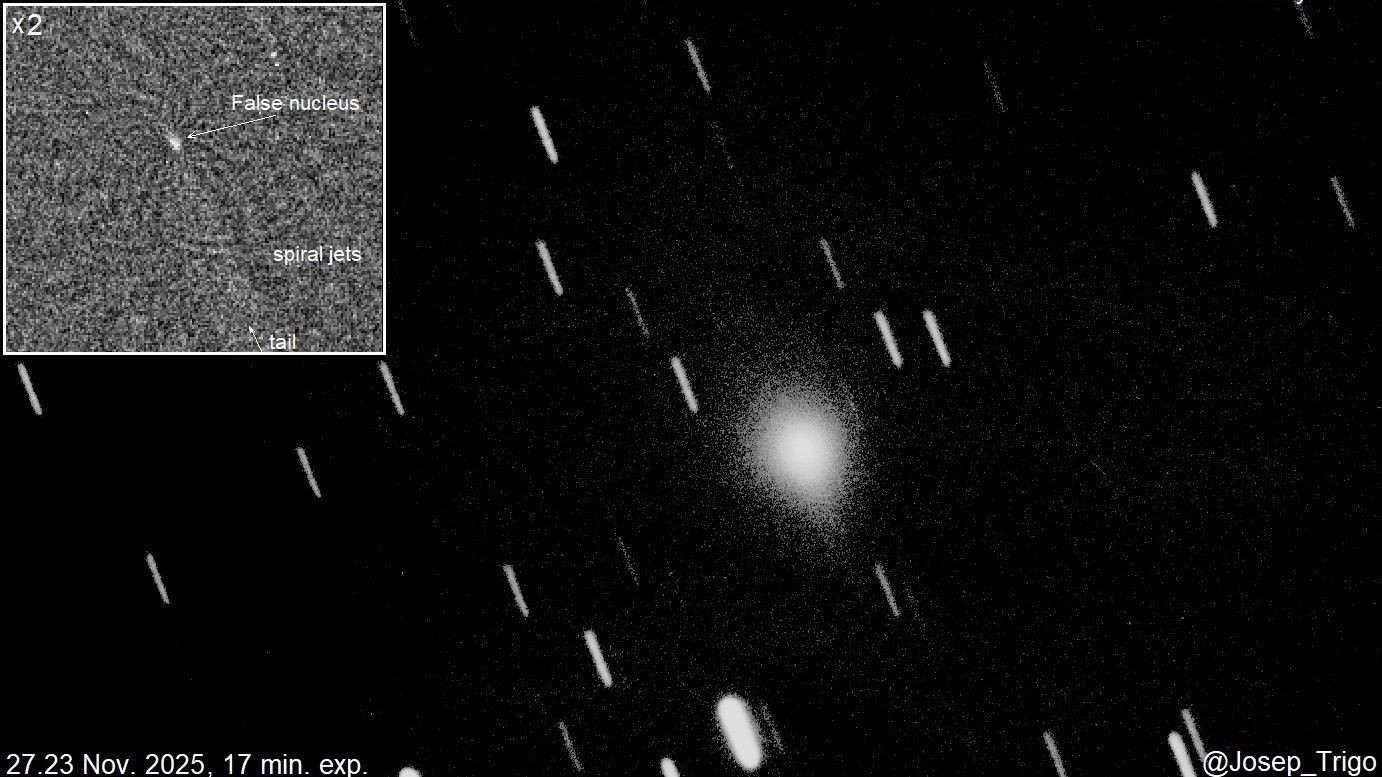
Comet 3I/ATLAS Reveals “Ice Volcanoes”
Preliminary research suggests that the interstellar comet 3I/ATLAS is covered in cryovolcanoes – “ice volcanoes” – spewing material as it approaches the sun. This discovery connects the comet to icy bodies beyond Neptune, offering insights into the composition and behavior of distant celestial objects. The findings haven’t been peer-reviewed yet, but suggest that 3I/ATLAS could provide a valuable glimpse into the early solar system.
Climate Tipping Points: Scientists Issue Urgent Warning
More than 500 scientists have signed a declaration stating that “the planet’s future hangs in the balance,” warning that failing to address climate change quickly will result in irreversible environmental damage. The declaration follows the underwhelming COP30 agreement, which lacked firm commitments on fossil fuels. The planet is nearing critical tipping points where warming may become self-perpetuating, regardless of future emission reductions.
Ancient Humans in Australia: New Genetics Reveal Earlier Arrival
Genetic research confirms that modern humans settled northern Australia as early as 60,000 years ago, potentially interacting with archaic hominids like Homo floresiensis (“the hobbit”). This discovery underscores the ingenuity of early humans, who had to develop watercraft to reach the continent. The new data resolves a long-standing debate about the timing of human migration into Australia.
Chernobyl’s Fungi May Be Thriving on Radiation
In an extraordinary finding, scientists believe that the fungus Cladosporium sphaerospermum in the Chernobyl exclusion zone could be using radiation as a food source through a process called radiosynthesis. This hypothetical mechanism, involving melanin, would allow the fungus to metabolize ionizing radiation. If confirmed, it would represent a novel form of life adapting to extreme environments. The exclusion zone also hosts thriving populations of feral dogs, wild horses, and even moonshine production from locally grown apples.
Solar Flares and Aircraft: Airbus Recall
Solar flares are causing real-world disruptions, including a recall of thousands of Airbus A320 passenger jets due to corrupted flight control data. The issue affects airlines worldwide, with Avianca reporting that 70% of its fleet is impacted. As solar activity increases, the vulnerability of modern technology to space weather will become more apparent.
In conclusion, the latest science news showcases a planet under pressure from both natural cosmic events and human-induced crises. From intensifying solar storms to the urgency of climate action, these developments demand attention and proactive solutions.