


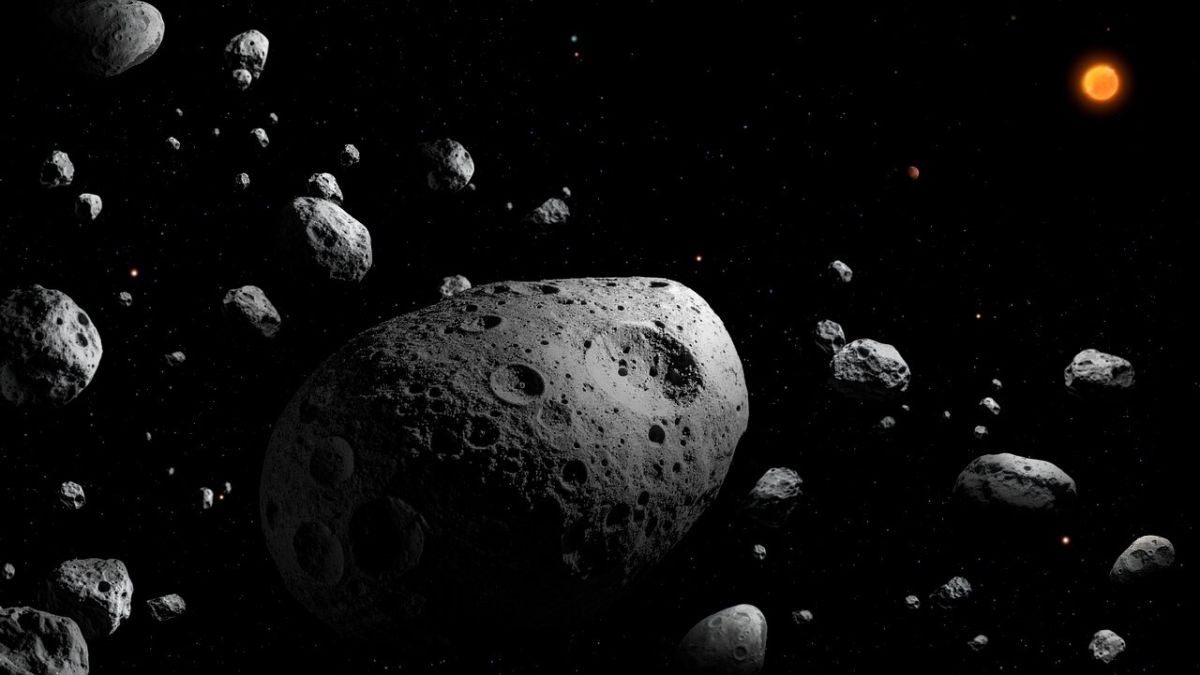
New observations from the Vera C. Rubin Observatory are forcing scientists to rethink how asteroids form and survive in the Solar System. The telescope, even in its pre-survey phase, has detected multiple asteroids spinning at speeds previously considered impossible, defying decades of established theory.
Unexpected Spin Rates
The most striking finding is asteroid 2025 MN45, a 710-meter (2,330-foot) object in the Main Belt between Mars and Jupiter. It completes a full rotation in just 1.88 minutes – far faster than the 2.2-hour limit beyond which asteroids should disintegrate from centrifugal forces.
This isn’t an isolated case. The Rubin Observatory identified 18 additional asteroids rotating at similarly high speeds, suggesting that asteroids can be far stronger than previously assumed. This is significant because existing models assume most asteroids are loosely bound “rubble piles” – collections of rock and dust held together by weak gravity. If true, such asteroids shouldn’t survive rapid spinning.
Why This Matters
For decades, astronomers believed the 2.2-hour spin barrier was a hard limit. The theory, tested in the 1990s and confirmed in 2000, suggested that faster rotation would tear apart most asteroids. The new findings challenge this assumption, implying that many asteroids may be composed of denser, more cohesive materials like solid rock.
This has major implications for our understanding of the early Solar System. These fast-spinning asteroids could be remnants of violent collisions that occurred during the chaotic early phases, preserving internal structures that most asteroids lost over time. In other words, they are like time capsules from the Solar System’s birth, offering a glimpse into its turbulent past.
The Rubin Observatory’s Role
The Rubin Observatory’s ability to catalog asteroids in unprecedented detail is key. The recent observing campaign, conducted over nine nights in April-May 2025, analyzed over 340,000 asteroids, measuring the spins of 76. Nineteen of those defied the spin barrier, including three rotating in under five minutes.
The data suggests that a substantial number of Main Belt asteroids possess high density and structural integrity. The lead researcher, Sarah Greenstreet, notes that 2025 MN45 “must be made of material that has very high strength in order to keep it in one piece as it spins so rapidly.”
Future Implications
These findings will refine our understanding of asteroid composition and evolution. They also support future missions like NASA’s Lucy, which will study asteroids up close. The discovery underscores the potential for the Rubin Observatory to radically transform our knowledge of the Solar System’s building blocks.
The prevalence of these surprisingly durable asteroids suggests that current models may underestimate the number of solid, high-density asteroids in the Main Belt. This data will not only rewrite textbooks but also reshape how we approach asteroid exploration and assess potential risks from near-Earth objects.


