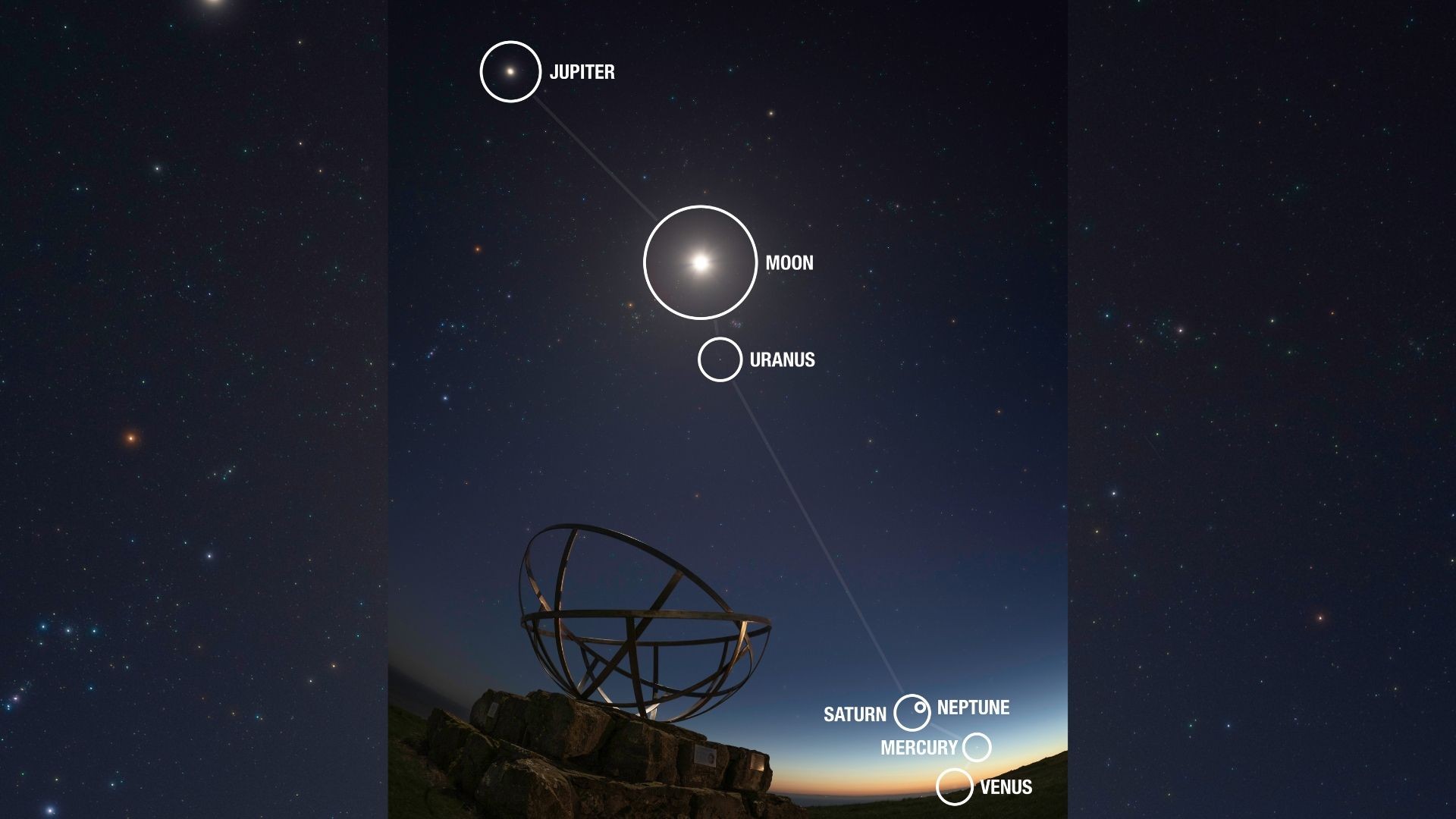
An award-winning astrophotographer has documented a spectacular six-planet alignment stretching across nearly 180 degrees of the night sky. The event, captured by Josh Dury from the southern coast of England on February 24th, showcases Mercury, Venus, Jupiter, Saturn, Uranus, and Neptune—all visible to the naked eye, though some require keen observation or optical aid.
A Challenging Celestial Display
Dury’s photograph required specialized techniques to overcome several hurdles. The wide scale of the planetary parade demanded an ultra-wide-angle lens (a Sigma 15mm fisheye) to capture the full 180-degree span. Fading twilight and the presence of a first-quarter moon further complicated the shot, necessitating a wait for deeper darkness to reveal the fainter planets. Dury employed a NiSi Starsoft filter to enhance their surface brightness.
The result is not only a visually striking image but also a rare opportunity to observe multiple planets simultaneously. Until February 28th, observers may catch some of these planets above the western horizon, although binoculars or telescopes will likely be needed for the full effect.
Why This Matters: Planetary Alignments and Observation
Planetary alignments are not uncommon, but events with this many visible planets spanning such a wide arc are rare. They occur due to the planets’ orbital mechanics, where their paths briefly appear to converge from our perspective on Earth.
This matters because it provides a unique chance for scientific observation, allowing astronomers to study planetary positions, brightness, and atmospheric conditions in relation to each other. For the public, it’s a beautiful reminder of the scale and dynamism of the solar system.
Juxtaposition: Sky Meets Earth
Dury’s photograph includes a telecommunications tower in the foreground, intentionally placed to evoke a sense of connection between humanity’s search for life beyond Earth and the ongoing planetary alignment. This juxtaposition suggests that as we scan the cosmos for other habitable worlds, these rare celestial events serve as a reminder of the planets already within our reach.
Dury noted the difference between this alignment and that of 2025, when all seven naked-eye planets were visible simultaneously. This year, Mars is positioned on the opposite side of the Sun, making it invisible during this particular parade.
The alignment offers a fleeting window for observation, but the captured image serves as a lasting record of this striking celestial event.