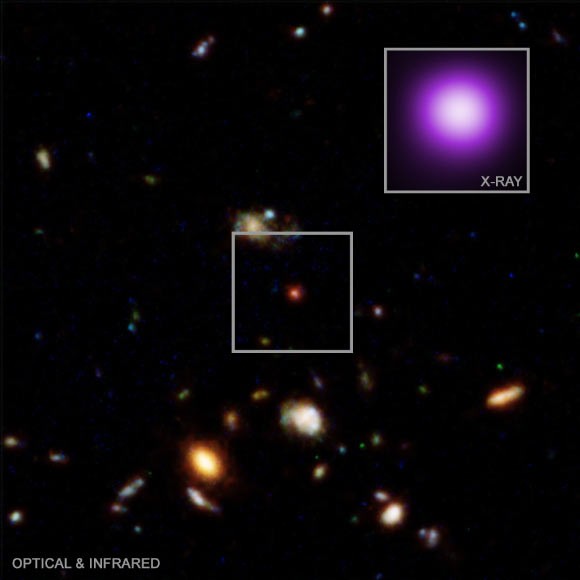
Astronomers have identified a unique celestial object that may finally solve one of the most puzzling mysteries in modern cosmology: the nature of the “little red dots” (LRDs). This newly analyzed object, designated 3DHST-AEGIS-12014, appears to be a transitional phase between hidden supermassive black holes and the bright, active giants we typically observe.
The discovery, made by combining data from NASA’s Chandra X-ray Observatory and the James Webb Space Telescope (JWST), suggests that LRDs are indeed young, rapidly growing supermassive black holes shrouded in dense gas. The “X-ray dot” offers the first clear glimpse of these hidden engines as they begin to emerge from their cosmic cocoons.
The Mystery of the Little Red Dots
Shortly after the James Webb Space Telescope began its operations, astronomers detected hundreds of small, red, and extremely distant objects. Known as little red dots, these entities are located more than 12 billion light-years from Earth, meaning they existed when the universe was less than a billion years old.
The mystery lies in their silence. Typically, growing supermassive black holes emit intense ultraviolet light and X-rays as they devour surrounding matter. However, LRDs are notably dim in X-rays. This led to the “black hole star” hypothesis : the idea that these black holes are embedded in such dense clouds of gas and dust that their high-energy emissions are blocked, masking their true nature.
“Astronomers have been trying to figure out what little red dots are for several years,” said Dr. Raphael Hviding of the Max Planck Institute for Astronomy. “This single X-ray object may be — to use a phrase — what lets us connect all of the dots.”
A Bridge Between Two Worlds
The object 3DHST-AEGIS-12014, located 11.8 billion light-years away, shares the key physical characteristics of an LRD: it is small, red, and distant. However, unlike its counterparts, it glows brightly in X-rays.
This distinction is critical. Researchers believe this object represents a transition phase. As a supermassive black hole consumes its surrounding gas cloud, patches of the cloud eventually thin out or disappear. This allows X-rays from the accretion disk—the swirling material falling into the black hole—to escape and become visible to observatories like Chandra.
Dr. Anna de Graaff of the Harvard & Smithsonian Center for Astrophysics explained the significance: “If little red dots are rapidly growing supermassive black holes, why do they not give off X-rays like other such black holes? Finding a little red dot that looks different from the others gives us important new insight into what could power them.”
Evidence of Obscuration
The Chandra data provides further evidence supporting the transition theory. The X-ray brightness of the dot varies over time. This variability suggests that the black hole is partially obscured by rotating clouds of gas. As denser and less dense patches of gas move across the line of sight, they block and reveal the X-ray source, causing fluctuations in brightness.
“If we confirm the X-ray dot as a little red dot in transition, not only would it be the first of its kind, but we may be seeing into the heart of a little red dot for the first time,” said Dr. Hanpu Liu of Princeton University. “We would also have the strongest piece of evidence yet that the growth of supermassive black holes is at the center of some, if not all, of the little red dot population.”
Alternative Theories and Future Observations
While the transition model is compelling, scientists remain cautious. An alternative hypothesis suggests that 3DHST-AEGIS-12014 might be a standard growing supermassive black hole veiled by an exotic type of dust previously unknown to astronomers. This dust could selectively block certain wavelengths while allowing others to pass, creating a unique signature.
To distinguish between these scenarios, further observations are planned. The discovery underscores the power of multi-messenger astronomy, combining the infrared capabilities of JWST with the high-energy vision of Chandra.
“The X-ray dot had been sitting in our Chandra survey data for over ten years, but we had no idea how remarkable it was before Webb came along to observe the field,” noted Dr. Andy Goulding of Princeton University. “This is a powerful example of collaboration between two great observatories.”
Conclusion
The identification of the “X-ray dot” provides a crucial missing link in understanding how the universe’s most massive black holes formed in its infancy. By revealing a transitional state where hidden black holes begin to shine, this discovery supports the theory that little red dots are indeed the obscured, early-stage ancestors of today’s supermassive black holes.