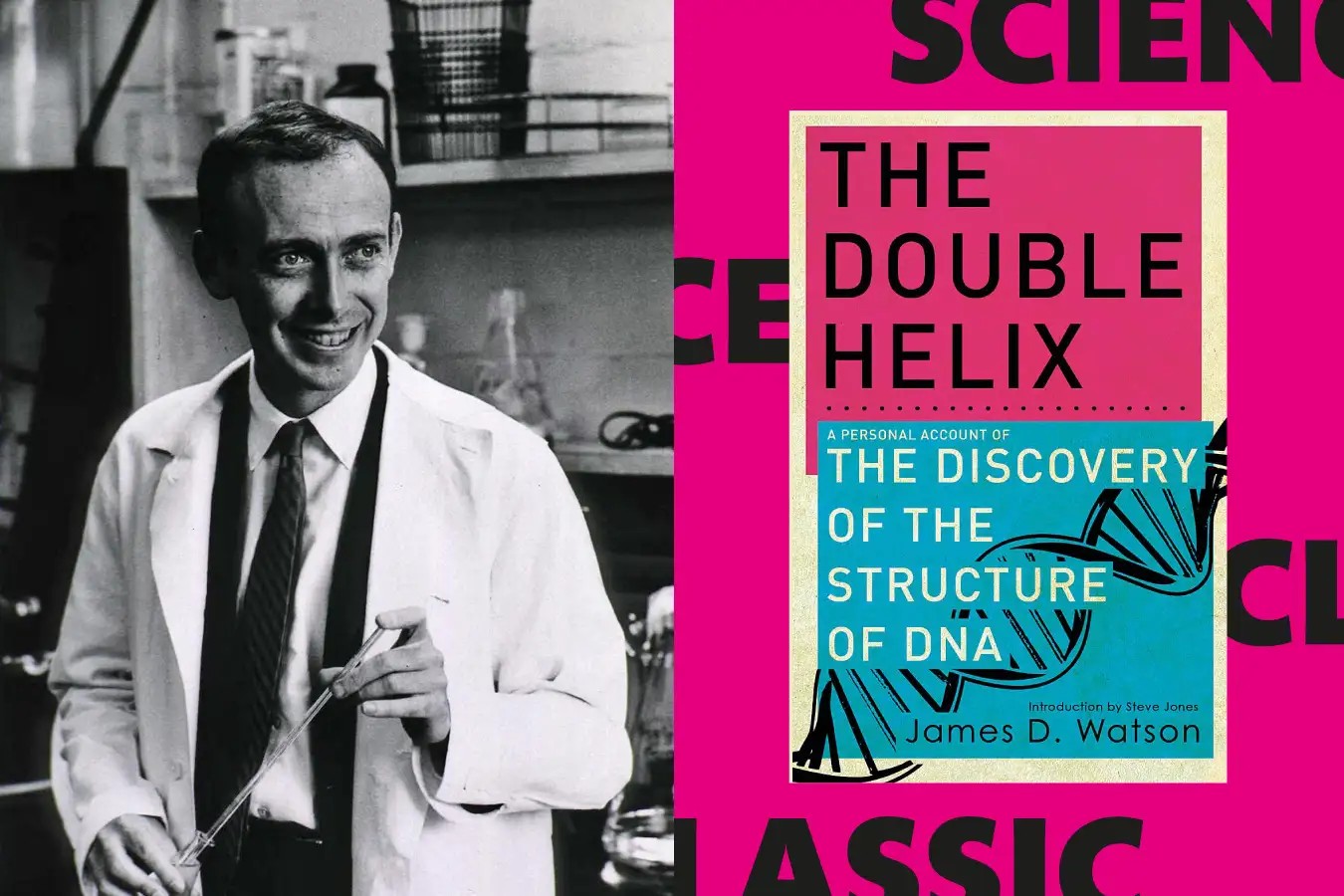
James Watson’s The Double Helix occupies a paradoxical space in scientific literature. While it is widely considered one of the most influential science books ever written, it remains deeply polarizing—and for many modern readers, profoundly difficult to stomach.
The book chronicles the race to discover the structure of DNA between 1951 and 1953, focusing on the partnership between Watson and Francis Crick. However, the brilliance of its storytelling is inextricably linked to its many ethical and personal failings.
A New Genre: The “Non-Fiction Novel”
Before The Double Helix, scientific memoirs were largely seen as dry, clinical records of facts and progress. Watson changed the game by treating science as a high-stakes human adventure. He replaced the “bloodless march of facts” with a narrative driven by ego, personality, and competition.
Historians note that Watson was likely influenced by Truman Capote’s In Cold Blood, a pioneer of the “non-fiction novel.” By applying this dramatized style to biology, Watson achieved something remarkable: he turned complex chemistry into a bestseller that sold over a million copies and inspired generations of young people to enter the field.
The Problem of the Unreliable Narrator
The primary tension for a modern reader lies in the book’s relationship with the truth. Experts suggest that The Double Helix should be viewed more as a novelization than a memoir.
Several key issues complicate its credibility:
- Distorted Collaboration: While the book suggests the discovery was largely a product of Watson’s own brilliance, historical evidence suggests the process was far more collaborative. The role of Rosalind Franklin and Maurice Wilkins—whose data was essential to the discovery—is significantly downplayed or misrepresented.
- The “Villain” Narrative: In his pursuit of a compelling plot, Watson cast Rosalind Franklin as a foil or even a villain. This was fueled by the sexist zeitgeist of 1968, where disparaging remarks about female scientists were often accepted as professional norms.
- Character Flaws: Watson portrays himself as an “unreliable narrator”—admitting to being vain, lazy, and even deceptive. While some argue this was intended as self-deprecating irony, it creates a fundamental distrust in his account of scientific ethics.
Comedy or Obnoxiousness?
There is a scholarly debate regarding the book’s tone. Nathaniel Comfort, a biographer of Watson, suggests the book is actually a comedy, noting its self-aware, almost absurdly confident prose.
However, many historians and readers find the “humor” to be misplaced. The jokes often “fall flat,” and the tone frequently crosses the line from lighthearted ribbing into what many describe as immature, sexist, and even nasty behavior. This reflects a broader pattern in Watson’s life, culminating in his later years when his controversial views led to his professional downfall.
Why It Matters Today
The controversy surrounding The Double Helix raises a fundamental question about the intersection of science and storytelling: Can a book be “great” if it compromises scientific ethics to achieve narrative impact?
“It can’t really be called ‘great’ when it overtly promotes an ethical position antithetical to science’s values and presents a false image of how research is conducted.” — Patricia Fara, Historian of Science
While the book succeeded in making science gripping and accessible, it did so by blurring the lines between fact and drama, often at the expense of the very people whose work made the discovery possible.
Conclusion
The Double Helix remains a landmark text that revolutionized how science is communicated, but it serves as a cautionary tale about the dangers of prioritizing narrative drama over scientific integrity and ethical accuracy.