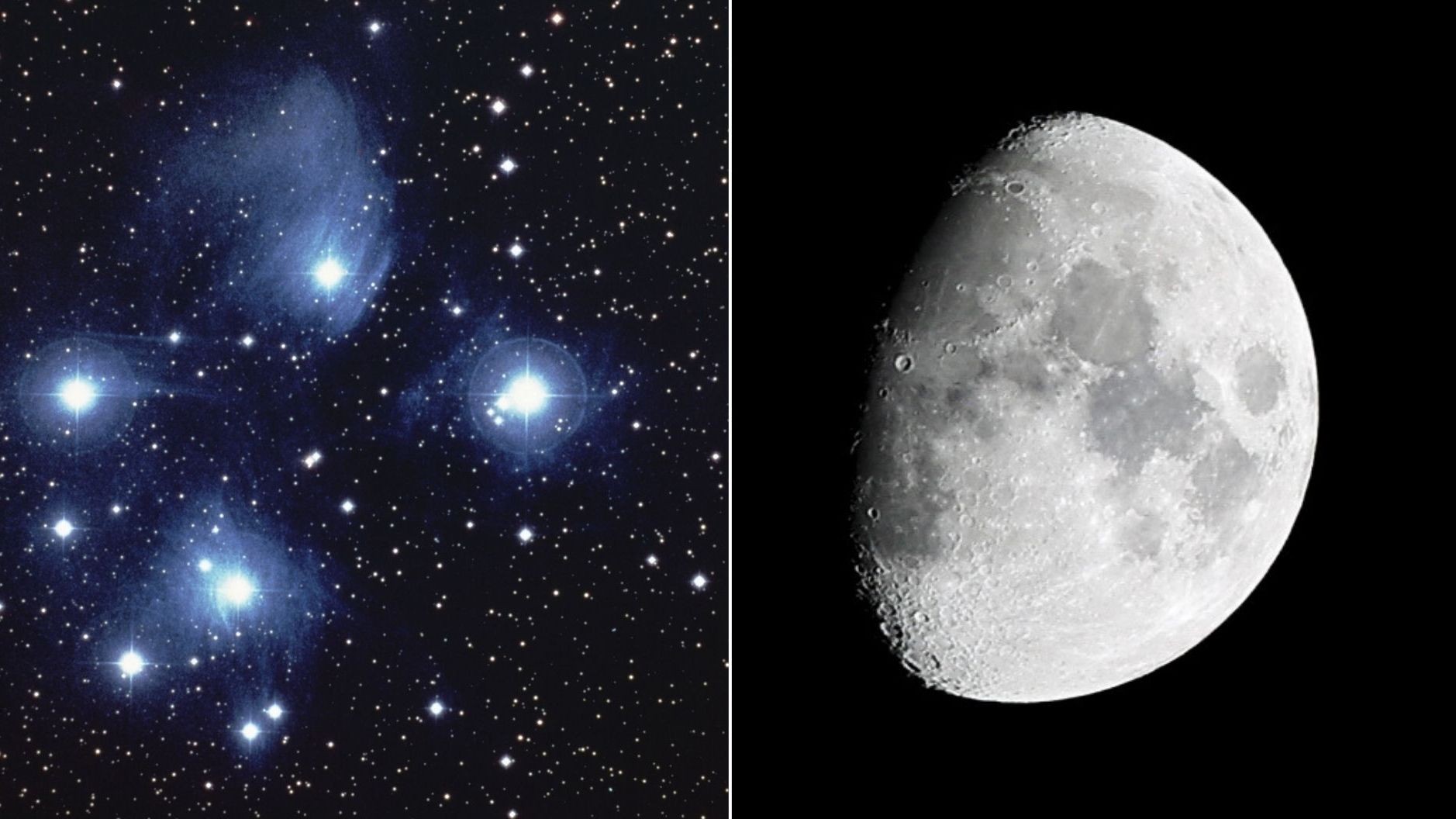
The Pleiades star cluster, also known as the “Seven Sisters”, will appear strikingly close to the waxing gibbous moon tonight, January 27th, offering a beautiful celestial event visible after sunset.
What to Expect
Look towards the southeastern horizon shortly after dusk. The moon, currently 76% illuminated, will dominate the sky, with the Pleiades positioned just under 5 degrees to its right. This makes for an easily observable pairing, even without specialized equipment.
The light from the Pleiades has traveled for roughly 440 years to reach us – meaning the photons entering your eyes tonight began their journey around the time William Shakespeare was born. This cluster isn’t just a pretty sight; it’s a window into the vastness of space and time.
Viewing with Equipment
While visible with the naked eye, binoculars (10X50 recommended) will reveal the cluster’s bright blue-white stars, giving a clearer view of Asterope, Alcyone, Celaeno, Electra, Merope, Maia, and Taygete. A telescope with a 6-inch aperture will reveal dozens more faint stars within the cluster, as well as details on the moon’s surface.
Specifically, you can explore shadowed impact craters like Clavius and Tycho along the terminator – the dividing line between the lit and dark sides of the moon. This offers a dynamic view of lunar geography.
Timing and Resources
The moon will slowly drift away from the Pleiades throughout the night, setting around 3 a.m. local time on January 28th. For precise rise and set times in your location, consult a reliable website like Time and Date.
This conjunction is more than just an astronomical event; it’s a reminder of the universe’s beauty and how much we can observe with even minimal tools.
Whether using the naked eye, binoculars, or a telescope, tonight’s alignment provides a unique opportunity to connect with the cosmos.