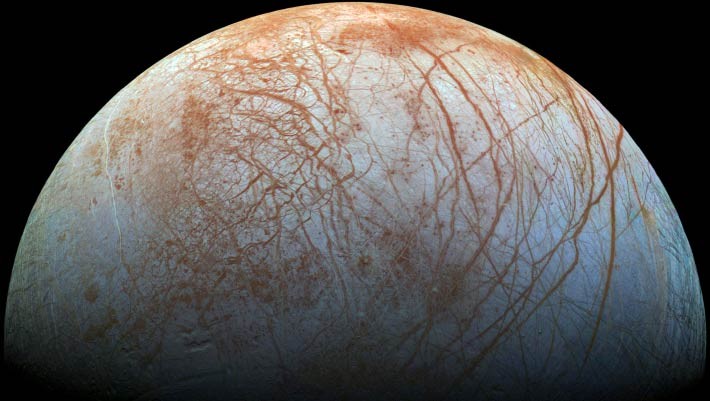
New research suggests that Jupiter’s moon Europa likely has a remarkably calm ocean floor, which could significantly reduce the prospects for life in its subsurface ocean. A detailed modeling study, published in Nature Communications, indicates that the geological activity needed for robust hydrothermal circulation – a key ingredient for potential life – is probably absent.
Why This Matters: Earth as a Baseline
The study’s findings are particularly relevant because on Earth, tectonic activity drives critical water-rock interactions at the seafloor. These interactions release chemical energy that supports thriving ecosystems even in the absence of sunlight. The existence of such activity on other worlds is therefore considered a strong indicator of potential habitability. Europa, with its confirmed subsurface ocean, has been a prime target in the search for extraterrestrial life.
Modeling Europa’s Interior
Researchers led by Dr. Paul Byrne at Washington University in St. Louis used extensive computer simulations to assess the likelihood of tectonic activity within Europa’s hidden ocean. They examined multiple factors – tidal stresses, global contraction, mantle convection, and serpentinization (a reaction between rock and water) – comparing them to observations from Earth and Saturn’s moon Enceladus.
The conclusion: none of these forces appear strong enough to trigger significant geological activity on Europa’s seafloor today. This means that any water-rock interactions are likely restricted to the uppermost few hundred meters, limiting the energy sources that could sustain life.
Implications for Habitability
“If we could explore that ocean with a remote-control submarine, we predict we wouldn’t see any new fractures, active volcanoes, or plumes of hot water on the seafloor,” Dr. Byrne stated. “Geologically, there’s not a lot happening down there. Everything would be quiet.”
The researchers emphasize that Europa still has some tidal heating, preventing it from freezing solid. However, this heating isn’t strong enough to drive substantial geological activity at depth.
The absence of significant seafloor activity doesn’t rule out life entirely, but it narrows the possibilities to areas where chemical energy is concentrated near the surface, rather than deep-sea hydrothermal vents.
The team’s findings underscore the challenges in determining Europa’s habitability. Future missions will need to gather direct evidence of its subsurface geology to confirm these predictions. The quiet ocean floor suggests that, if life exists, it will likely be very different from what we find on Earth.