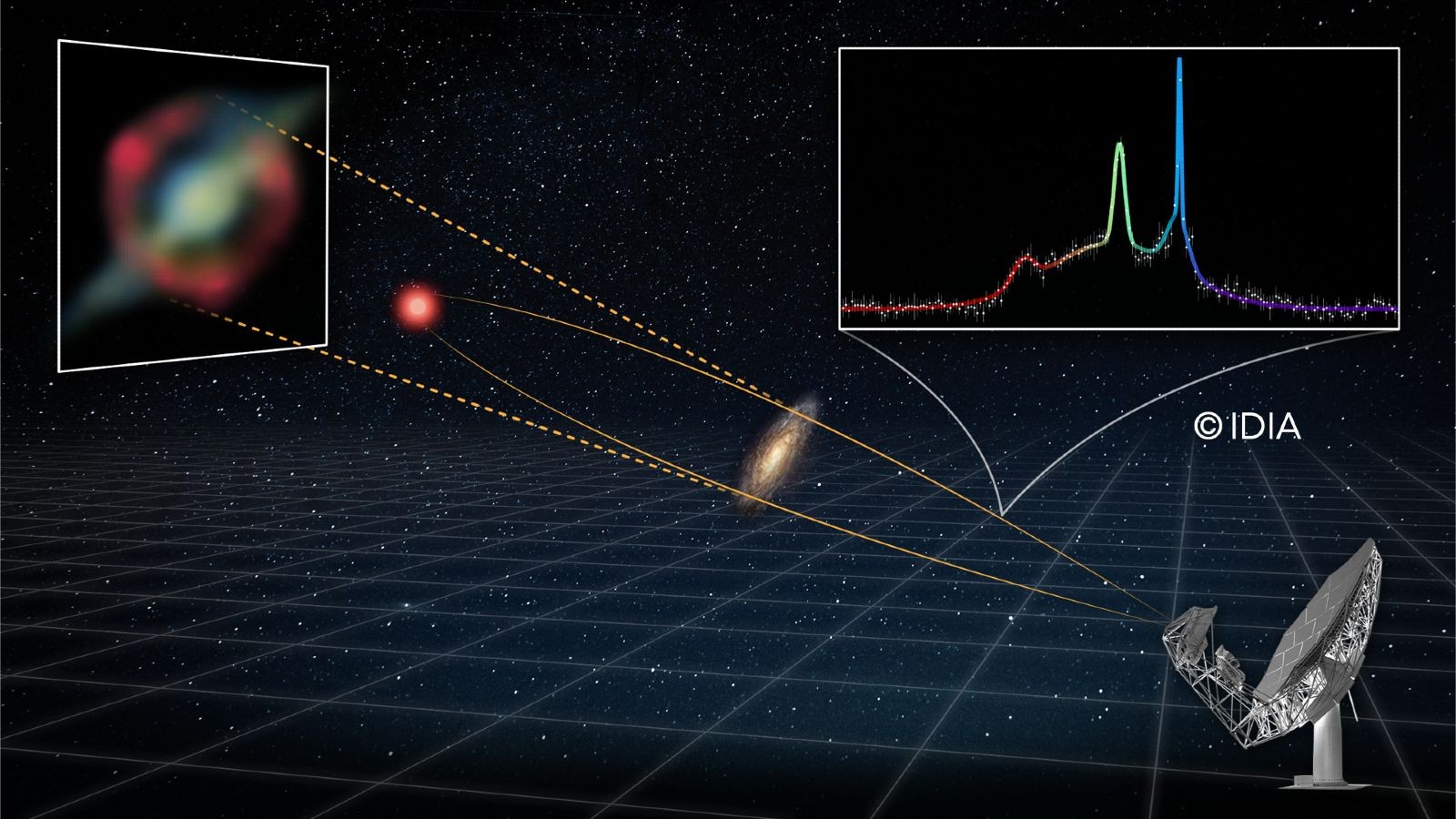
Astronomers have detected an incredibly powerful natural laser beaming across the universe towards Earth, originating from a pair of colliding galaxies 8 billion light-years away. This “hydroxyl megamaser” is the most distant and brightest of its kind ever observed, offering a unique window into the early universe and galaxy evolution.
How Space Lasers Work
This isn’t science fiction. These natural lasers form when galaxies collide, compressing vast gas clouds and exciting hydroxyl (OH) molecules. This excitation releases high-energy microwaves, which are then amplified—similar to how human-made lasers amplify light. The key difference is that these “masers” amplify microwaves instead of visible light. The signal from this particular system is so strong that researchers suggest it should be reclassified as a “gigamaser,” a theoretical next step in intensity.
The Discovery of HATLAS J142935.3–002836
The source, designated HATLAS J142935.3–002836, was initially identified in 2014. The microwaves it emits are stretched to approximately 7 inches in length (1,665 megahertz) and are extraordinarily bright. The sheer distance of this megamaser—from a time when the universe was roughly half its current age—makes it invaluable for studying the formation and evolution of ancient galaxies.
Einstein’s Relativity Plays a Role
Normally, signals from such a distance would be too faint to detect. However, a phenomenon predicted by Albert Einstein’s theory of relativity, gravitational lensing, has amplified the signal. Massive objects between us and the megamaser warp spacetime, bending and magnifying the microwaves. This effect, sometimes creating an “Einstein ring” of light, allows astronomers to analyze the distant source with unprecedented clarity.
Why This Matters
Megamasers serve as “cosmic beacons,” allowing scientists to peer into the early universe. The discovery of this gigamaser demonstrates that these powerful signals are more common than previously thought, especially when observed through the lens of gravitational magnification. The team plans to scan other gravitationally lensed systems, hoping to uncover hundreds or thousands more megamasers. This will significantly expand our understanding of galactic evolution and the conditions present in the early universe.
“This system is truly extraordinary,” said Thato Manamela, the study’s lead author, underscoring the significance of this breakthrough. “We are seeing the radio equivalent of a laser halfway across the universe.”
This discovery marks a major step forward in astrophysical research, and continued observation promises further insights into the distant cosmos.