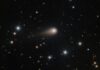
Astronomers have documented a dramatic shift in the behavior of WOH G64, an exceptionally large and luminous red supergiant star located in the Large Magellanic Cloud galaxy. Over three decades of observation, the star has undergone a rapid transition, becoming hotter and shedding material – a phenomenon that challenges current understanding of how massive stars evolve.
The Life Cycle of Red Supergiants
Red supergiants are massive stars, at least eight times the size of our Sun, with relatively short lifespans (1-10 million years). These stars are destined to end their lives in spectacular supernova explosions or, in some cases, collapse directly into black holes. However, the final stages of the most extreme red supergiants remain poorly understood. The sheer luminosity and size of stars like WOH G64 make them rare and difficult to study, leaving key questions unanswered about their ultimate fates.
WOH G64: A Star in Flux
First discovered in the 1980s, WOH G64 has long been recognized as one of the brightest and largest red supergiants in its galaxy, roughly 160,000 light-years from Earth. Recent analysis of brightness measurements dating back to 1992, combined with new spectral data, reveals a startling pattern. The star began dimming in 2011, then unexpectedly brightened and warmed by over 1,000 degrees Celsius between 2013 and 2014. By 2025, it had faded again, accompanied by noticeable changes in its atmospheric composition.
Two Possible Explanations
The observed changes suggest two primary scenarios. First, WOH G64 may be part of a binary star system. Interactions with a companion star could trigger the ejection of outer layers, causing the supergiant to transition into a rarer yellow hypergiant phase. Alternatively, the star may have experienced a massive eruption of material that masked its true yellow hypergiant nature for decades before revealing itself in 2014.
“The findings raise the question of whether extreme red supergiants, such as WHO G64, exist because they are interacting binaries, and therefore would not reach these extreme states if they were single stars.”
This discovery highlights a fundamental debate in astrophysics: do the most luminous red supergiants exist only because they’re part of binary systems? If so, it suggests that single, isolated stars may never reach such extreme states. The ultimate fate of WOH G64—whether it will explode as a supernova, collapse into a black hole, or merge with its companion—remains to be seen.
The study, published in Nature Astronomy, provides critical new insights into the volatile lives of massive stars and underscores the need for continued observation to refine our understanding of stellar evolution.