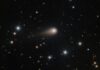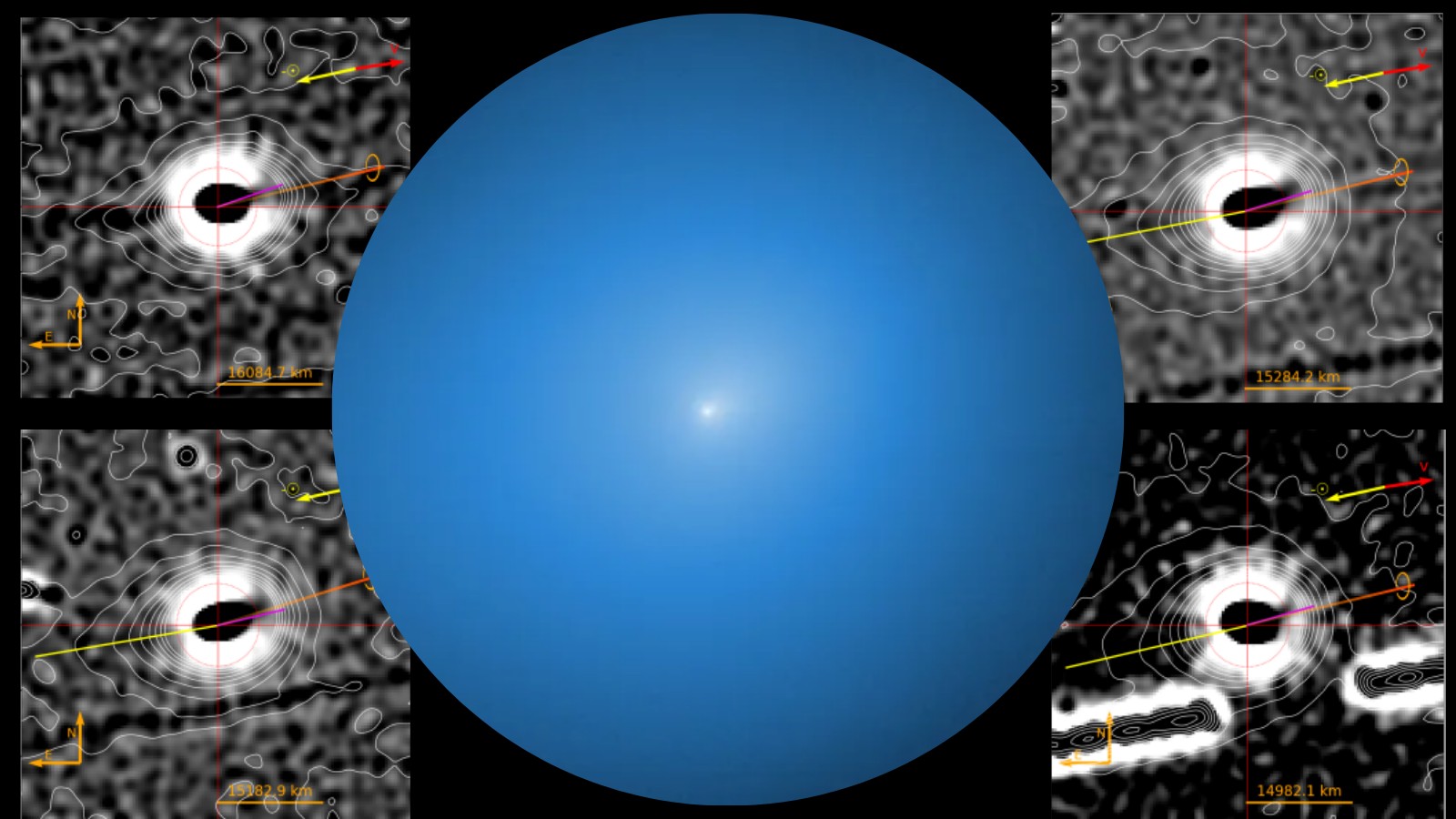
An interstellar comet, 3I/ATLAS, currently passing through our solar system, has revealed a peculiar behavior in its sun-facing tail: wobbling jets of gas and dust that repeat every 7 hours and 45 minutes. This marks the first time such activity has been observed in a comet originating from outside our star system, providing a rare glimpse into the composition and physics of objects formed around other stars.
The Comet’s Strange Anti-Tail
Comets are known for their tails, which are formed when solar radiation heats up the ice and dust in their nuclei, causing them to vaporize and stream away from the sun. However, 3I/ATLAS displays a rare anti-tail – a tail that points toward the sun. The newly observed jets within this anti-tail aren’t static; they wobble in a predictable pattern. This wobbling is significant because it suggests the comet’s icy core rotates once every 15 hours and 30 minutes, faster than earlier estimates.
Significance of Interstellar Visitors
3I/ATLAS is only the third confirmed interstellar object to visit our solar system. The first was ‘Oumuamua, discovered in 2017, and the second was comet 2I/Borisov, spotted in 2019. While anti-tails and jet activity have been seen in comets originating within our own solar system, studying them in an interstellar comet provides valuable data.
“Characterizing jets in 3I thus represents a rare opportunity to investigate the physical behavior of a pristine body formed in another planetary system,” researchers stated in a recent paper.
How the Observations Were Made
The discovery was made through 37 nights of observation between July and September 2025, using the Two-meter Twin Telescope in Tenerife, Canary Islands. Researchers tracked the evolution of the comet’s coma – the cloud of gas and dust surrounding its nucleus – as it approached the sun. The anti-tail became more pronounced as solar radiation intensified, triggering the wobbling jet activity. The comet came within 130 million miles of the sun on October 30, 2025, making this a unique opportunity to observe an interstellar body up close.
The observed behavior of 3I/ATLAS provides scientists with a rare opportunity to study an object formed in another star system, shedding light on the physical properties and behavior of interstellar comets. The wobbling jets confirm that these objects can exhibit complex dynamics under the influence of solar radiation, further expanding our understanding of the diversity of celestial bodies in the galaxy.