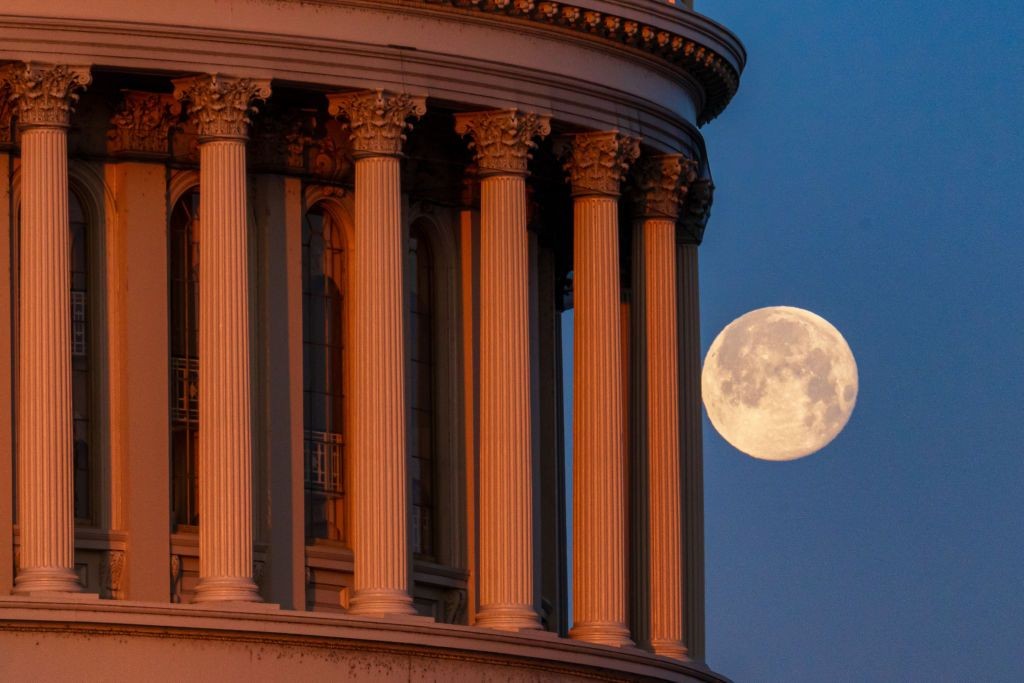
The second full moon of 2026, known as the Snow Moon, will rise on Sunday, February 1st, appearing alongside the prominent Beehive Cluster – a beautiful, easily visible grouping of stars. This celestial event offers a rare opportunity to see both a bright full moon and a dazzling star cluster in the same view.
Optimal Viewing Conditions
The moon reaches peak fullness at 5:09 p.m. EST on February 1st, and will be best observed at dusk as it rises. It will be positioned within the constellation Leo, appearing below the Beehive Cluster. The full moon will also remain bright on February 2nd.
To maximize visibility, find a location with an unobstructed view of the eastern horizon, such as an elevated area or open field. While the full moon is easily seen with the naked eye, binoculars or a telescope will reveal the Beehive Cluster’s over 100 stars in detail. The Beehive Cluster (also known as M44 or NGC 2632) is one of the brightest and closest open clusters to our solar system, located just 577 light-years away.
Locating the Cluster
The Beehive Cluster will appear between Pollux (in Gemini, to the upper right of the moon) and Regulus (in Leo, to the lower left). Regulus will become easier to spot about an hour after moonrise, along with other stars in Leo.
On February 2nd, observers in parts of North America may witness a rare occultation: Regulus will appear to vanish behind the nearly full moon for about an hour. This event won’t repeat until the late 2030s.
Cultural Significance & Upcoming Events
Historically, February’s full moon has been called by various names, including the Hungry Moon, Storm Moon, and Candles Moon. Indigenous cultures have their own traditions: the Cree call it the Bald Eagle Moon, while the Ojibwe know it as the Bear Moon.
Beyond this weekend’s event, February 17th will bring a new moon coinciding with a rare annular solar eclipse visible from Antarctica – where the moon will appear to create a “ring of fire” around the sun.
The following full moon, the Worm Moon, will rise on March 3rd and is expected to be a total lunar eclipse. During this event, visible from North America, the Pacific, Australia, and East Asia, the moon will turn a reddish-copper color for nearly an hour – a phenomenon known as a “blood moon”.
These celestial events remind us of the dynamic beauty of the night sky and the cyclical patterns of our solar system.