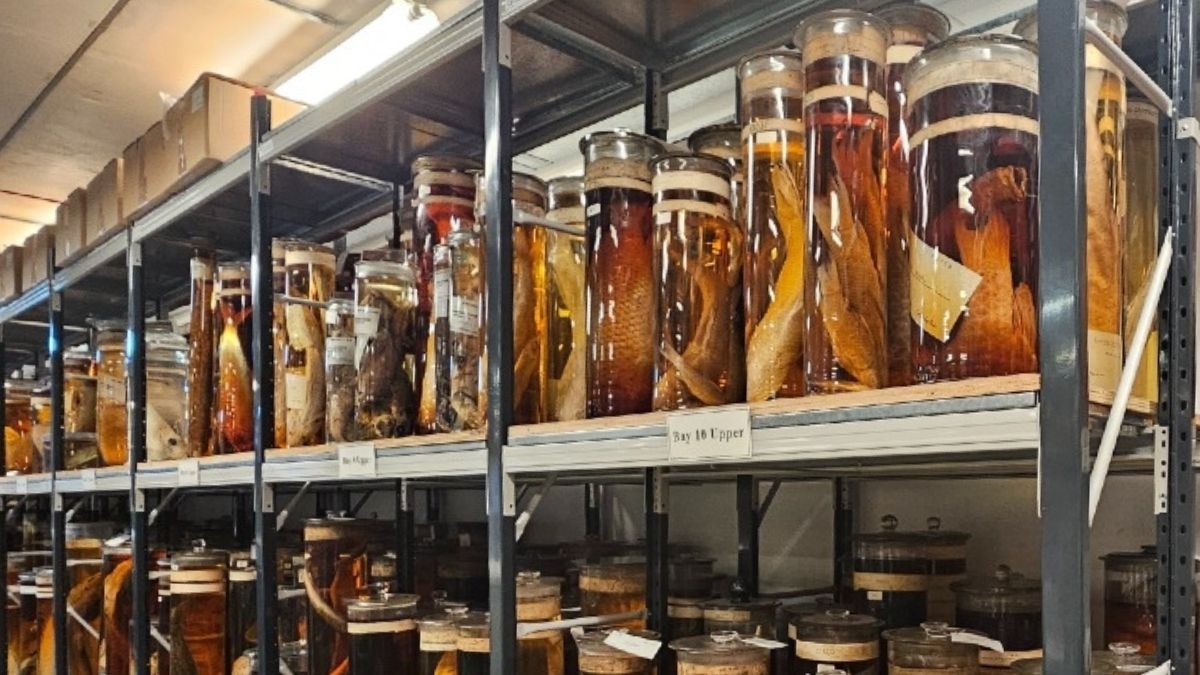
For two centuries, rows of glass jars containing specimens collected by Charles Darwin during his groundbreaking voyage on the HMS Beagle have remained unopened in the archives of London’s Natural History Museum (NHM). Now, a new laser-based technique has provided an unprecedented, non-destructive look inside, revealing the chemical cocktails preserving these historical treasures.
Darwin’s meticulous observations of wildlife in the Galapagos Islands formed the basis of his revolutionary theory of natural selection and evolution – a cornerstone of modern biology. While researchers have long studied the visible contents of these jars (mammals, reptiles, fish, and invertebrates), the precise composition of the preservation fluids remained a mystery, until now.
Why This Matters: Opening these specimens risks damage from evaporation, contamination, or exposure to air. Identifying the preservation fluids is crucial for long-term conservation, as different chemicals degrade at varying rates and can react with the specimens over time. Museums worldwide hold over 100 million fluid-preserved samples, many of which are too fragile to open.
A Non-Destructive Approach: SORS Technology
The breakthrough comes from applying a technique called spatially offset Raman spectroscopy (SORS). This advanced method uses lasers to analyze the molecular structure of materials without physically disturbing them. Traditional Raman spectroscopy struggles with opaque containers like these jars because the laser light scatters off the surface, masking the contents. SORS solves this by taking multiple laser readings at slightly different angles. Subtracting these readings reveals the chemical fingerprints of both the container and the liquid inside.
The scientists used a portable SORS device to analyze nearly 80 percent of Darwin’s jars with high accuracy. Another 15 percent gave partial results, while only 6.5 percent remained unidentifiable. This is a monumental leap forward in the field of biological conservation.
What They Found Inside
The study revealed a surprising diversity in preservation methods. Mammals and reptiles were predominantly fixed in formalin and stored in ethanol. Invertebrates, especially jellyfish and shrimp, were submerged in formaldehyde, sometimes mixed with glycerol or phenoxetol to maintain tissue integrity.
These findings underscore the historical variability in preservation techniques. In the late 19th century, formaldehyde became popular. Earlier methods included aromatic spices (clove, pepper, and cardamom) steeped in ethanol–water by Dutch anatomist Frederik Ruysch, or the formaldehyde, picric acid, and acetic acid concoction favored by French histologist Pol Bouin.
“This technique allows us to monitor and care for these invaluable specimens without compromising their integrity,” says physicist Sara Mosca.
The Future of Biological Collections
This new method isn’t limited to Darwin’s collection. It offers a vital tool for preserving the countless fluid-preserved specimens housed in museums globally. By non-destructively identifying preservation fluids, researchers can optimize storage conditions and ensure these invaluable biological records endure for future study.
The ability to analyze specimens without opening them marks a turning point in biological conservation. It allows scientists to safeguard irreplaceable resources while unlocking the secrets held within.