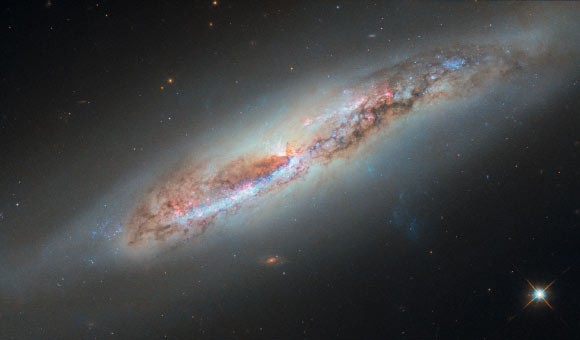
The NASA/ESA Hubble Space Telescope has delivered a breathtaking new view of NGC 4388, a spiral galaxy positioned approximately 59 million light-years away in the Virgo constellation. This latest image reveals a previously unseen plume of gas ejected from the galaxy’s core, providing astronomers with crucial new insights into the dynamics of galactic clusters.
Discovery and Characteristics
Originally observed by Sir Wilhelm Herschel in 1784, NGC 4388 (also known as LEDA 40581 and IRAS 12232+1256) spans 120,000 light-years in diameter. Its notable brightness makes it one of the most prominent galaxies within the Virgo Cluster – a massive collection of over 2,000 galaxies. Astronomers classify it as an active galaxy due to its energetic central nucleus.
Unusual Perspective Reveals Hidden Details
What sets NGC 4388 apart is its extreme tilt relative to Earth. This edge-on view, captured with exceptional clarity by Hubble, showcases a striking phenomenon absent in earlier images from 2016: a billowing plume of gas streaming from the galaxy’s nucleus toward the lower-right corner of the frame.
The Mystery of the Outflow
The origin and glowing nature of this gas plume remain under investigation. The prevailing theory centers on the galaxy’s movement through the Virgo Cluster’s intracluster medium – a vast network of hot gas filling the space between galaxies.
As NGC 4388 travels through the cluster, it interacts with this hot gas, stripping material from its own disk. This interaction creates a trailing plume as the galaxy moves forward. The energy source ionizing the gas is still debated; a supermassive black hole at the galaxy’s center is a leading candidate, with its superheated disk potentially fueling the ionization process.
The Role of Galactic Clusters
The study of galaxies like NGC 4388 in dense cluster environments provides critical clues about galactic evolution. These interactions with the surrounding medium shape how galaxies lose mass and form new stars. The dynamics of clusters like Virgo are essential for understanding the broader evolution of the universe.
“Understanding how galaxies interact with their environment is key to deciphering the complex processes that drive cosmic evolution,” Hubble astronomers suggest.
The new Hubble image of NGC 4388 adds another piece to this puzzle, showcasing the powerful forces at play in the universe’s most crowded galactic neighborhoods.