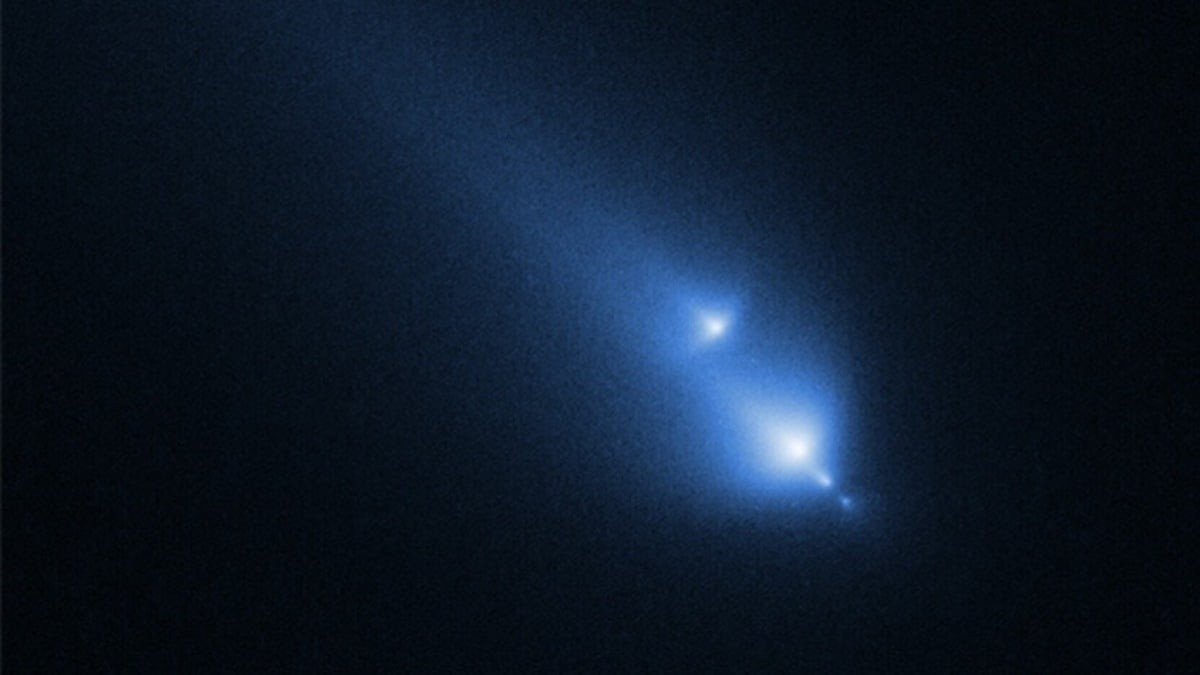
For decades, astronomers have sought to observe a comet disintegrating in real-time, a feat considered difficult to predict. NASA’s Hubble Space Telescope has now achieved this rare observation with comet C/2025 K1 (ATLAS), providing unique insight into the composition of icy bodies formed during the early stages of our solar system. The unexpected event occurred due to scheduling conflicts, when researchers turned Hubble to K1 as a substitute target, only to discover the comet had already fractured into four distinct pieces.
Why Comet Breakups Matter
Comets are essentially time capsules from the formation of our solar system, roughly 4.6 billion years ago. Their interiors contain pristine ice, dust, and chemicals largely unchanged since that era. Unlike the comet’s surface, which is altered by heat and radiation, the interior offers a glimpse into the raw materials present when planets were forming. This makes studying a breakup event crucial for understanding the building blocks of our planetary system.
The vast majority of comets remain unobserved, originating from either the Kuiper Belt beyond Neptune or the more distant, theoretical Oort Cloud up to 50 times farther away. The Oort Cloud remains largely unconfirmed due to the extreme faintness of its inhabitants.
The Discovery of K1’s Fragmentation
Researchers observed K1 over three consecutive days in November, roughly a month after its closest approach to the Sun. Hubble captured the breakup in progress, revealing four fragments each surrounded by its own glowing halo of gas and dust—the coma. The team estimates the breakup began about eight days before the first images were taken. The original comet was roughly the size of a small city, such as Key West, Florida.
Unexpected Findings and Future Research
The timing of the observation revealed an anomaly: Earth-based telescopes detected K1 brightening later than expected. This suggests that comet brightness may be more closely tied to reflected sunlight off dust than newly exposed ice, which takes time to warm and vaporize.
Preliminary measurements also indicate K1 contains unusually low levels of carbon compared to other comets, a factor scientists hope to investigate further. These findings underscore the unpredictable nature of cometary behavior and the importance of accidental discoveries in scientific progress.
Now fragmented and drifting away from the solar system at approximately 250 million miles from Earth, K1 is unlikely to return. The data gathered from this chance observation, however, will continue to inform our understanding of the early solar system for years to come.