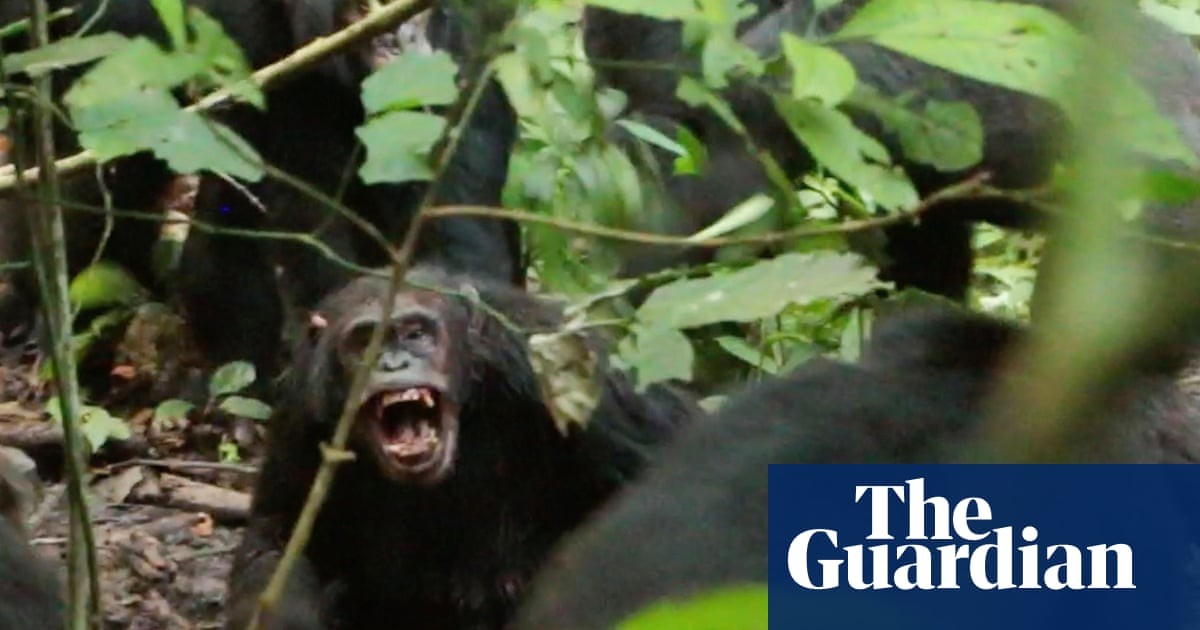
New research published in the journal Science has documented a phenomenon previously thought to be uniquely human: a “civil war” within a single chimpanzee community. In Uganda’s Kibale National Park, a once-unified group of Ngogo chimpanzees split into two warring factions, engaging in years of coordinated, lethal aggression against one another.
A Sudden Shift in Social Dynamics
The fracture was first noticed by primatologist Aaron Sandel in 2015. During routine observations, he noted that chimpanzees who had previously lived as a cohesive unit began behaving with intense suspicion and anxiety toward one another. What appeared to be mere social tension soon evolved into a permanent divide.
By 2018, the Ngogo community had split into two distinct entities: the Western group and the Central group. Following this division, the Western group launched 24 sustained, coordinated attacks against the Central group. The violence was devastating, resulting in the deaths of at least seven adult males and 17 infants.
Why Did the Group Split?
Researchers believe the breakdown of this large community was not caused by a single event, but rather a “perfect storm” of social and environmental stressors:
- Leadership Transitions: A shift in the social hierarchy—specifically the alpha male submitting to another individual—weakened the traditional power structure.
- Loss of “Social Glue”: The deaths of several key older chimpanzees in the years leading up to the split likely dissolved the long-standing social connections that held the various neighborhoods together.
- Disease Outbreaks: A significant outbreak in 2017 is believed to have acted as a catalyst, making the final separation between the two groups inevitable.
This highlights a critical biological principle: in complex social species, group cohesion often relies on a few key individuals. When those “connectors” are lost, the entire social network can become fragile and prone to polarization.
The Evolutionary Logic of Violence
From a biological perspective, the violence serves a grim but calculated purpose. Evolutionary anthropologists note that this conflict follows the logic of Darwinian fitness. By systematically attacking the Central group, the Western group successfully:
1. Increased their own survival chances.
2. Decreased the survival and reproductive success of their competitors.
The results are stark: the Central group now faces the lowest survivorship rates ever documented in a wild chimpanzee community.
Implications for Conservation
While genetic evidence suggests these massive social ruptures may only occur once every 500 years, the study raises urgent concerns for the future of great apes.
Chimpanzees are already facing the threat of extinction. Scientists warn that human-driven disruptions—such as deforestation, climate change, and the spread of disease —could destabilize chimpanzee social structures more frequently. If these environmental pressures continue to weaken group connectivity, we may see these violent “civil wars” become a more common occurrence in the wild.
“It shows that social ties and network connectivity are the cement of group cohesion, and that these ties can be fragilized in specific circumstances,” notes Sylvain Lemoine of the University of Cambridge.
Conclusion
The Ngogo study reveals that even in the animal kingdom, social stability is fragile and can be shattered by leadership changes and environmental stress. This unprecedented observation of primate “civil war” serves as a warning that human-induced environmental changes could fundamentally alter the social survival of endangered species.