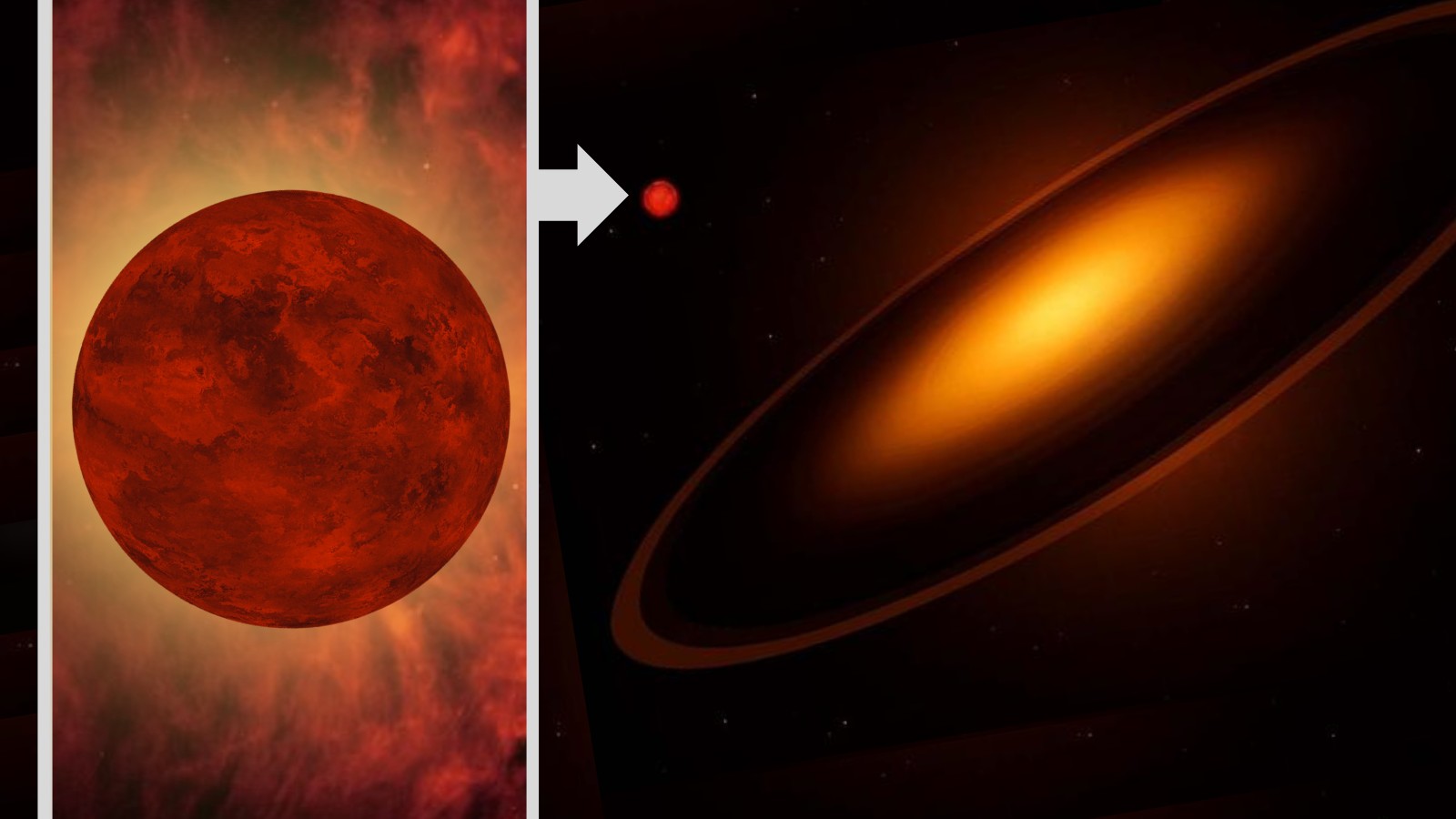
Astronomers are investigating a dramatic and prolonged dimming of a star 3,200 light-years away, suspecting a massive object – either a “failed star” known as a brown dwarf or an enormous exoplanet – is responsible. The event, first observed in late 2024, saw the star ASASSN-24fw’s brightness drop by 97% over roughly 200 days, an unusually long and extreme fade.
The Puzzle of the Dimming
The most likely cause appears to be an extensive ring system encircling the unseen object. These rings, extending out to about half the distance between the Sun and Mercury, blocked a significant portion of the star’s light. The question is what these rings orbit: a brown dwarf or a super-Jupiter exoplanet.
Brown dwarfs are objects too small to sustain nuclear fusion in their cores, hence the nickname “failed stars.” They form like stars but lack the mass to ignite hydrogen fusion. The dividing line between the heaviest planets and the lightest brown dwarfs is fuzzy, typically around 13–80 times the mass of Jupiter.
Why This Matters
This discovery is rare because such long-lasting dimming events require a precise alignment between the star and the orbiting object. This alignment only became apparent as denser regions of the rings moved in front of the star. Such events provide a rare opportunity to study the formation and evolution of planetary or substellar systems.
The star itself, estimated to be 1 billion years old, also exhibits signs of past planetary collisions, indicated by gas and dust fragments around it. This is unusual for stars of its age, suggesting a chaotic history.
Future Observations
Researchers plan to use the Very Large Telescope and James Webb Space Telescope to measure the temperature, age, and composition of ASASSN-24fw, hoping to refine their understanding of the object causing the dimming. Another dimming event is expected in 42–43 years, offering a second chance for detailed observation.
This rare event allows us to study complex systems in remarkable detail, shedding light on how planetary systems evolve over time.
The ongoing investigation will help determine whether the dimming is caused by a failed star or a gigantic planet, advancing our understanding of these exotic celestial bodies.