


The ocean floor saw something special last February. Deep under the Mediterranean.
Scientists found a neutrino. Not just any one, either. This was the most powerful “ghost particle” ever recorded. It hit Earth on February 13, 2003, racing along at nearly the speed of light alone with a muon that KM3NeT detected three kilometers down.
Its energy was staggering. Twenty-two million billion electron volts. To put that in perspective? You would need an accelerator as long as the entire circumference of Earth to recreate it in a lab. The Large Hadron Collider looks like a toy in comparison.
But where did it come from?
“There are several possible explanations for the origin,” said Meriem Bendahman from the KM3NeT team. “For example… neutrinos originate from a diffuse flux produced by a poplation of extreme accelerators… like blazars.”
Blazars. That’s the current lead suspect.
The Cosmic Culprit
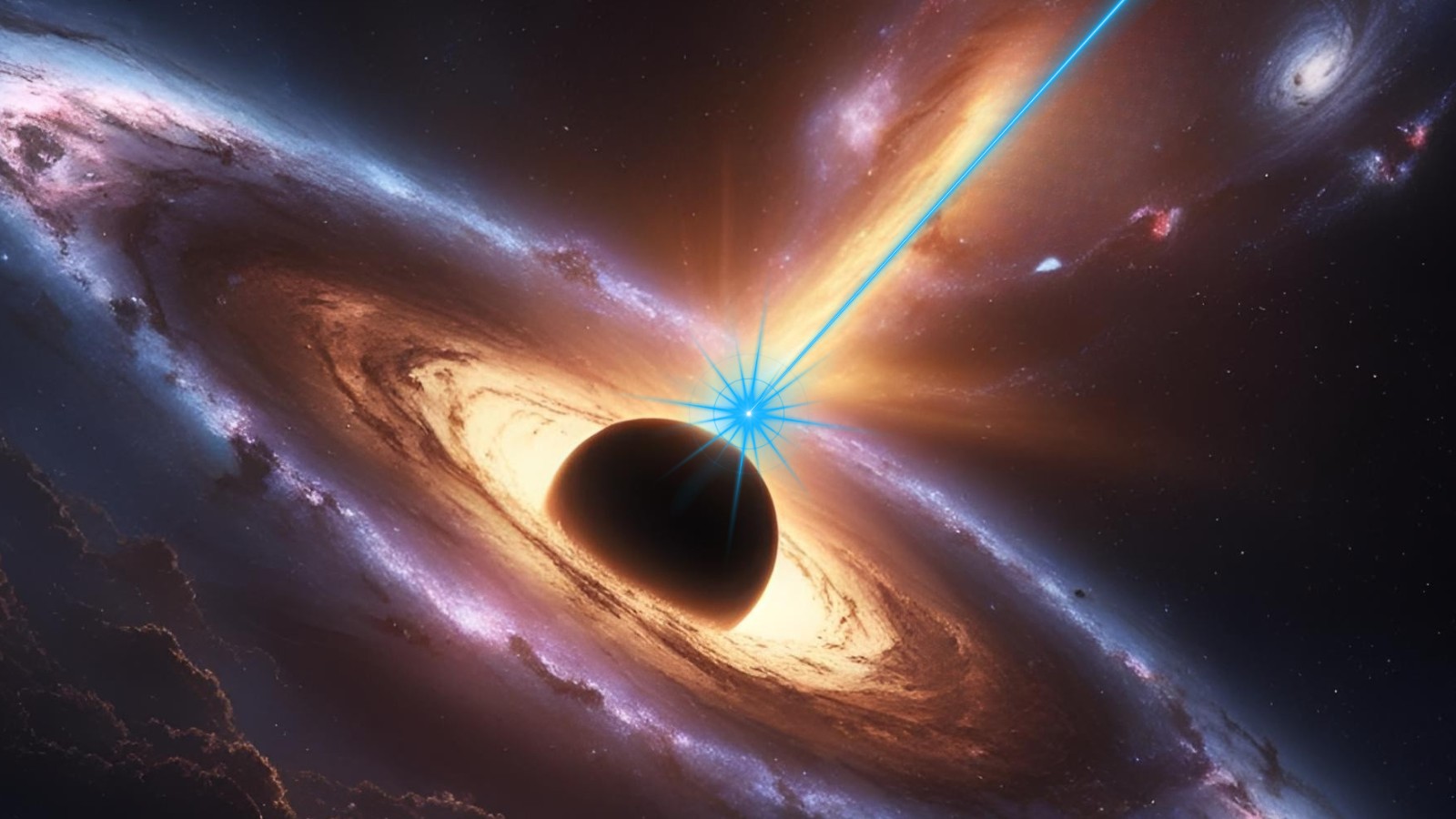
Think of a quasar. You know the bright core of a distant galaxy, the supermassive black hole feeding on stars and gas, spewing jets of radiation into space? Now imagine that jet pointing straight at us. That’s a blazar.
Usually, quasars blast sideways. Blazars aim right for our backyard.
This neutrino wasn’t alone in its history, but it was a beast compared to its predecessor. Thirty times more energetic. Why does that matter? Because finding the source is like being a forensic detective at a crime scene with no witnesses.
Here is the weird part. Usually, when you get this much energy from a single spot—like a supernova or a stellar flare—you also get light. Radio waves, X-rays, gamma rays. A signal across the spectrum.
There was no signal.
The sky was silent in those bands.
“That leads us to consider… a diffuse background,” Bendahman explained. Not one explosion, but a hum of many sources adding up to one big punch.
Simulating the Storm
The team had to model this. They needed a simulation that could explain the neutrino’s massive energy without violating other laws of physics. Specifically, they couldn’t exceed the gamma-ray limits observed by the Fermi satellite, nor could they ignore the lack of similar detections at IceCube in Antarctica or the unfinished KM3NeT array near Sicily.
They tweaked variables. Magnetic fields. Particle acceleration limits. They looked at “baryonic loading” – essentially comparing how much energy protons carried versus electrons.
The math checked out.
A population of blazers could produce this neutrino. It fits the data. It respects the gamma-ray ceiling. It explains the rarity.
So we found the culprit?
Not exactly. The model suggests blazars are a viable engine for these cosmic bullets, but it doesn’t prove it’s this blazar, or that one. It just shows that these feeding black holes are capable of throwing harder than we thought.
We need more data. Always more data. Until then, the ghost keeps passing through us—100 trillion a second—while the rare giants linger in the dark, uncaught, unseen.
Just waiting.


