


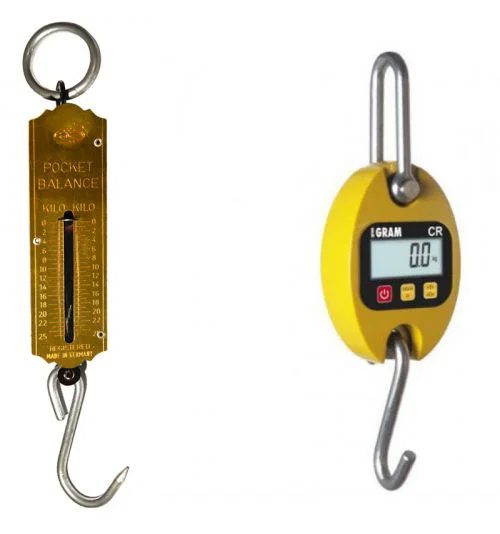
A dynamometer is a simple but ingenious tool designed to measure the force or weight of an object. This depends on the elastic properties of the spring or coil. When you hang something on it, the spring stretches. The amount of stretch tells exactly how much force is applied.
The name itself tells you what it does. It comes from two Greek words. Dýnamis means force. Metron means measure. When you combine these, you have a tool that measures force.
This device is everywhere. You can see it in the physics lab. This can be seen in industrial settings where tension matters. It’s not just about weight. It refers to a push or pull force applied to an object. The spring inside deforms. The deformation is linear. Double the force, double the stretch. This predictability makes it reliable.
No electricity is needed. No battery. Just mechanics. A spring, a scale, and a hook. It has everything you need to measure force.
The hidden mechanics of force measurement
We tend to think of weight and force as the same thing. They are not. One of them is the measure of mass under gravity. The other is push or pull. However, we use tools every day that blur this line.
A measuring device? Dynamometer.
His mission is special. It measures body weight. It checks the penetration depth in hardness tests. It records tensile force. It measures force.
Newton’s origin story
The traditional spring-based dynamometer dates back to Isaac Newton. That’s right. The same guy who looked at an apple and thought of orbits also figured out how to measure force.
He just didn’t guess. He applied Robert Hooke’s law of elasticity. The principle is simple, but effective. Stretch the material. The more you pull, the more it expands. The relationship is direct. Linear. Predictable.
Hooke’s law became the basis. Newton built for this. Result? A tool that transforms invisible force into visible movement.
How it works in practice
Old school dynamometers are very simple.
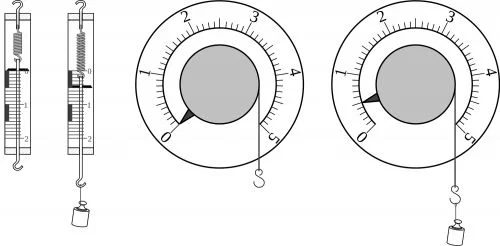
A hook hangs at the bottom. You hang an object on it. Gravity pulls downwards. The spring inside stretches. The scale shows the result.
It is elegant in its minimalism. No batteries. No circuits. Just metal and math.
Modern Confusion
Things are getting chaotic here. We still use springs today. But not in the way Newton intended.
Modern personal scales and flat scales use the same principle of elasticity. You have just changed the hook. Now you are standing on the plate. You place objects on the surface. The inner springs are compressed or stretched according to the load.
Because the physics are identical, people confuse the tools.
A dynamometer measures force. The scale measures the weight obtained from the mass. But both often rely on Hooke’s law.
This confusion is not harmless. It affects how we think about measurements. When you step on the scale, you don’t just see your body. You can see the force your body is exerting on the plane. It’s a subtle difference. But it is important.
Why it still matters
You might think that digital sensors have replaced springs. They haven’t entirely.
Load cells based on this elasticity principle are still used in industrial testing machines. When engineers test how far a metal can bend before it breaks, they measure force. They use the same logic that Newton and Hooke presented centuries ago.
Technology has developed. The core idea didn’t.
We are surrounded by measurements that we do not notice. Bridge cable tension. The pull in a cargo container. The patient’s weight in the hospital bed. It all comes down to the fundamental relationship between stretch and force.
Isaac Newton didn’t just describe motion. He gave us a way to measure it. And it’s still the backbone of everything from lab equipment to food scales.
The spring remains. It’s just easier to hide now.

How to keep a dynamometer together
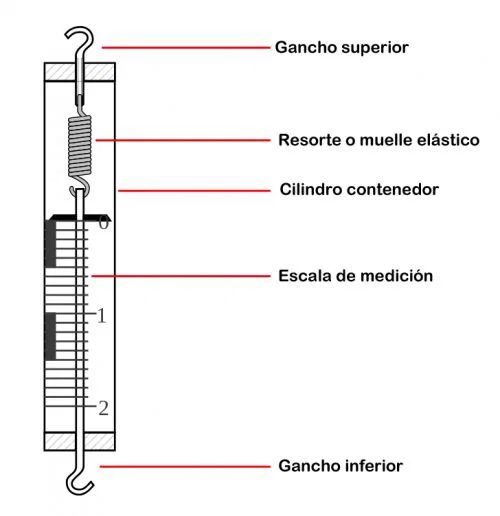
Basically, a dyno isn’t magic. It’s a simple mechanics. You can break it down into five physical components that together measure strength.
First, there is a spring. This is the heart of the device. It compresses or stretches depending on the stress applied to it.
Next comes the cylinder. This housing keeps the spring in line. Without it, the spring will buckle. The cylinder ensures that the force moves in a straight line along the measuring axis.
Then there are the hooks. There are two of them located at opposite ends of the device.
One hook is for mounting. It attaches the dynamometer to a fixed point. Bar. Wall. Fixed frame. This head doesn’t move. It provides resistance.
The other hook is where the action takes place. This is the point of contact. This is where you attach the object. You pull. Spring is stretching. The force is transferred to the spring through the hook.
Finally, there is scale. It translates the physical strain of the spring into readable numbers. Most scales display readings in newtons. Some also show kilogramsgrams. You can use a scale to quantify the tension.
The physics of measurement
Why is spring so important? Because it obeys Hooke’s law. This law states that the force required to extend a spring is proportional to the distance it extends.
$$F = kx$$
$F$ is the force. $k$ is the spring constant. $x$ is an extension.
The dynamometer is based on this relationship. When you hang a weight on the bottom hook, gravity pulls it down. The spring provides resistance. It stretches until the force of the spring equals the weight of the object. The scale marks this balance point.
Therefore, the spring must be consistent. If the spring gets tired or bent, the readings will become unreliable. For this reason, high-quality steel or special alloys are used in high-quality dynamometers. They are designed to return to their original shape every time.
Choosing the Right Scale
You may notice that some scales use Newtons. Others use kilogramss. Which one should you use?
Newton measures force directly. This is the standard unit of physics and engineering. When you measure cable tension or engine thrust, Newtons give you accurate information.
Mass is measured in kilogramsgrams. However, in everyday language, weight is often referred to as kilograms. A dynamometer calibrated in kilogramsgrams tells you the mass equivalent of the force being applied. It assumes standard gravity.
In general use, kilogramss can be more intuitive. Lifting a 10 kg object feels like lifting 10 kg. But for scientific accuracy newtons are superior. They account for the variations in gravity. On the moon, an object weighing 10 kg weighs less. Newton’s value would change. The kilogramsmass would remain the same.
Practical applications
Where do you actually use a dynamometer?
In the laboratory. For testing material strength. You pull a sample until it breaks. The peak force recorded is the tensile strength.
In the gym. Measure grip strength or muscle performance. These handheld devices provide immediate performance feedback.
In industry. For checking the tension of belts, ropes or chains. Correct tension prevents wear. It guarantees safety.

There are basically two ways to measure force: the old-fashioned mechanical way and the modern digital version. They look different. They work differently. And they cost differently.
Mechanical option
Mechanical dynamometers are classics. Think of the spring balances you may have seen in a physics lab or hardware store. They work on a purely physical principle and are based on Newton’s laws without a plug or battery.
The spring inside stretches when you pull on it. The weight of the object or the force applied to it stretches the spring. A pointer moves over a calibrated dial. That’s it.
Why is this important? First, reliability. There is no failure during the test, and no batteries that die during the test. On the other hand, accuracy. High-quality mechanical units can offer an error rate as low as 0.3%. It’s close. In industries where a small miscalculation causes a part to fail later, this mechanical simplicity is a feature, not a bug.
Digital transformation
Then there are electronic dynamometers. These are more complex beasts. They use sensors – often strain gauges – to detect deformation. But this detection requires energy. You need batteries or an outlet to operate.
The mechanism inside is much more complex than a simple spring. The sensor converts physical deformations into electrical signals. The microprocessor then converts this signal into a number on the LCD screen.
This complexity brings benefits. You get the measurements faster. You can log data directly to a computer. You can measure forces in several directions simultaneously. But you trade this rugged simplicity for reliance on power supplies and more sensitive electronics.
Dynamometer vs Scale: Confusion
People mix it up all the time. You assume that a scale and a dynamometer do the same thing because they both involve hanging something or placing something on a surface. They don’t.
A dynamometer measures force. More precisely, it measures the weight of an object, i.e. the force of gravity acting on it. It also measures tension, compression, and pull.
The scale measures mass.
This difference seems insignificant until you think about where you are. Mass is constant. If you weigh 70 kilograms on Earth, you have 70 kilograms of mass on the Moon, Mars or space.
However, the weight changes. Weight depends on gravity. On the moon, your weight would be about one-sixth of what it is on Earth. A dynamometer would show this lower number because the gravitational pull is weaker. A balance that compares masses (like a traditional balance beam) or uses a spring calibrated to Earth’s gravity will give you a different kind of data.
Most modern digital bathroom scales actually measure force and then convert it to mass using Earth’s standard gravity. But in a scientific context, the difference is striking. The scale compares the unknown mass to the known masses. It is based on balance. The dynamometer is based on deformation.
Why the difference is important
If you are testing the breaking strength of a cable, you need a dynamometer. You want to know the exact force needed to snap it. A scale can’t tell you that.
When you check if your baggage is below the airline limit, you’re dealing with mass. A scale (or a spring-based luggage.

There is a fundamental difference between a spring scale and a traditional scale that comes from physics. A dynamometer measures force. More specifically, it measures the gravitational pull of an individual item. We call this weight.
But weight is not an inherent property of an object. It depends on gravity. If you put this object on the moon, the mass will remain the same. Gravity changes. So does the weight.
This means that the dynamometer is location-specific. You can’t just move it from New York to London and expect accurate results without recalibration. Gravity varies slightly depending on latitude and altitude. The force changes. Reading changes. A balance does not have this problem. It compares mass to mass. It is immune to local variations in gravity.
Spring systems vs. counterweight systems
Most often, the terms are used synonymously. They shouldn’t.
If the device uses a spring or an elastic element in the measurement, it is a dynamometer. The spring stretches. The extent of the stretch indicates the force applied. Since this force is gravity acting on mass, it measures weight.
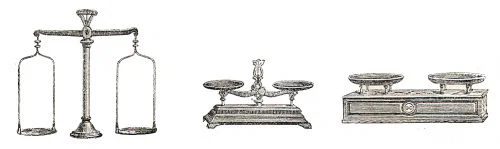
If the device uses counterweights to balance the object, it is a balance. It works on the principle of equilibrium. You put the object on one side. You add known masses to the other until it is in equilibrium. The result tells the mass. It does not care how hard gravity is pulling. A kilogram is a kilogram, whether you are at sea level or on a mountain.
Why calibration is important
This difference is not just academic. It affects how you use these tools in the real world.
If you buy a digital bathroom scale, it probably uses load cells. Load cells are basically advanced dynamometers. They measure deformations caused by force. If you move the scale to another floor or the building settles, the reading may change slightly. Not because your weight has changed, but because the gravitational field or mechanical alignment has changed.
In scientific or industrial environments, this is crucial.
- Dynamometers must be calibrated according to each location and gravitational constant.
- Balances must be calibrated so that the reference masses are correct. However, they do not require recalibration when moving between cities of different gravity.
Big picture
Understanding this helps clarify the properties of matter.
- Mass is the amount of matter in an object. It’s constant.
- Weight is the gravitational force on this mass. It varies.
- Force is a general category. Weight is a type of force.
When you see a device that uses springs, remember: it measures force. It tells how hard the Earth is pulling. If you want to know how much “stuff” you have, no matter where you are, you need balance.
This is why precision laboratories use balances for chemical analysis. You need to know the exact amount of the substance, not how much it weighs under the local ceiling. Weight varies. The mass does not.
So the next time you step on the scale, ask yourself: Are you measuring your mass? Or are you measuring the Earth’s pull? The answer depends on the tool. And the tool matters.


