


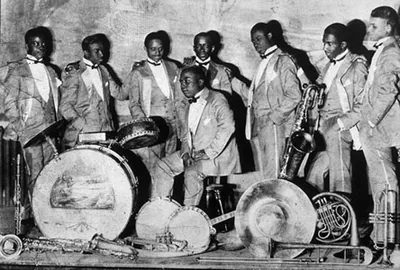
He was the guy who put the swing in the Midwest before anyone really knew what that meant. Bennie Moten wasn’t just a pianist. He was an architect of sound in Kansas City, Missouri. Born on November 13, 1894, he spent his life there until an early death on April 2, 1935. In between those dates, he became one of the first major bandleaders to organize jazz bands in the American heartland.
Moten took the reins in his hometown around 1922. He stayed at the helm until the end. His very first recording sessions in 1923? They weren’t anything special. Just standard fare for the time. But the music evolved. By 1931, he had absorbed most of the members from Walter Page’s Blue Devils into his own orchestra. This wasn’t a merger so much as a takeover of talent.
The result was a sound that defined a city.
The Sound of a City
You can hear it in the 1932 recordings. Tracks like “Toby” and “Moten Swing” aren’t just songs. They are blueprints. They exemplify what we now call Kansas City orchestral jazz. It was loose but tight. It had room to breathe but kept a driving rhythm.
Moten’s importance lies in how he structured the larger jazz orchestra. He didn’t just pick songs. He picked players who could listen to each other. That specific chemistry created a template.
The Legacy That Outlived Him
His death in 1935 left a vacuum. The music needed a pilot. Enter Count Basie.
Basie had been Moten’s second pianist. He didn’t just inherit the group. He streamlined it. He took the remnants of the Bennie Moten Orchestra and cut the fat. The result was a new, leaner machine. It became one of the most outstanding orchestras in jazz history.
Think about that. The foundation of the Count Basie Orchestra—the one that defined the Swing Era for millions—was built on the bones of Bennie Moten’s group.
“His achievement is verified when, after his untimely death in 1935, the remnants of his group were taken up by his second pianist, Count Basie, and fashioned into a new, far more streamlined orchestra.”
Moten is often forgotten in the broad sweep of jazz history. We talk about Armstrong. We talk about Ellington. We rarely mention the man who taught the locals how to swing before the world caught on. But without Moten absorbing those Blue Devils players, the timeline changes. The sound might not have been as sharp.
Basie took the clay Moten molded and fired it in a hotter kiln. But the clay was still there. You can hear Moten in Basie. You can hear Kansas City in every section. It started with a pianist who knew how to organize a room full of musicians who wanted to play loud and play together. That’s the real story.


